


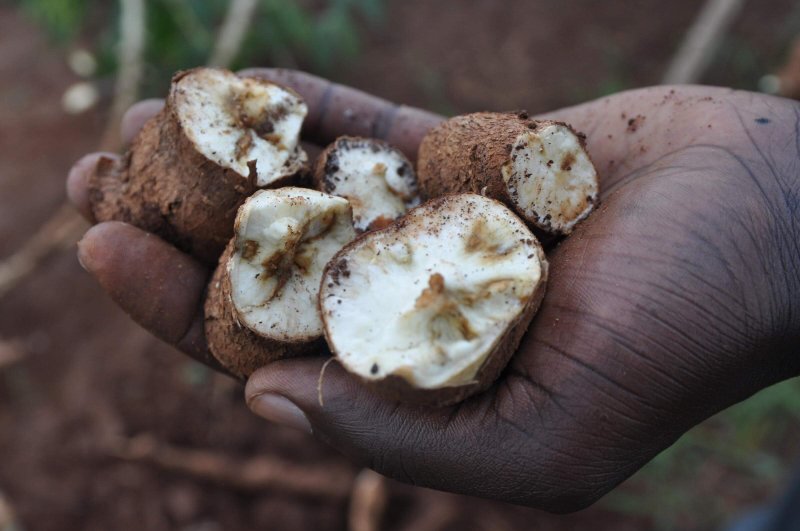
But biotech solutions to the diseases are on the horizon. And farmers say the technology is so desperately needed, they would consider growing GMO cassava varieties illegally if their countries stall in approving the already-tested crops.
GMO cassava breeding in East Africa
Many countries, including Uganda, Kenya, Tanzania, Mozambique, Rwanda, Burundi and Malawi—populated by approximately 150 million people—depend on cassava as a staple food. It contributes more than any other single crop to household wealth, with 63 percent of families selling cassava products to generate an average income of up to $90 per year in regions where most of the population subsists on $1 per day.
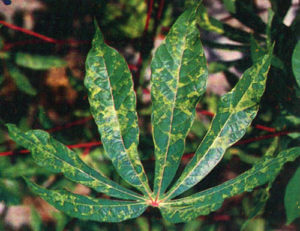
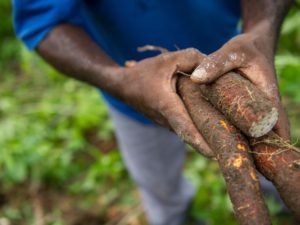
But these millions of cassava growers fight yearly battles for their livelihoods against the deadly cassava mosaic virus (CMV) and cassava brown streak virus (CBSV), which periodically ravage farmers’ fields. CBSV, which leads to rotting of cassava tubers, was first reported in Tanzania in 1936 and then spread to neighboring countries over the proceeding decades. Farmers have also struggled to control CMV, which causes yellowing and wrinkling of cassava leaves, thereby limiting growth of the tuber.
Finally, after many years in development, researchers in Kenya and Uganda have genetically engineered a disease-resistant cassava variety that is nearing commercialization. This is a tremendous scientific achievement that could substantially benefit millions of people. The wild card is politics. Opposition stirred by European anti-GMO activists who have infiltrated African civil groups are lobbying hard to put the research and commercialization on hold.
Kenya takes the lead
The effort to develop a biotech solution began in 2006 through a regional partnership known as the Virus Resistant Cassava for Africa (VIRCA) Plus project. VIRCA is a collaborative research program established by the Donald Danforth Plant Science Center in the US, the National Crops Resources Research Institute (NaCRRI) in Uganda and the Kenya Agricultural and Livestock Research Organization (KALRO).
Project scientists reached their first milestone by engineering CBSV resistance into a popular cassava variety called TME204. This transgenic crop was crossed with conventional varieties that are already resistant to CMV. More than five years of field testing has shown that the new varieties posses 100% resistance to both diseases, and VIRCA is eager to distribute them to farmers, hopefully in the near future.
The final step in getting these enhanced crops to farmers began in March 2020 when “researchers …. asked the Kenyan government to approve Cassava Brown Streak Disease-resistant cassava line 4046,” Margaret Karembu, director of the International Service for the Acquisition of Agri Biotech Applications (ISAAA), wrote in an email.
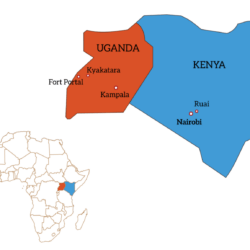



Karembu explained that an application from KALRO containing extensive information on the safety of the disease-resistance traits has been accepted by the National Biosafety Authority (NBA) in Nairobi. The NBA is now conducting a science-based review with input from relevant regulatory agencies and independent experts to verify that GM cassava poses no risk to human health or the environment.
Public input is being sought through the NBA’s website and other stakeholder engagement activities in Kenya. The biosafety agency says its review process can take as long as 150 days, though that timetable assumes no delays. And of course, the coronavirus pandemic adds another layer of uncertainty that could slow the approval.
Many Ugandan farmers say they will grow GMO cassava illegally
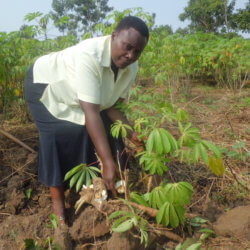
While Kenya appears on track to approve GMO cassava, farmers in neighboring countries still won’t have access to the improved crops. Kenyangi Apiyo [pseudonym]is a young cassava grower in the West Nile region of Uganda. Like many of her colleagues, she is eager to plant the disease-resistant varieties—even if she has to break the law.
Uganda’s legislators, often under the influence of anti-biotech activists, haven’t been eager to approve GM crops thus far, even those developed in the country. Uganda may finally enact its long-debated biosafety bill that would allow the commercialization of biotech plants. But if a nearby nation approves the enhanced cassava varieties sooner, many Ugandan farmers like Kenyangi say they won’t hesitate to acquire them illegally. To Kenyangi, crossing into Kenya to get plant material from local growers is an obvious choice:
I have attended sensitization meetings organized by scientists from the National Crop Resources Research Institute. I have seen the GM cassava varieties under field trial, and the tubers are clean from CBSV and they are high yielding. I have been following the conversation of its release on social media, and I am eagerly waiting [the chance] to grab seedlings from Kenyan farmers. There is no challenge to crossing over the Kenyan border to acquire the GMO cassava seedling. Farmers in Uganda and Kenya are used to exchanging seed of any type of crop as long as it is disease free and high yielding.
Dembe Okello [psuedonym], another cassava grower in Eastern Uganda, holds a similar view. He lives within walking distance of the Kenyan border, so it would be easy to acquire GM varieties he knows will generate higher yields.
Farmers living in border districts of these countries have no problem sharing seed; we have been doing this over time. I am aware that the GM cassava varieties are resistant to CBSV, which is a challenge to a number of farmers growing the plant. Usually when I plant resistant varieties, I am able to harvest two tons per hectare. But when the disease causes rotting, I can hardly harvest anything from the farm.
While farmers are willing to engage in this illegal cross-border crop trading, Saviour hopes the progress in Kenya will capture the attention of Ugandan legislators—who remain ambivalent toward technology that could dramatically improve the lives of millions within Uganda’s borders.
Lominda Afedraru is a freelance science journalist in Uganda who specializes in agriculture, health, environment, climate change and marine science. Follow her on the Daily Monitor, Facebook or Twitter @lominda25





























