Survival of the brainiacs: Controversial new thesis says humans evolved smarter to capture smaller prey

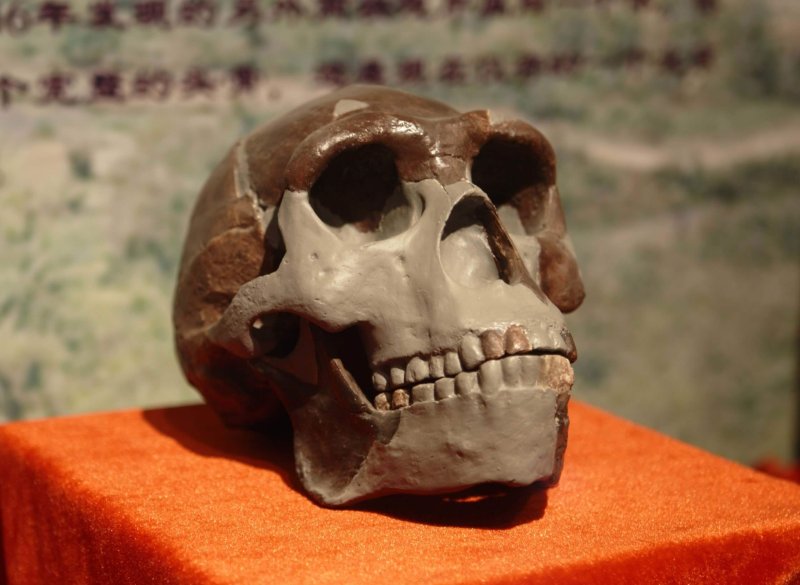
Credit: Yan Li/Paleozoological Museum of China

As the largest animals on the landscape disappeared, the scientists propose, human brains had to grow to enable the hunting of smaller, swifter prey. 

This hypothesis argues that early humans specialized in taking down the largest animals, such as elephants, which would have provided ample fatty meals. When these animals’ numbers declined, humans with bigger brains, who presumably had more brainpower, were better at adapting and capturing smaller prey, which led to better survival for the brainiacs. 

Follow the latest news and policy debates on sustainable agriculture, biomedicine, and other ‘disruptive’ innovations. Subscribe to our newsletter.

The hypothesis also explains why brain size shrank slightly, to about 80 cubic inches (1,300 cubic cm), after farming began: The extra tissue was no longer needed to maximize hunting success.

This new hypothesis bucks a trend in human origins studies. Many scholars in the field now argue that human brains grew in response to a lot of little pressures, rather than one big one. But Tel Aviv University archaeologists Miki Ben-Dor and Ran Barkai argue that one major change in the environment would provide a better explanation.

“We see the decline in prey size as a unifying explanation not only to brain expansion, but to many other transformations in human biology and culture, and we claim it provides a good incentive for these changes,” [said] Barkai.


Read the original post

{{ reviewsTotal }}{{ options.labels.singularReviewCountLabel }}
{{ reviewsTotal }}{{ options.labels.pluralReviewCountLabel }}
{{ options.labels.newReviewButton }}
{{ userData.canReview.message }}

Related Articles

Infographic: Global regulatory and health research agencies on whether glyphosate causes cancer

Infographic: Global regulatory and health research agencies on whether glyphosate causes cancer

Does glyphosate—the world's most heavily-used herbicide—pose serious harm to humans? Is it carcinogenic? Those issues are of both legal and ...

Most Popular

Screenshot-2026-04-20-at-2.26.27-PM
Viewpoint — Food-fear world: The latest activist scientists campaign: Cancer-causing additives
Screenshot-2026-03-13-at-12.14.04-PM
The FDA wants to make many popular prescription drugs OTC—a great idea. Here’s why it’s unlikely to happen
Screenshot-2026-05-04-at-12.54.32-PM
How Utah became the country’s supplement capital  — and a haven for unregulated, ineffective and fake products
Screenshot-2026-05-01-at-11.56.24-AM
‘Science moves forward when people are willing to think differently’: Memories of DNA maverick Craig Venter
ChatGPT-Image-May-1-2026-02_20_13-PM
How RFK, Jr.’s false vaccine claims are holding up $600 million to fight diseases in poor countries
Screenshot-2026-04-03-at-11.15.51-AM
Paraben panic: How a flawed study, media hype, and chemophobia convinced the public of the danger of one of the safest classes of preservatives
Screenshot-2026-04-30-at-2.19.37-PM
5 myths about summer dehydration that could damage your health — or even kill you
viva-la-vida-watermelons
Misinformation and climate change are endangering summer watermelons
ChatGPT-Image-Mar-27-2026-11_27_05-AM
The myths of “process”: What science says about the “dangers’ of synthetic products and ultra-processed foods
Drinking lots of water can help reduce the effects of aging
Nanoplastics in drinking water: MAHA activists forge science-based bipartisan coalition 
ChatGPT-Image-Mar-10-2026-01_39_01-PM
Viewpoint—“Miracle molecule” debunked: Why acemannan supplements don’t work
circular-bioeconomy-should-focus-on-sustainable-wellbeing
GLP podcast: What's wrong with 'doomsday' environmentalism? It's false.
glp menu logo outlined

Get news on human & agricultural genetics and biotechnology delivered to your inbox.