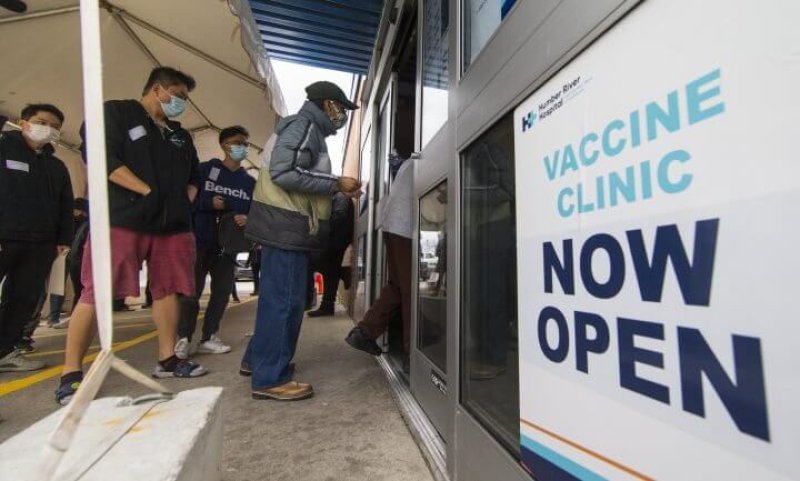
Going forward, will we need an annual COVID vaccine or will ‘one and done’ be enough?

Credit: Global News
Credit: Global News

[New COVID] mutations are popping up in increasingly complicated patterns, spurring a drive by top biologists to devise new ways to track a fire hose of incoming genomic data.

The goal: Quickly detect variants that can lessen the effectiveness of vaccines for a pathogen that’s unlikely to be eradicated any time soon. The SARS-CoV-2 virus could settle down and become a mere nuisance like the common cold. Or much like influenza, it could retain its ability to cause severe disease in some segments of the population, a scenario that could require regular booster shots.

…

“Does it mean we need to make a new vaccine every year?” said Paul Duprex, who heads the University of Pittsburgh’s Center for Vaccine Research. ”We don’t know.”

For one thing, mRNA vaccines for Covid-19 have efficacy rates above 90%, much higher than the 60% rate for flu shots in a good year. But vaccine makers Moderna and Pfizer, along with its partner BioNTech, aren’t taking any chances. Just in case, they’re already starting trials of booster shots aimed at B.1.351.


Mis- and disinformation are distorting science and public policy. Subscribe to our Daily and Weekly Digests for incisive coverage of ‘disruptive’ innovations in AI, agricultural biotechnology, food, chemicals, nuclear energy, vaccines, and other disruptive innovations.

What makes SARS-CoV-2’s future so hard to predict is that viral evolution is like a three dimensional chess game. It’s not just the individual mutations that matter, but also the order and combinations in which they occur.


Read the original post

Related Articles

Infographic: Global regulatory and health research agencies on whether glyphosate causes cancer

Infographic: Global regulatory and health research agencies on whether glyphosate causes cancer

Does glyphosate—the world's most heavily-used herbicide—pose serious harm to humans? Is it carcinogenic? Those issues are of both legal and ...

Most Popular

ChatGPT-Image-Mar-10-2026-01_39_01-PM
Viewpoint—“Miracle molecule” debunked: Why acemannan supplements don’t work
Screenshot-2026-10-06-at-11.13.59-AM
RFK Jr.’s plan to curb America’s appetite for ultra-processed foods and artificial dyes blocked by the White House
Screenshot-2026-09-22-at-12.26.15-PM
‘Forever chemical’ concerns: Separating hysteria from reasonable concern in the debate over PFAS danger
Screenshot 2026-10-08 at 1.34
Hooked on kratom: The unregulated, natural, alcohol-free “social tonic” that is destroying lives 
Screenshot-2026-10-06-at-2.36.47-PM
Is organic farming really more sustainable? 100 recent studies say ‘no’
Resolute-Portrait-with-Injured-Teddy-Bear
Anti-vax Texas Senate candidate Ken Paxton alleges conspiracy by doctors, drugmakers, and insurers to push childhood vaccination for profit
Screenshot-2026-09-28-at-11.26.17-AM
Viewpoint: Wellness movement activists reposition nicotine from a killer addictive drug into a cure-all for brain ills
AI-Force-Uniform-Insignia-Close-Up
Trump wants an AI Force like Space Force, but that could make AI’s risks harder to manage
Radioactive-Americana-Collage-2
The kooky logic behind the raft of spurious cancer claims from Harvard’s T.H. Chan School of Public Health
No-Data-Center-Farm-Protest-Sign-2
Rural revival or corporate windfall? Trump’s One Big Beautiful Bill tax law opens the door to big breaks for data centers—but tech giants aren’t cashing in
ChatGPT-Image-Sep-21-2026-11_21_39-AM
Viewpoint: Food cults: Online ‘nutrition communities’ can pose unique dangers
strand of dna genetics
No, GMO foods do not “damage genes, natural disposition and hormones, or decrease physical health and intelligence”
Supreme-Court-Amid-Climate-Crisis
Should fossil fuel companies be shielded from lawsuits over climate change damage? The Supreme Court takes up the question
glp menu logo outlined

Get news on human & agricultural genetics and biotechnology delivered to your inbox.