Polar bears are the largest surviving predator in North America. How do they measure up to what used to roam the continent?

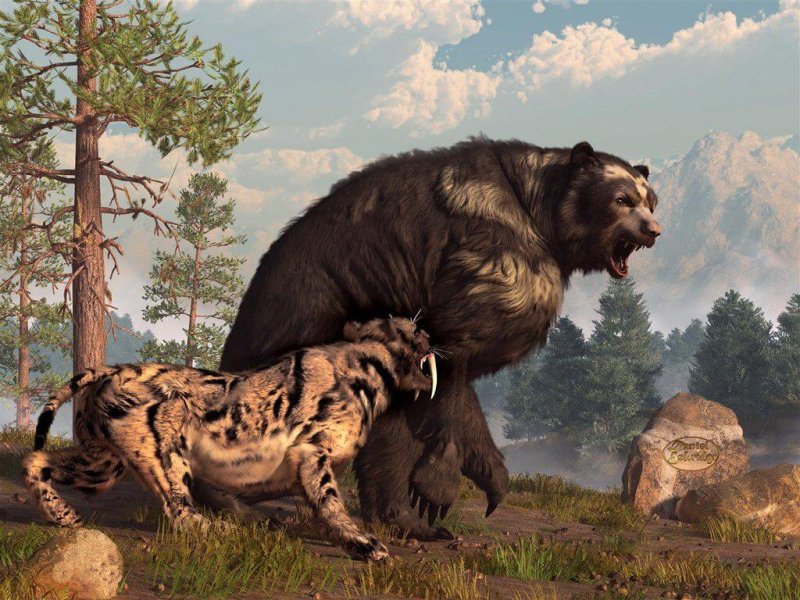
Artist's depiction of the prehistoric short-faced bear. Credit: Animal Face Off Wiki

North America’s largest predatory mammal was probably the massive short-faced bear (Arctodus simus), said Ross MacPhee, senior curator of mammals at the American Museum of Natural History in New York City. Sometimes affectionately called the “bulldog bear,” this now-extinct creature had a signature short, broad muzzle. It stood around 5.5 feet (1.6 meters) tall at the shoulder and over 11 feet (3.4 m) on its lanky hind legs, according to the University of Iowa Museum of Natural History

It can be difficult for scientists to gauge the exact body weight of an extinct species, because they have to extrapolate those numbers using existing species as benchmarks, MacPhee told Live Science in an email. However, paleontologists comfortably estimate that the short-faced bear probably weighed around 1,540 pounds (700 kilograms).

Modern polar bears (Ursus maritimus) aren’t too far off — the largest males stand around 5 feet (1.5 m) at the shoulder and weigh around 1,300 pounds (600 kg), according to Polar Bears International

Mis- and disinformation are distorting science and public policy. Subscribe to our Daily and Weekly Digests for incisive coverage of ‘disruptive’ innovations in AI, agricultural biotechnology, food, chemicals, nuclear energy, vaccines, and other disruptive innovations.

Each of these creatures, however, eventually died out as the result of environmental upheaval. Like many highly specialized predators, once their prey became scarce, they simply couldn’t keep up with their energy needs. 

This is an excerpt. Read the original post here.

Related Articles

Infographic: Global regulatory and health research agencies on whether glyphosate causes cancer

Infographic: Global regulatory and health research agencies on whether glyphosate causes cancer

Does glyphosate—the world's most heavily-used herbicide—pose serious harm to humans? Is it carcinogenic? Those issues are of both legal and ...

Most Popular

ChatGPT-Image-Sep-17-2026-12_28_43-PM
Vitamin D, omega-3 fish oil and glucosamine supplements could cause brain damage 
ChatGPT-Image-Mar-10-2026-01_39_01-PM
Viewpoint—“Miracle molecule” debunked: Why acemannan supplements don’t work
ChatGPT-Image-Sep-17-2026-10_17_15-AM
Viewpoint: Why are the less intelligent more likely to be conservative—and smarter people more socially liberal?
Screenshot-2026-08-12-at-11.31.46-AM
AI is helping develop new vaccines
Screenshot-2026-09-10-at-12.20.19-PM
'Jet fuel didn't melt the steel': 9/11 conspiracy theories debunked
Screenshot-2026-09-17-at-10.24.54-AM
Viewpoint: Dubious environmental fears: Why the AI buildout is critical to America’s ecological future
Screenshot-2026-09-16-at-12.07.47-PM
The heated debate over trans athletes in the WNBA
Screenshot 2026-09-11 at 12.39
Child-monitoring apps: When the cure is worse than the harm—and how the technology could be tweaked
ChatGPT-Image-Sep-9-2026-02_48_24-PM
Viewpoint: Trump-RFK Jr. report on “Gender Ideology & Left-wing Ideology’ targets LGBTQ community—and science
Screenshot-2026-09-10-at-11.50.46-AM
Did COVID vaccines kill 2,500 service members? RFK Jr. hires an investigator who compares vaccine promoters to Nazi doctors
glp menu logo outlined

Get news on human & agricultural genetics and biotechnology delivered to your inbox.