Infographic: Is Huntington’s an ‘incurable’ brain disease? New gene therapies offer hope

Credit: Lisk Feng
Credit: Lisk Feng

Huntington’s disease (HD) is an inherited condition that causes widespread deterioration in the brain and disrupts thinking, behaviour, emotion and movement. The disease usually begins in midlife, with subtle changes such as mood swings and difficulty in staying focused. As it progresses, people develop dementia and an inability to speak or move.

Mis- and disinformation are distorting science and public policy. Subscribe to our Daily and Weekly Digests for incisive coverage of ‘disruptive’ innovations in AI, agricultural biotechnology, food, chemicals, nuclear energy, vaccines, and other disruptive innovations.

There are no treatments available to stop or slow the progression of Huntington’s, even though its genetic cause has been clear since 1993. Most other neurodegenerative diseases also lack effective therapies and, although their genetic roots are less clear-cut than for Huntington’s, many of the genes associated with conditions such as motor neuron disease (amyotrophic lateral sclerosis, or ALS), Alzheimer’s and Parkinson’s have been known for decades.

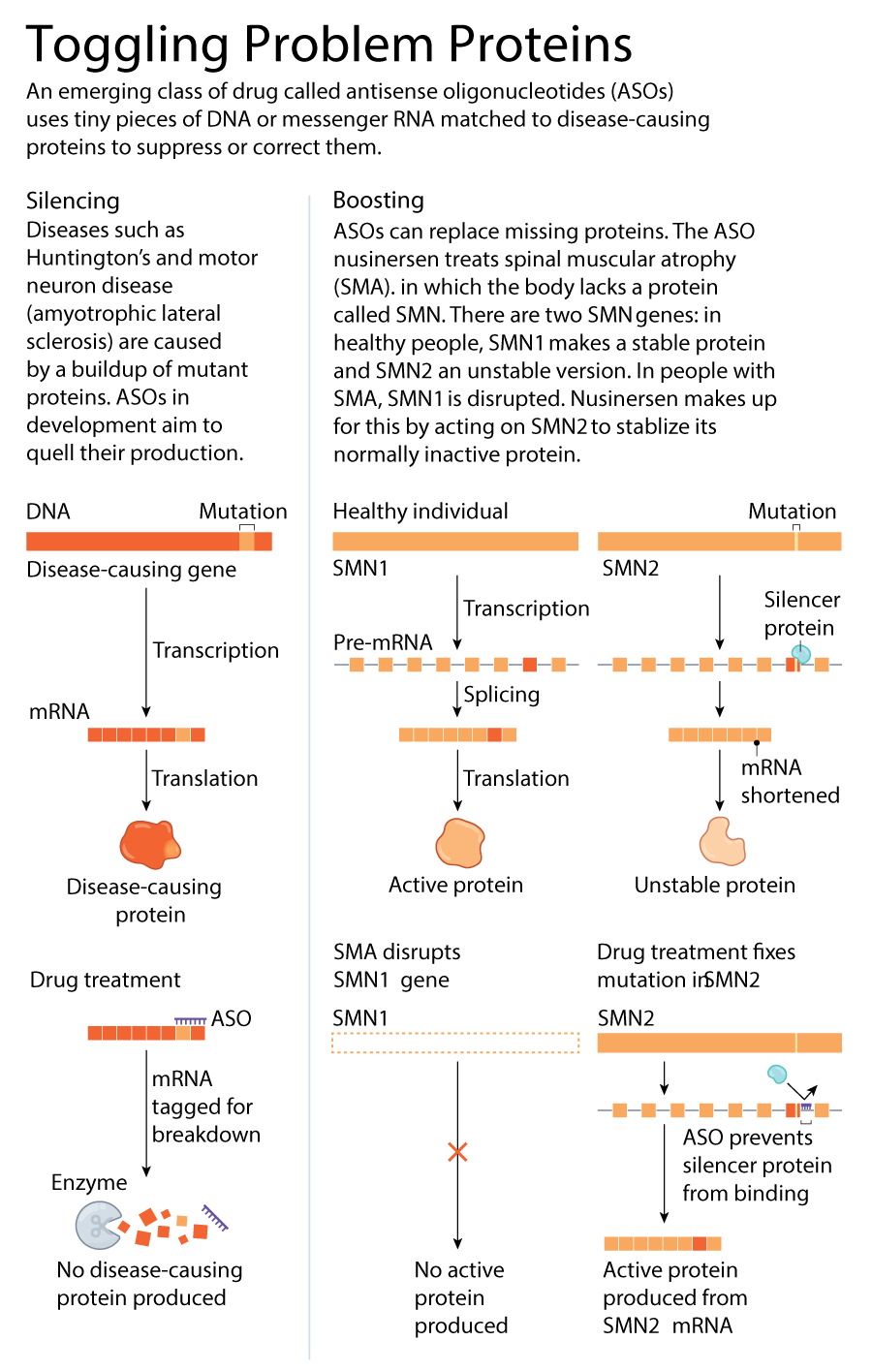
Now, the tide might be turning for treating these kinds of diseases. Many researchers are hopeful about drugs known as antisense oligonucleotides (ASOs). These are short strings of DNA or RNA letters that are designed to cling to particular sequences of RNA made by faulty genes, and to rebalance the levels of proteins they produce—boosting missing proteins or quashing faulty ones.
gene therapy graphic

This is an excerpt. Read the original post here.

Related Articles

Infographic: Global regulatory and health research agencies on whether glyphosate causes cancer

Infographic: Global regulatory and health research agencies on whether glyphosate causes cancer

Does glyphosate—the world's most heavily-used herbicide—pose serious harm to humans? Is it carcinogenic? Those issues are of both legal and ...

Most Popular

ChatGPT-Image-Sep-17-2026-12_28_43-PM
Vitamin D, omega-3 fish oil and glucosamine supplements could cause brain damage 
ChatGPT-Image-Mar-10-2026-01_39_01-PM
Viewpoint—“Miracle molecule” debunked: Why acemannan supplements don’t work
ChatGPT-Image-Sep-17-2026-10_17_15-AM
Viewpoint: Why are the less intelligent more likely to be conservative—and smarter people more socially liberal?
Screenshot-2026-08-12-at-11.31.46-AM
AI is helping develop new vaccines
Screenshot-2026-09-10-at-12.20.19-PM
'Jet fuel didn't melt the steel': 9/11 conspiracy theories debunked
Screenshot-2026-09-17-at-10.24.54-AM
Viewpoint: Dubious environmental fears: Why the AI buildout is critical to America’s ecological future
Screenshot-2026-09-16-at-12.07.47-PM
The heated debate over trans athletes in the WNBA
ChatGPT-Image-Sep-9-2026-02_48_24-PM
Viewpoint: Trump-RFK Jr. report on “Gender Ideology & Left-wing Ideology’ targets LGBTQ community—and science
Screenshot 2026-09-11 at 12.39
Child-monitoring apps: When the cure is worse than the harm—and how the technology could be tweaked
Screenshot-2026-09-10-at-11.50.46-AM
Did COVID vaccines kill 2,500 service members? RFK Jr. hires an investigator who compares vaccine promoters to Nazi doctors
glp menu logo outlined

Get news on human & agricultural genetics and biotechnology delivered to your inbox.