3-D printed breast implants? This alternative to silicon regrows breast tissue and degrades without a trace

Credit: Healshape
Credit: Healshape

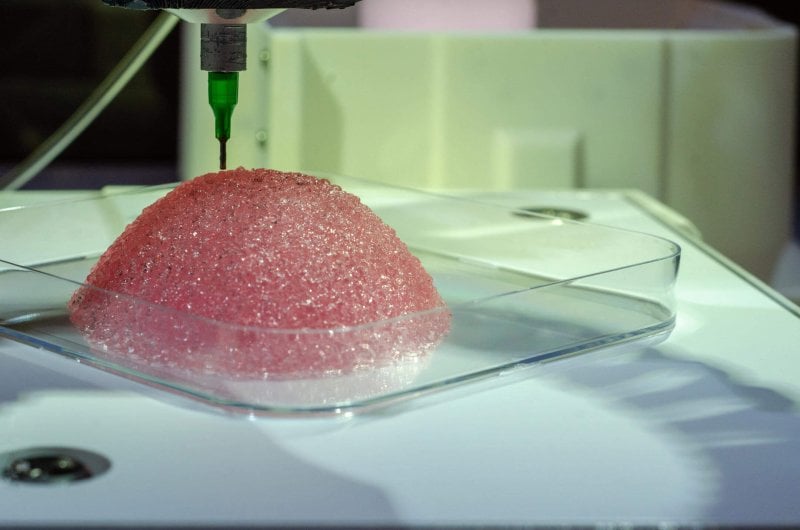
Every year, 2 million people worldwide are diagnosed with breast cancer. Most choose not to have their breasts reconstructed; in the UK, it is only about 30%. Now a handful of startups want to change that, armed with 3D-printed implants that grow new breast tissue before breaking down without a trace. “The whole implant is fully degradable,” says Julien Payen, CEO of the startup Lattice Medical, “so after 18 months you don’t have any product in your body.”

Mis- and disinformation are distorting science and public policy. Subscribe to our Daily and Weekly Digests for incisive coverage of ‘disruptive’ innovations in AI, agricultural biotechnology, food, chemicals, nuclear energy, vaccines, and other disruptive innovations.

Healshape uses a hydrogel to 3D-print a soft implant that will slowly be colonised by the person’s own fat cells, the initial batch of which is injected, while the implant disappears over six to nine months. The company CollPlant is developing something similar using a special collagen bioink, extracted from tobacco leaves it has genetically engineered to produce human collagen. “I think it will change the opinion of many patients,” says CEO, Yehiel Tal.

Lattice Medical has a different approach. Its implant is a 3D-printed cage made of a degradable biopolymer, in which they encase a small flap from underneath the breast area. This flap then grows to fill the cage with fat tissue, while the cage itself is absorbed by the body, ultimately leaving a regrown breast in its place.


This is an excerpt. Read the original post here

Related Articles

Infographic: Global regulatory and health research agencies on whether glyphosate causes cancer

Infographic: Global regulatory and health research agencies on whether glyphosate causes cancer

Does glyphosate—the world's most heavily-used herbicide—pose serious harm to humans? Is it carcinogenic? Those issues are of both legal and ...

Most Popular

Screenshot-2026-09-20-at-9.03.54-AM
From Malaysia to the world: A pioneering science communicator reimagines global science communication for a digital age
Screenshot-2026-09-16-at-2.26.42-PM
Viewpoint: How to ecologically damage America’s forests: Ban glyphosate
ChatGPT-Image-Sep-17-2026-12_28_43-PM
Vitamin D, omega-3 fish oil and glucosamine supplements could cause brain damage 
ChatGPT-Image-Mar-10-2026-01_39_01-PM
Viewpoint—“Miracle molecule” debunked: Why acemannan supplements don’t work
Screenshot-2026-09-20-at-4.31.28-PM
White House drafting executive order to control what OMB Director Vought claims are “woke” NIH science grants
ChatGPT-Image-Sep-20-2026-04_22_32-PM
What’s Trump’s ‘AI Force’? Administration rushes to announce ill-defined watchdog agency and czar amid criticism of its resistance to curb AI acceleration
Screenshot-2026-08-12-at-11.31.46-AM
AI is helping develop new vaccines
Screenshot-2026-09-14-at-4.31.14-PM
Viewpoint: What’s the likely impact when the EPA loosens rules limiting methane pollution from oil and gas wells?
Screenshot-2026-08-19-at-6.19.42-PM
Facts & Fallacies podcast: 'Regenerative farming'? RFK Jr.’s federal push romanticizes the past and risks food security
ChatGPT-Image-Aug-28-2026-03_33_46-PM
Viewpoint: Bad science—Five bogus Trump administration claims about vaccines and autism
ChatGPT-Image-Sep-18-2026-10_49_24-AM
‘Symptom borrowing’: Young people are copying health problems they see on TikTok
ChatGPT-Image-Sep-9-2026-02_48_24-PM
Viewpoint: Trump-RFK Jr. report on “Gender Ideology & Left-wing Ideology’ targets LGBTQ community—and science
glp menu logo outlined

Get news on human & agricultural genetics and biotechnology delivered to your inbox.