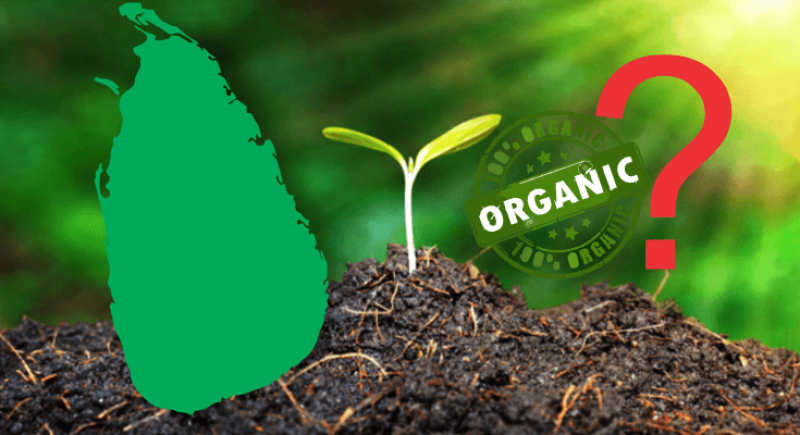
Sri Lanka ran an evil experiment on its citizens last year. Under the sway of nitwit organic-food activists, the government banned imports of synthetic pesticides and fertilizers as part of an effort to transition the country to all-organic agriculture, leaving the vast majority of farmers without access to the vital tools they use to grow the crops their country depends on. Polls taken at the time showed that most growers didn’t know how to farm organically.
The result of Sri Lanka’s experiment was predictable and tragic: roughly one-third of the island nation’s agricultural land was left dormant in 2021; farmers lost hundreds of millions of dollars in needed income, and there wasn’t enough food to go around. As I explained last September, the government did what most governments do in times of crisis—it deflected, blaming others for the deprivation its policies caused:
The president appointed a former military general to serve as “Commissioner General of Essential Services” and confiscate agricultural commodities from “hoarders.” The government then set price controls for these goods “in order to protect the consumers,” which has a well-documented history of causing and exacerbating shortages. Nice job, commissioner.
Farmers waiting to weigh rice at a store in Agbopura, Sri Lanka. Credit: Devjyot Ghoshal via Reuters
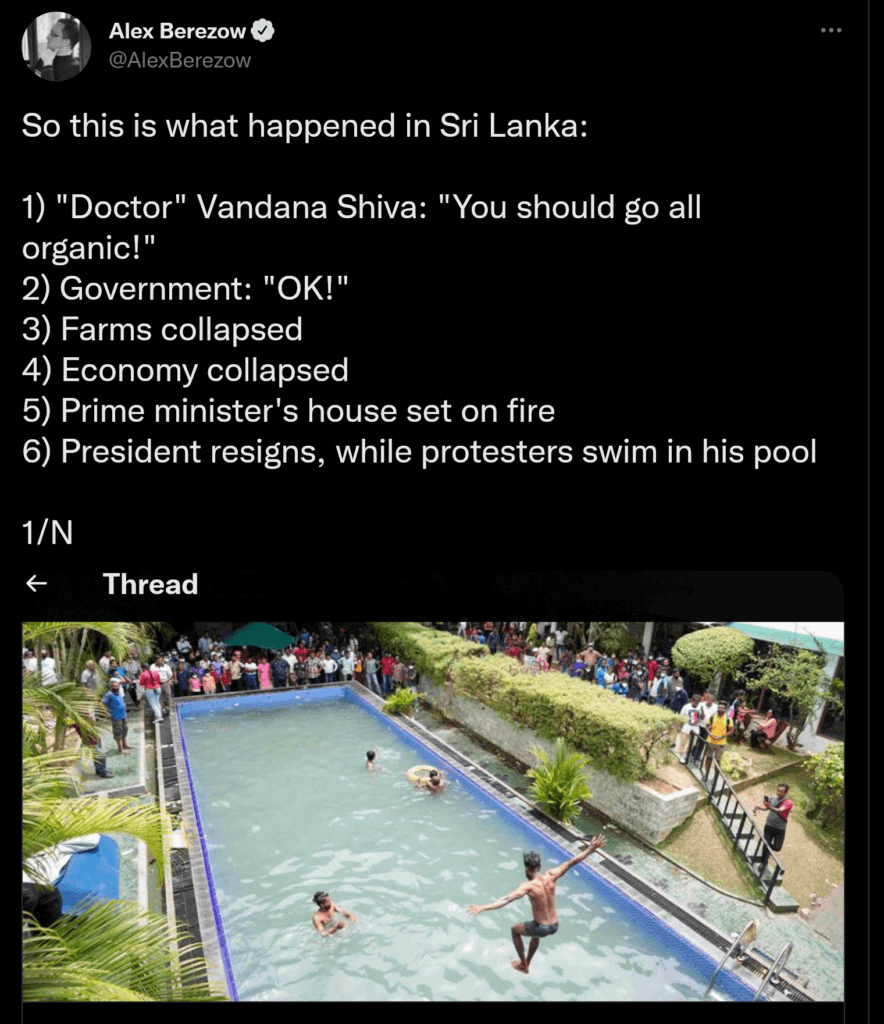
Swimming in the president’s pool
Hunger can drive people to radical action, and Sri Lanka’s populace illustrated how earlier this month. “Protesters swim in Sri Lanka president’s pool,” Sky News reported on July 11, “and warn they’re staying until he leaves office.” President Gotabaya Rajapaksa fled the country two days later. NBC News summarized the unfolding chaos hours later:
For six months now, Sri Lanka’s economic crisis — its worst since gaining independence from Britain in 1948 — has worsened with each passing day. Financial mismanagement, large amounts of foreign debt and economic shocks have left the South Asian island nation of 22 million people without enough money to pay for imports of food, fuel, medicine and other essential goods. Last month, the United Nations said it risked becoming a full-blown humanitarian crisis.
BigThink executive editor and ACSH advisor Dr. Alex Berezow put it more bluntly:
Enter the organic apologists
Sri Lanka’s political instability goes beyond its farm policies, but we know this is a key aspect of the tumult; doubling the price of staple foods tends to have a destabilizing effect. Organic activist groups haven’t missed the significance either. Much like the country’s leadership, they were eager to deflect responsibility for the food shortages roiling the country. The UK-based Soil Association, for example, tweeted:
We’d argue that a critical part of any large transition is appropriate planning and time to make that transition. We’d never advocate for a nation like this to go organic overnight. Lots of lessons to be learnt from Sri Lanka, but ‘see, organic doesn’t work’ isn’t one of them.
You see, they didn’t do it right. Had Sri Lanka only taken a decade to retrain its farmers in organic production and primed its citizens for the massive yield drops that come with abandoning modern agriculture, then they’d be on their way to a green paradise.
This is a foolish, face-saving narrative. Take 10 years or take 100 years; it doesn’t matter. The problem is not the transition period, but the production methods farmers are supposed to utilize. We know that organic farming alone cannot produce the amount of food we need to feed the globe. The research has been done, the evidence is in. This was all known long before the events in Sri Lanka unfolded. Agricultural scientists in the country knew it, and they were ignored.
Parenthetically, nobody told Sri Lanka beforehand that their all-organic experiment would end in disaster. It was anti-GMO “rock star” Vandana Shiva who encouraged the country to take the dramatic steps it took. And you’ll never guess who frequently collaborates with the Soil Association. Here’s an association report featuring Shiva’s complaints about “industrial” farming. The group also sponsored a June 2021 conference, just before things in Sri Lanka were beginning to nosedive, which prominently featured Shiva’s argument that
Regenerative agriculture provides answers to the soil crisis, the food crisis, the climate crisis and the crisis of democracy.
Sri Lanka is only the latest example of what happens when technophobic activists are allowed to make policy: the world gets poorer and more people go hungry. Anti-pesticide groups and organic food advocates will continue distancing themselves from the ensuing chaos, but they have to be held accountable for the consequences of their ideology.
Vandana Shiva studied philosophy but sells themselves as a quantum physicist and savior of the environment. Credit: Aditya Krishnamurthy
Farmers didn’t ask for an agrochemical ban, neither did the public—Vandana Shiva did. She and her allies owe Sri Lankans an apology, and perhaps several massive donations to help them rebuild their economy. After that, they should follow the former president’s lead and find new jobs.
Cameron English is a writer, editor and co-host of the Science Facts and Fallacies Podcast. Before joining ACSH, he was managing editor at the Genetic Literacy Project, a nonprofit committed to aiding the public, media, and policymakers by promoting science literacy. You can visit Cameron’s website here
A version of this article was posted at American Council on Science and Health and is used here with permission. You can check out the American Council on Science and Health on Twitter @ACSHorg