Orange ‘super banana’: Gates-funded Ugandan scientists develop vitamin A enhanced fruit that could help reduce blindness and save lives

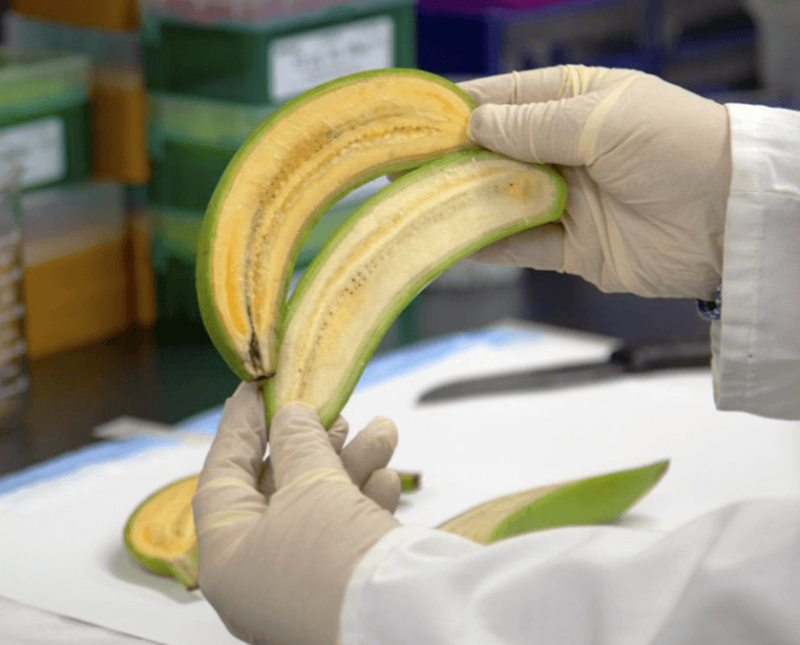
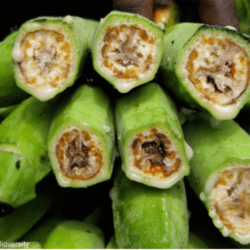
PVA-biofortified “Cavendish” banana in Australia. Credit: Jean-Yves Paul via CC-BY-4.0

Wilberforce Tushemereirwe holds up a genetically modified banana that took millions of dollars and 20 years to make. It contains so much provitamin A, a substance that transforms into vitamin A in the body, that its flesh has a distinctive orange tint.

This “super banana” was created at Uganda’s National Agricultural Research Laboratories (NARL) for the noblest of causes: to save the lives of thousands of children who die in Uganda every year from vitamin A deficiency. Scientists have long crossbred banana plants to improve resistance to pests, fungus, or drought. But fortifying bananas to deliver nutrients to humans who eat them is a first.

The breakthrough is the result of a partnership of the lab in Kawanda, where Tushemereirwe serves as director, James Dale, an Australian agricultural scientist and banana expert, and the Bill and Melinda Gates Foundation, which invested $11 million in one of the longest running research projects the foundation has ever undertaken.
Follow the latest news and policy debates on sustainable agriculture, biomedicine, and other ‘disruptive’ innovations. Subscribe to our newsletter.

The Ugandan government has tried for decades to solve the problem—with limited success. Distribution of vitamin A capsules, for example, worked well in urban areas but failed to reach those most in need in rural areas. Fortifying maize and wheat flour and edible oils with vitamin A to boost nutritional values proved more effective. But those foods are not consumed in large enough amounts to make a meaningful difference.

{{ reviewsTotal }}{{ options.labels.singularReviewCountLabel }}
{{ reviewsTotal }}{{ options.labels.pluralReviewCountLabel }}
{{ options.labels.newReviewButton }}
{{ userData.canReview.message }}

Related Articles

Infographic: Global regulatory and health research agencies on whether glyphosate causes cancer

Infographic: Global regulatory and health research agencies on whether glyphosate causes cancer

Does glyphosate—the world's most heavily-used herbicide—pose serious harm to humans? Is it carcinogenic? Those issues are of both legal and ...

Most Popular

ChatGPT-Image-Jun-25-2026-12_23_17-PM
No, Bill Gates did not secretly engineer ticks to promote veganism
ChatGPT-Image-Jun-23-2026-03_12_23-PM
Is cellular reprogramming junk science? Nearly 20 patients are getting eye injections in the first FDA-cleared cellular trial
ChatGPT-Image-Jun-24-2026-11_36_47-AM
Why the human genome is less a script than a puzzle
Screenshot-2026-06-15-at-1.55.27-PM
America's trust in Trump-Kennedy's CDC health recommendations is plunging
ChatGPT-Image-Jun-17-2026-10_52_43-AM
Anguished parents, doctors in tears: Utah’s long measles outbreak takes a toll
ChatGPT-Image-Mar-10-2026-01_39_01-PM
Viewpoint—“Miracle molecule” debunked: Why acemannan supplements don’t work
Screenshot 2026-06-25 at 10.55
Leading OB-GYN group challenges RFK, Jr. gutting of maternal vaccine schedule
Screenshot-2026-06-22-at-9.04.46-PM
Kennedy's nutrition prescription for medical schools: Real problem, bad cure
Screenshot-2026-06-24-at-2.57.41-PM
Viewpoint: Trump’s Reflecting Pool algae fiasco points to a bigger culprit: Climate change
Screenshot-2026-06-24-at-2.40.46-PM
Hegseth reversal: As Air Force flu outbreak continues to surge, military reinstitutes mandatory vaccines for recruits
Screenshot-2026-06-25-at-1.48.40-PM
Glyphosate affirmed as safe: Supreme Court rejects lawsuit claiming Roundup herbicide causes cancer, upholding EPA determination

Sorry. No data so far.

glp menu logo outlined

Get news on human & agricultural genetics and biotechnology delivered to your inbox.