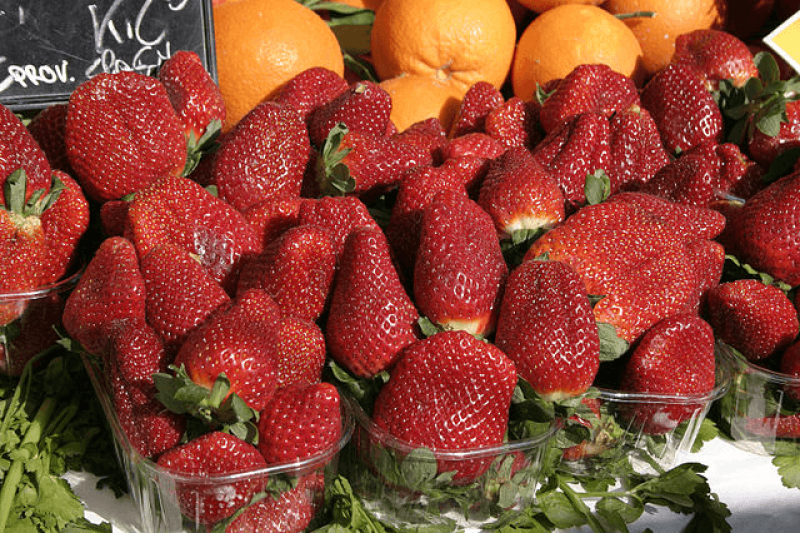
Strawberries are often perfectly shaped, humongous and uniform — but the flavor leaves much to be desired. Genetic engineering could change that

Native strawberries have been grown in the British Isles for centuries. But the ones we eat today are the product of centuries of cross breeding, including a mix of North and South American varieties.

Follow the latest news and policy debates on sustainable agriculture, biomedicine, and other ‘disruptive’ innovations. Subscribe to our newsletter.

But, as in much of the agriculture sector, advances in gene science have given producers new ways of improving their produce.

So [Farmer Marion] Regan, uses genetic markers which can speed up the search for improved varieties.

Genomic informed breeding, she emphasises, is not gene editing or genetic modification but rather looking at the genetic traits of strawberry varieties in order to pick the best ones from which to breed.

Such techniques were given a boost four years ago when scientists mapped the cultivated strawberry genome.

Now, breeders are using this knowledge to grow strawberries with new and improved flavours – even a savoury strawberry.

The knowledge might reverse a trend in recent decades where retailers have prized shape, size and uniformity of fruit and vegetables and neglected flavour.

The National Institute of Agricultural Botany (NIAB) says precision breeding could allow us to replace the 59,000 tonnes of imported strawberries with homegrown varieties – that’s almost a third of all strawberries consumed in the UK each year.


{{ reviewsTotal }}{{ options.labels.singularReviewCountLabel }}
{{ reviewsTotal }}{{ options.labels.pluralReviewCountLabel }}
{{ options.labels.newReviewButton }}
{{ userData.canReview.message }}

Related Articles

Infographic: Global regulatory and health research agencies on whether glyphosate causes cancer

Infographic: Global regulatory and health research agencies on whether glyphosate causes cancer

Does glyphosate—the world's most heavily-used herbicide—pose serious harm to humans? Is it carcinogenic? Those issues are of both legal and ...

Most Popular

ChatGPT-Image-Jun-15-2026-11_00_13-AM-2
Glucosamine alert: Alzheimer’s progresses faster among those taking the popular supplement
Screen Shot at AM
Facts & Fallacies Podcast: Right-wing politics bad for your health? Separating speculation from science
ChatGPT-Image-Jun-9-2026-01_11_37-PM
Turmeric supplements: More risks than benefits
ChatGPT-Image-Jun-3-2026-04_29_13-PM
Viewpoint: While unvaccinated children are dying overseas, Congress challenges Trump and Kennedy’s block on aid
ChatGPT-Image-Jun-15-2026-12_13_41-PM
Viewpoint: Behind the effort to re-purpose the tobacco attack strategy to fight ultra-processed foods
Screenshot-2026-06-12-at-2.10.55-PM
Physician warns online statin myths delay care and raise heart risk
ChatGPT-Image-Jun-14-2026-09_41_44-AM-2
Viewpoint—‘The gleeful efficiency of an arsonist’: Administration’s health and science research cuts are ‘sabotaging’ America’s future
ChatGPT-Image-Mar-10-2026-01_39_01-PM
Viewpoint—“Miracle molecule” debunked: Why acemannan supplements don’t work
Screenshot-2026-06-14-at-9.14.26-AM
‘Humanitarian catastrophe’: Trump’s USAID shutdown could help drive nearly 23 million deaths — including 5.4 million children — by 2030, Lancet study warns
ChatGPT-Image-Jun-11-2026-01_15_03-PM
Selective Pressure, Selective Silence
Screenshot-2026-06-05-at-2.12.30-PM
Some plants can poison you. So how did humans figure out what is safe to eat?
ChatGPT-Image-Jun-15-2026-10_42_06-AM
Viewpoint: ‘Steroid Olympics’ marketing stunt: ‘It seemed less like a sporting event and more like a loss leader to peddle testosterone injections, GLP-1s, and peptides’
glp menu logo outlined

Get news on human & agricultural genetics and biotechnology delivered to your inbox.