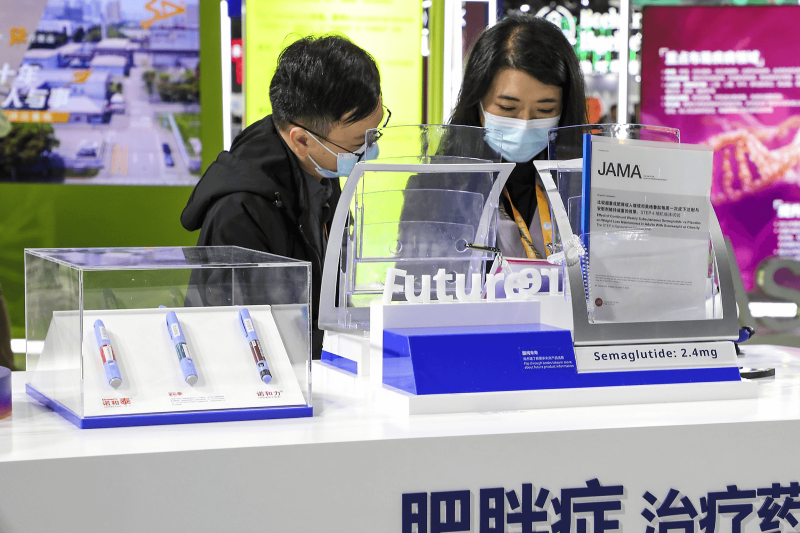
Discount weight loss drugs? India and China vying to make lower-cost versions of blockbuster Wegovy

Credit: Sixth Tone
Credit: Sixth Tone

Blockbuster weight-loss drugs such as Wegovy could soon become a lot cheaper — and reach more people — thanks to Chinese and Indian pharmaceutical companies. A long queue of companies is developing copies of the complex biological drugs, and some are racing to create modified or improved versions to compete in the global market.

Mis- and disinformation are distorting science and public policy. Subscribe to our Daily and Weekly Digests for incisive coverage of ‘disruptive’ innovations in AI, agricultural biotechnology, food, chemicals, nuclear energy, vaccines, and other disruptive innovations.

A month’s worth of semaglutide or tirzepatide injections can cost upwards of US$1,000. One way that Indian and Chinese pharmaceutical companies plan to slash that price is by developing biosimilars, cheaper versions of expensive brand-name drugs. Unlike generics, which are exact copies of chemically synthesized branded drugs, biosimilars very closely resemble their reference product and are derived from modified living organisms, such as yeast.

Companies are preparing to release biosimilar versions of GLP-1 drugs when patent protections lift in different markets. In China, the patent for liraglutide has already expired, and the one for semaglutide will expire in 2026 in India and China.

How much the cost will drop “is yet to be seen”, says [Abhijit Zutshi, chief commercial officer of the pharmaceutical giant Biocon, headquartered in Bengaluru, India]. It could be cut in half, or be one-tenth the current price, he says. If drugs are cheaper, more people will use them, thus expanding demand, he adds. This, in turn, could have a “ripple effect” in which companies reduce the price of existing weight-loss drugs “in anticipation of the competition coming”.


This is an excerpt. Read the full article here

Related Articles

Infographic: Global regulatory and health research agencies on whether glyphosate causes cancer

Infographic: Global regulatory and health research agencies on whether glyphosate causes cancer

Does glyphosate—the world's most heavily-used herbicide—pose serious harm to humans? Is it carcinogenic? Those issues are of both legal and ...

Most Popular

ChatGPT-Image-Sep-17-2026-12_28_43-PM
Vitamin D, omega-3 fish oil and glucosamine supplements could cause brain damage 
ChatGPT-Image-Mar-10-2026-01_39_01-PM
Viewpoint—“Miracle molecule” debunked: Why acemannan supplements don’t work
ChatGPT-Image-Sep-17-2026-10_17_15-AM
Viewpoint: Why are the less intelligent more likely to be conservative—and smarter people more socially liberal?
Screenshot-2026-09-10-at-12.20.19-PM
'Jet fuel didn't melt the steel': 9/11 conspiracy theories debunked
Screenshot 2026-07-29 at 10.40
The COVID vaccine turbo cancer scare is back. Science still proves it’s wrong.
ChatGPT-Image-Aug-28-2026-03_33_46-PM
Viewpoint: Bad science—Five bogus Trump administration claims about vaccines and autism
Screenshot-2026-09-10-at-11.50.46-AM
Did COVID vaccines kill 2,500 service members? RFK Jr. hires an investigator who compares vaccine promoters to Nazi doctors
Screenshot-2026-09-16-at-12.07.47-PM
The heated debate over trans athletes in the WNBA
screenshot at  am
‘Glyphosate is not carcinogenic’: Independent EU chemical oversight agency reaffirms—for the 3rd time in 9 years—that the herbicide is safe-as-used
glp menu logo outlined

Get news on human & agricultural genetics and biotechnology delivered to your inbox.