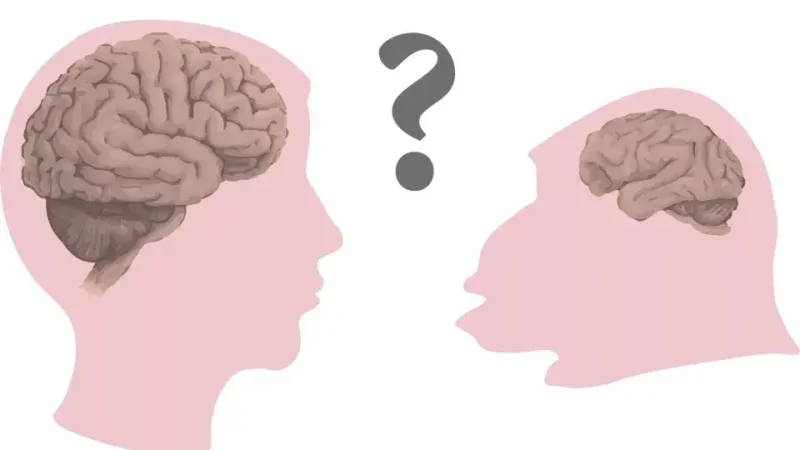
Mensa brain or monkey brain: What makes us different and how did that happen?

Credit: Marie Jönsson

Scientists have long tried to understand the human brain by comparing it to other primates. Researchers are still trying to understand what makes our brain different to our closest relatives. Our recent study may have brought us one step closer by taking a new approach — comparing the way brains are internally connected.

Follow the latest news and policy debates on sustainable agriculture, biomedicine, and other ‘disruptive’ innovations. Subscribe to our newsletter.
[T]he main differences we found were not in the prefrontal cortex. They were in the temporal lobe, a large part of cortex located approximately behind the ear. In the primate brain, this area is devoted to deep processing of information from our two main senses: vision and hearing. One of the most dramatic findings was in the middle part of the temporal cortex.

In humans, this brain area has much more extensive connections to other parts of the brain processing complex visual information, such as facial expressions and behavioural cues. This suggests that our brain is wired to handle more intricate social processing than those of our primate relatives. Our brain is wired up to be social. These findings challenge the idea of a single evolutionary event driving the emergence of human intelligence. Instead, our study suggests brain evolution happened in steps.


This is an excerpt. Read the original post here

{{ reviewsTotal }}{{ options.labels.singularReviewCountLabel }}
{{ reviewsTotal }}{{ options.labels.pluralReviewCountLabel }}
{{ options.labels.newReviewButton }}
{{ userData.canReview.message }}

Related Articles

Infographic: Global regulatory and health research agencies on whether glyphosate causes cancer

Infographic: Global regulatory and health research agencies on whether glyphosate causes cancer

Does glyphosate—the world's most heavily-used herbicide—pose serious harm to humans? Is it carcinogenic? Those issues are of both legal and ...

Most Popular

ChatGPT-Image-May-26-2026-07_51_21-AM-2
Viewpoint: There are more than 1,000 chemicals in a cup of coffee—including many substances that can cause cancer. Why isn’t it banned?
Screenshot-2026-04-14-at-11.11.06-AM
‘Turbo cancer’ or mRNA cancer cure? Strategies to counter misinformation
ChatGPT-Image-May-22-2026-10_56_42-AM-2
‘It’s not super useful’: As wariness about AI grows, Trump proposes rollback of healthcare safeguards
Screenshot 2026-05-29 at 2.47
Psychological inoculation: With a vaccine to prevent HIV on the horizon, misinformation is soaring. What can be done.
Screenshot-2026-04-30-at-11.33.46-AM
Anti-seed-oil to anti-vax pipeline: MAHA movement spreads to teen influencers
ChatGPT-Image-Mar-10-2026-01_39_01-PM
Viewpoint—“Miracle molecule” debunked: Why acemannan supplements don’t work
Screenshot 2025-07-30 at 10.48
Can gene editing eliminate Down syndrome? Scientists have done it in lab-grown cells
ChatGPT-Image-May-28-2026-02_12_17-PM
Can ‘Social Stress Indicators’ help contain social media misfluencers?
Screenshot-2026-05-29-at-1.23.52-PM
Viewpoint: Scientists recently revised downward the likelihood of catastrophic global warming. Reassured? You shouldn't be.
Screenshot-2026-04-22-at-12.21.32-PM
Viewpoint: Why the retracted Monsanto glyphosate study doesn’t change the science—the world’s most popular herbicide is safe 
ChatGPT Image May 28, 2026, 08_16_38 PM
Viewpoint: Why the EPA mismeasures cancer risk of chemicals and what should be done to fix it
edb7f6d7-2370-418f-9578-74e29678e35c
Facts & Fallacies Podcast: Nicotine vaping—public health miracle, or risk to children? Professor Cliff Douglas
Screenshot-2026-05-29-at-12.17.58-PM
RFK, Jr.’s delusion: Anti-depressants are not harder to quit than heroin—but that does not mean tapering off is easy
glp menu logo outlined

Get news on human & agricultural genetics and biotechnology delivered to your inbox.