In June, the Ramazzini Institute published the results of its long-heralded Global Glyphosate Study via an article in a Ramazzini-managed journal. They have been promoting the findings via a wide range of NGOs and interest groups but there has been little attention to the scientific weaknesses of the Ramazzini publication.
The academic journal structure has proven to be inadequate in refuting bad scientific research when an organization like the Ramazzini Institute is promoting its claims via activists, NGOs, filmmakers, foundation-funded media groups, political organizations and the US litigation industry. The Firebreak has worked with Dr Robert Tarone to provide a response to what can only be described as a travesty of science, one that has earned research conducted by the Italian institute the title: “Ramazzini Science”.
While the response Dr Tarone prepared below is valuable for the scientific community to discuss, there are important conclusions about the publication coming from the Ramazzini Global Glyphosate Study that all stakeholders and decision makers need to consider, outside of the noise coming from the anti-glyphosate activist community attempting to use this latest episode of “Ramazzini Science” to amplify their political agenda.
Namely:
- The results provided by the Ramazzini researchers suffered from a faulty statistical analysis (using incorrect approximate rather than much larger exact p-values) meaning that the number of significant tumor trends was actually very small
- The funding for the research was laden with undeclared conflicts of interest (particularly from the US litigation industry)
- The publication process for the paper was biased (in a Ramazzini-controlled journal peer reviewed by an activist from Pesticide Action Network)
- The researchers were drawing conclusions despite the absence of statistically significant evidence in their result tables
- The researchers chose not to cite and discuss an important rodent tumor study that contradicted their findings
- Summarized results from IARC Monograph 112 were for observed adenomas alone, with no apparent progressions to carcinomas
- The three glyphosate-exposed groups in the Ramazzini study were consistent in showing an absence of evidence for trends in tumor incidence across anatomic sites.
Dr Tarone’s response to the Ramazzini paper below, although technical, is largely comprehensible for the non-expert. The discussion on the erroneous approximate p-values has been moved to an annex at the end of the article.
A recently published paper claims to provide evidence of significant dose-related increasing trends in rates of benign and malignant tumors at multiple anatomic sites in Sprague Dawley (SD) rats exposed to glyphosate and glyphosate-based herbicides (GBHs) (Panzacchi et al., Environ Health 2025; 24:36). The authors concluded that most increases were in tumors that are rare in SD rats. The evidence presented does not support the conclusions of the paper when the tumor data are evaluated using appropriate statistical methods.
Questionable Motivation of the Investigators
Funders of the research include the Ramazzini Institute and the Heartland Health Research Alliance (HHRA). The HHRA was launched by Charles Benbrook, an anti-pesticide activist and plaintiff expert witness in numerous US pesticide lawsuits, with seed money from organic food proponents and law firms involved in law suits against Monsanto claiming that Roundup causes non-Hodgkin lymphoma (NHL).
The funding sources and stated goals of the HHRA indicate that the investigators involved in the Global Glyphosate Study are far from being disinterested researchers. In 2018, chair of Science Advisory Committee at both the HHRA and the Ramazzini Institute, Philip Landrigan, transferred almost one million dollars from the HHRA accounts to the Ramazzini Institute for the Global Glyphosate Study via his academic institution, Boston College (although he only acknowledged this transfer in 2023).
The HHRA website notes that the Ramazzini Institute is its major toxicology partner. The SD rat study paper is published in a Ramazzini-friendly journal (both founding editors and current senior editors of Environmental Health are Collegium Ramazzini Fellows), which may explain why such a deficient paper made it through peer review (the paper only had two reviewers, one being Peter Clausing, an activist from the Pesticide Action Network NGO).
Seriously Faulty Statistical Analyses
The authors of the Ramazzini rat study paper state that the Cochran-Armitage trend test was used to conduct the statistical analyses of tumor dose-response.
A note about p-values. A p-value is a measure of how likely it is that a given experimental outcome is due to chance. The smaller the p-value, the less likely it is that an observed outcome is a chance occurrence. The Ramazzini rat study investigators took a Cochran-Armitage test approximate p-value less than 0.05 to be evidence that exposure to glyphosate or a herbicide with glyphosate caused an observed increase in tumors.
With extremely low tumor counts such as those reported in the Ramazzini glyphosate SD rat study paper, p-values should be calculated using the exact distribution of the Cochran-Armitage test. The p-values reported in the paper, however, are approximate, the approximation being based on the standard normal distribution rather than using the appropriate exact test.
The same erroneous method was used in the analysis of rodent tumor data in the IARC Monograph 112 glyphosate chapter, and as in Monograph 112, the error was compounded in the Ramazzini SD rat paper by reporting only one-sided p-values for an increase in tumor rates with increasing glyphosate level (Tarone, Regul Toxicol Pharmacol 2018;98:A1-A4). Because the exact Cochran-Armitage distribution is positively skewed, the reported approximate p-values based on the symmetric normal distribution are too low, and often much too low. For example, most (i.e., 73%) of the allegedly significant trends reported in the Ramazzini rat study were for sites with one animal with tumor in the highest dose group and no tumors in the other three exposure groups; the exact Cochran-Armitage test p-value for this outcome is 0.25.
In the annex at the end of the article, the actual number of significant trends will be seen to be very small, particularly given the large number of tumor types for which dose-response analyses were performed.
Selection of Rare Tumors for Published Tables
It is the absence of spontaneous neoplasms in the tumor tables in the body of the Ramazzini rat study paper that allows the study authors to incorrectly claim so many significant trends based on the approximate Cochran-Armitage test. This reflects a selection bias for rare tumors made in order to be able to incorrectly claim statistical significance based on only one or two animals with tumors observed in the highest dose groups, and thus to conclude that most significant increases occurred for tumors rarely seen in SD rats.
Only two tumors were reported in control rats in Tables 1-18 of the paper – a hepatocellular carcinoma in a male rat and an osteoma in a female rat. SD rats are known to have rather high spontaneous tumor rates (Morse et al., Int J Toxicol 2025 May 26: 10915818251342565), and this is confirmed in the supplementary tables accompanying the Ramazzini rat study paper where the results for commonly occurring tumors in SD rats are presented. In particular, male and female SD rats have very high spontaneous rates of pituitary neoplasms. The Ramazzini rat study authors suggest that glyphosate and glyphosate-based herbicides (GBHs) may induce adverse carcinogenic effects via “impact on the hypothalamic-pituitary-adrenal axis”, but the supplementary tables indicate no evidence of an increase in pituitary or adrenal neoplasms.
There was no evidence that glyphosate or a GBH was associated with an increased trend in the incidence of neoplasms at any anatomic site for which tumor rates were summarized in the supplementary tables. In particular, there was no evidence that glyphosate or a GBH was associated with an increased incidence of lymphomas – a finding not noted in the paper.
The final paragraph of the Results section of the paper reports an increased incidence at the lowest dose of RangerPro in female rats for benign mammary tumors (tumor rates summarized in Supplementary Table 2). The increase in mammary adenomas, fibromas and fibroadenomas at the 0.5 RangerPro dose is significant (Fisher exact p=0.046), but there is no evidence of a positive trend (Cochran-Armitage exact p=0.36 in the direction of an inverse dose-response). No other type of tumor summarized in the supplementary tables has a significantly increased rate at an intermediate dose using the exact test.
Biased Ramazzini Science
The summary Table 20 in the Ramazzini rat study paper provides useful insight into the logic of “Ramazzini science”. (See table below.) The table has three columns, the first and third corresponding to papers published in the Ramazzini friendly journal, Environmental Health, and the middle column corresponding to the IARC Monograph 112 glyphosate chapter.
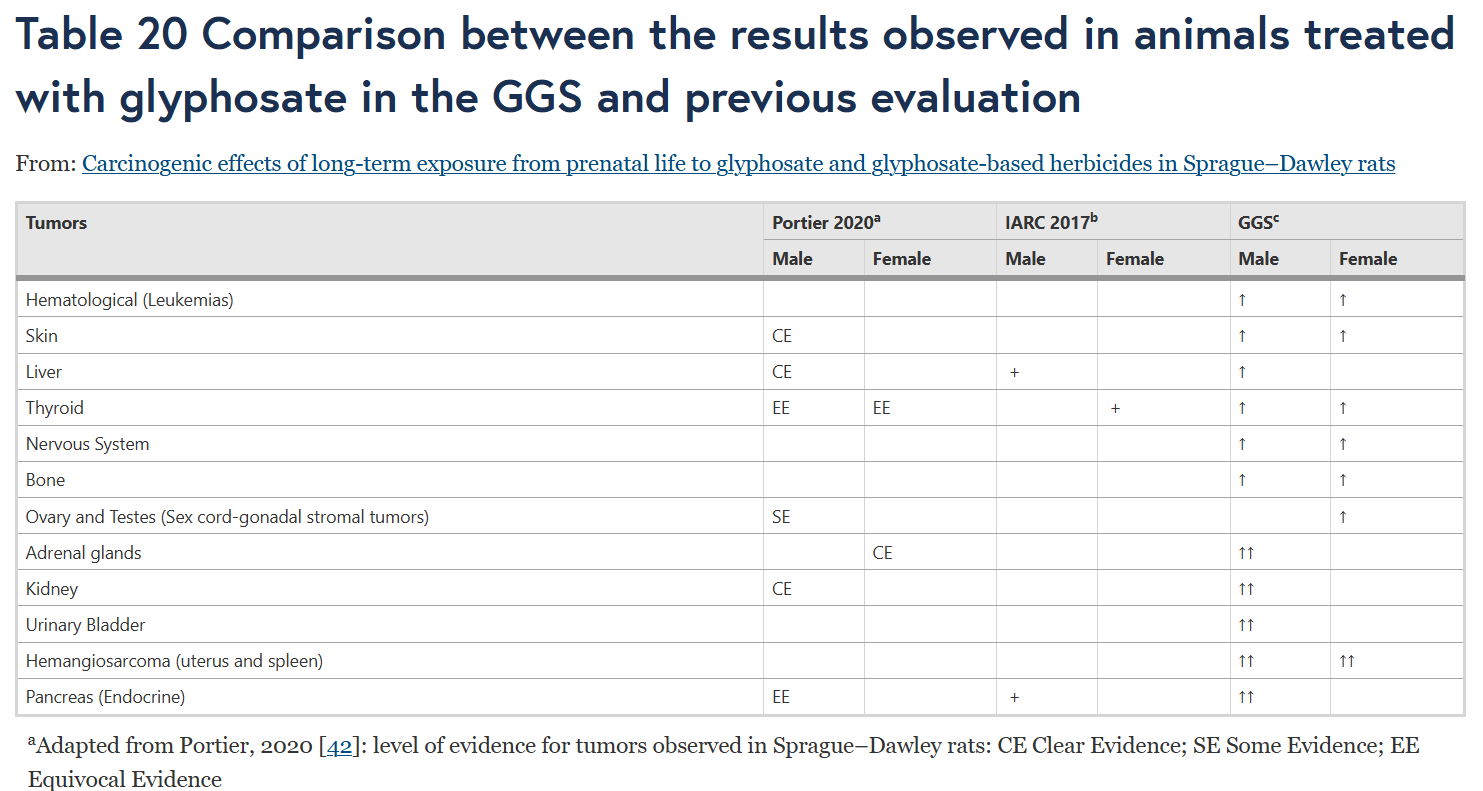
The rodent study review paper corresponding to the first column was written by a Collegium Ramazzini Fellow and plaintiff expert in Roundup litigation, and only considered observed increases in tumor rates with increasing glyphosate exposure levels (Portier, Environ Health 2020;19:1-17). This research was funded by US tort law firms and prepared for them while Christopher Portier was engaged by the US litigation industry as a consultant.
 Ramazzini — The backstory of the ‘independent’ Italian organization that partners with IARC, the multi-billion dollar ‘toxic predatort’ industry, and anti-chemical environmental groups
 Viewpoint—Toxic Narratives: The lucrative environmentalist–tort lawyer-media disinformation network driving drug and chemical scares



Another comprehensive review of glyphosate rodent studies that examined both tumor increases and tumor decreases is not cited in the Ramazzini rat study paper, but reported that there were slightly more significant tumor decreases with increasing glyphosate level than tumor increases (Crump et al., Toxicol Sci 2022;175:1546-167).
The middle column of Table 20, indicated to be “adapted from IARC” Monograph 112, shows alleged effects for liver and endocrine pancreas in male rats and for thyroid in female rats. One of the three SD rat two-year studies relied upon by IARC reported marginally significant increasing trends for liver adenomas in male rats and thyroid C-cell adenomas in female rats. The Working Group noted these trends, as well as the fact that there was no apparent progression to carcinoma for either tumor type, but the other two SD studies did not provide supporting evidence for an increase in liver or thyroid C-cell adenomas (Tarone, Eur J Cancer Prev 2018;27:82-87). Neither trend was cited by IARC as supporting the conclusion that there is sufficient evidence that glyphosate is an animal carcinogen (Guyton et al., Lancet Oncol 2015;16:490-491). The Ramazzini rat study showed no evidence of increased rates of liver neoplasms or thyroid C-cell neoplasms in exposed rats compared to concurrent controls in males or females.
An alleged increase in pancreatic islet cell adenomas in two SD rat studies was cited by IARC as supporting the conclusion that there is sufficient evidence that glyphosate is an animal carcinogen (Guyton et al., Lancet Oncol 2015;16:490-491). The claim is based on highly questionable pairwise comparisons of the lowest of three glyphosate exposure level groups to concurrent controls in both studies, in the absence of a significant dose-response and with an acknowledgement that there was no apparent progression to carcinoma in either study. The claim also ignores a significantly decreasing trend in pancreatic islet cell adenomas with increasing glyphosate exposure level in the third SD rat study relied upon by IARC (Tarone, Eur J Cancer Prev 2018;27:82-87; Tarone, Regul Toxicol Pharmacol 2018;98:A1-A4).
Based on a rigorous evaluation, the middle column of Table 20 should be empty, but regardless, all three alleged effects indicated in the middle column refer to observed adenomas, with no apparent progression to carcinomas. The Ramazzini rat study showed no evidence of increased rates of pancreatic islet cell neoplasms in exposed rats.
The last column refers to the current Ramazzini rat study, and as indicated in the Annex based on legitimately significant trends, there should be at most two entries – for benign skin tumors in males after glyphosate exposure and for all leukemias combined for males after RangerPro exposure. Even these should be considered questionable given the large number of statistical analyses performed, the marginal significance of the trends, and the absence of evidence from the other types of glyphosate exposure in the study (i.e., Roundup Bioflow and RangerPro for skin tumors, and glyphosate and Roundup Bioflow for leukemias).
Conclusion
The results of the Ramazzini rat study do not support the conclusion that there are dose-related increases of benign and malignant tumors at multiple anatomic sites in SD rats exposed to glyphosate and GBHs. One observation in the Ramazzini rat study that may require further research is the report of early leukemia deaths attributed by study authors to glyphosate exposure.
Early deaths from spontaneous lymphomas and leukemias have been reported in SD rats (Son and Gopinah, Toxicol Pathol 2004;32:371-374; Yoshizawa et al., Exp Toxicol Pathol 2016;301-305). It may be prudent to investigate whether the reported early deaths from leukemia in the Ramazzini study can be replicated following in utero and lifetime exposure to glyphosate or GBHs.
Such a study, if deemed necessary after exhaustive reviews of the Ramazzini study by regulatory bodies, should be performed in an independent, reputable laboratory by experienced and disinterested scientists. A full two-year lifetime study should not be necessary to confirm or refute the Ramazzini rat study leukemia results.
David Zaruk is the editor of Firebreak, and also writes under the pen-name The Risk Monger. David is a retired professor, environmental-health risk analyst, science communicator, promoter of evidence-based policy and philosophical theorist on activists and the media. Find David on X @Zaruk
Robert Tarone was a Research Mathematical Statistician at the U.S. National Cancer Institute for 28 years and Biostatistics Director at the International Epidemiology Institute for 14 years. Find Robert on X @RobertTarone
A version of this article was originally posted at Firebreak and has been reposted here with permission. Any reposting should credit the original author and provide links to both the GLP and the original article. Find Firebreak on X @The_Firebreak