What you probably don’t know: For most fast-food fans, bioengineering isn’t a choice — it’s the norm

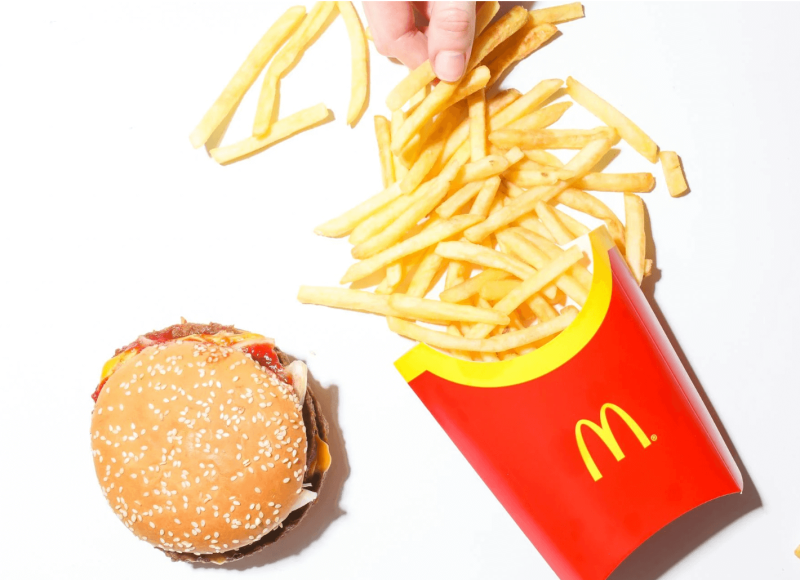
Credit: Polina Tankilevitch/Pexels

Think you’re grabbing a quick “natural” bite from your favorite burger joint? Think again. Whether you order a Big Mac, a taco, or even a salad, chances are you’re already eating bioengineered ingredients — and you’ll never see them labeled that way.

Under current U.S. law, restaurants are exempt from disclosing bioengineered or genetically modified ingredients, meaning chains from McDonald’s to Chick-fil-A can serve you modified foods without a hint on the menu (USDA).

Follow the latest news and policy debates on sustainable agriculture, biomedicine, and other ‘disruptive’ innovations. Subscribe to our newsletter.

The reason: nearly every staple ingredient in fast food — corn oil, soy protein, canola oil, sugar from sugar beets, and even cheese additives — originates from genetically engineered crops (FDA). Even “plant-based” products aren’t exempt; the Impossible Whopper uses a lab-engineered yeast that creates the burger’s “meaty” flavor (Center for Food Safety).

So the next time your fries taste exactly the same in any city, thank the science behind them — and the tightly controlled genetic uniformity that makes “fast food” truly fast.

This is an excerpt. Read the original post here

{{ reviewsTotal }}{{ options.labels.singularReviewCountLabel }}
{{ reviewsTotal }}{{ options.labels.pluralReviewCountLabel }}
{{ options.labels.newReviewButton }}
{{ userData.canReview.message }}

Related Articles

Infographic: Global regulatory and health research agencies on whether glyphosate causes cancer

Infographic: Global regulatory and health research agencies on whether glyphosate causes cancer

Does glyphosate—the world's most heavily-used herbicide—pose serious harm to humans? Is it carcinogenic? Those issues are of both legal and ...

Most Popular

ChatGPT-Image-May-26-2026-07_51_21-AM-2
Viewpoint: There are more than 1,000 chemicals in a cup of coffee—including many substances that can cause cancer. Why isn’t it banned?
Screenshot-2026-04-14-at-11.11.06-AM
‘Turbo cancer’ or mRNA cancer cure? Strategies to counter misinformation
ChatGPT-Image-May-22-2026-10_56_42-AM-2
‘It’s not super useful’: As wariness about AI grows, Trump proposes rollback of healthcare safeguards
Screenshot 2026-05-29 at 2.47
Psychological inoculation: With a vaccine to prevent HIV on the horizon, misinformation is soaring. What can be done.
Screenshot-2026-04-30-at-11.33.46-AM
Anti-seed-oil to anti-vax pipeline: MAHA movement spreads to teen influencers
Screenshot 2025-07-30 at 10.48
Can gene editing eliminate Down syndrome? Scientists have done it in lab-grown cells
ChatGPT-Image-Mar-10-2026-01_39_01-PM
Viewpoint—“Miracle molecule” debunked: Why acemannan supplements don’t work
ChatGPT-Image-May-28-2026-02_12_17-PM
Can ‘Social Stress Indicators’ help contain social media misfluencers?
Screenshot-2026-05-29-at-1.23.52-PM
Viewpoint: Scientists recently revised downward the likelihood of catastrophic global warming. Reassured? You shouldn't be.
ChatGPT Image May 28, 2026, 08_16_38 PM
Viewpoint: Why the EPA mismeasures cancer risk of chemicals and what should be done to fix it
edb7f6d7-2370-418f-9578-74e29678e35c
Facts & Fallacies Podcast: Nicotine vaping—public health miracle, or risk to children? Professor Cliff Douglas
Screenshot-2026-04-22-at-12.21.32-PM
Viewpoint: Why the retracted Monsanto glyphosate study doesn’t change the science—the world’s most popular herbicide is safe 
Screenshot-2026-05-29-at-12.17.58-PM
RFK, Jr.’s delusion: Anti-depressants are not harder to quit than heroin—but that does not mean tapering off is easy
glp menu logo outlined

Get news on human & agricultural genetics and biotechnology delivered to your inbox.