‘Glyphosate is not carcinogenic’: Independent EU chemical oversight agency reaffirms—for the 3rd time in 9 years—that the herbicide is safe-as-used

screenshot at  am

The European Chemicals Agency’s Risk Assessment Committee (RAC) has reaffirmed, for the third time in nine years, that glyphosate does not warrant a carcinogen classification, even after reviewing new tumor data, as Food Safety Magazine’s Bailee Henderson reports. The September 8, 2026 decision upholds RAC’s 2022 hazard assessment and a 2023 EU risk review that found no critical health concerns tied to the world’s most widely used herbicide.

Mis- and disinformation are distorting science and public policy. Subscribe to our Daily and Weekly Digests for incisive coverage of ‘disruptive’ innovations in AI, agricultural biotechnology, food, chemicals, nuclear energy, vaccines, and other disruptive innovations.

The committee weighed fresh findings from the Ramazzini Institute’s 2025 Global Glyphosate Study, which dosed thousands of rats with glyphosate in utero and over 104 weeks of life, reporting significant increases in several tumor types, including leukemia, at or below the EU’s official safety thresholds. Even so, RAC concluded the study “does not change the conclusions of glyphosate’s hazard assessment, in particular its former 2022 decision that the substance does not warrant a classification for carcinogenicity.”

The lone holdout remains the World Health Organization’s cancer research arm, which labeled glyphosate a “probable carcinogen” in 2015 using a hazard-based method critics say ignores real-world exposure. Every agency that has weighed the actual evidence since — ECHA three times over, plus EFSA and roughly 20 other regulators worldwide — has reached the same verdict: glyphosate is safe as used.
Read the original article here

Related Articles

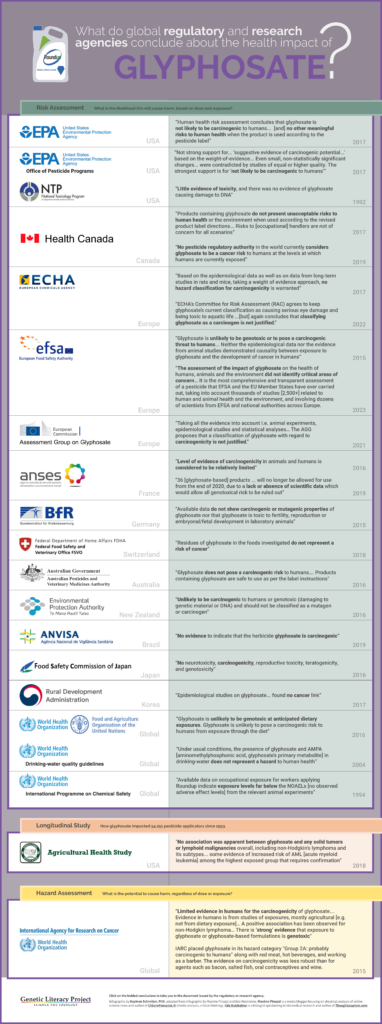
Infographic: Global regulatory and health research agencies on whether glyphosate causes cancer

Infographic: Global regulatory and health research agencies on whether glyphosate causes cancer

Does glyphosate—the world's most heavily-used herbicide—pose serious harm to humans? Is it carcinogenic? Those issues are of both legal and ...

Most Popular

ChatGPT-Image-Sep-17-2026-12_28_43-PM
Vitamin D, omega-3 fish oil and glucosamine supplements could cause brain damage 
ChatGPT-Image-Mar-10-2026-01_39_01-PM
Viewpoint—“Miracle molecule” debunked: Why acemannan supplements don’t work
ChatGPT-Image-Sep-17-2026-10_17_15-AM
Viewpoint: Why are the less intelligent more likely to be conservative—and smarter people more socially liberal?
Screenshot-2026-09-10-at-12.20.19-PM
'Jet fuel didn't melt the steel': 9/11 conspiracy theories debunked
Screenshot-2026-09-16-at-12.07.47-PM
The heated debate over trans athletes in the WNBA
Screenshot-2026-09-10-at-11.50.46-AM
Did COVID vaccines kill 2,500 service members? RFK Jr. hires an investigator who compares vaccine promoters to Nazi doctors
Screenshot 2026-07-29 at 10.40
The COVID vaccine turbo cancer scare is back. Science still proves it’s wrong.
ChatGPT-Image-Aug-28-2026-03_33_46-PM
Viewpoint: Bad science—Five bogus Trump administration claims about vaccines and autism
glp menu logo outlined

Get news on human & agricultural genetics and biotechnology delivered to your inbox.