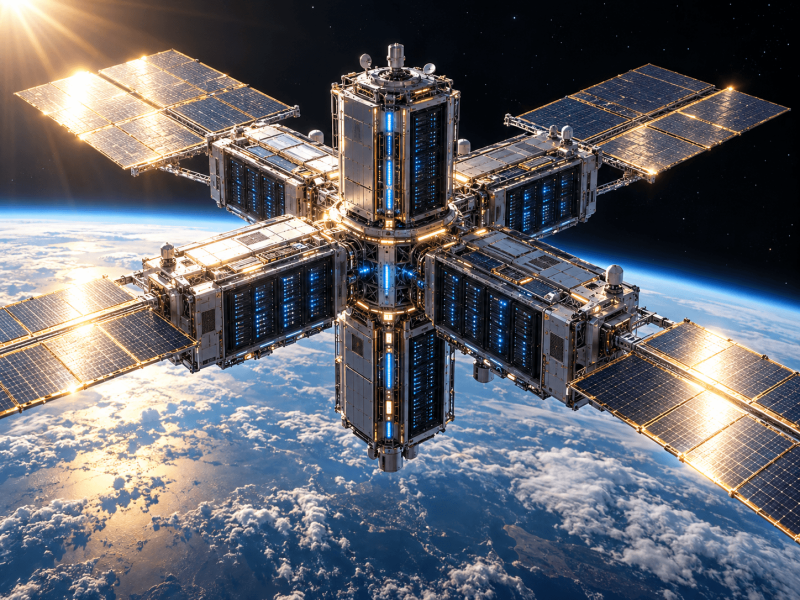

Google plans to launch a satellite on Oct. 1 that can run its artificial intelligence technologies in orbit, an early test of whether AI data centers could one day run on uninterrupted sunlight in space, reports Cade Metz of The New York Times. Tech titans including Elon Musk and Jeff Bezos have backed the vision, but many experts question its feasibility.
Don’t picture a warehouse strapped to a rocket. Built with help from SpaceX and Planet Labs, Google’s satellite carries the equivalent of a single data center server with four tensor processing units. The plan is to link many such satellites so they operate like one giant data center.
“This is about smaller satellites that are independently equipped with extremely efficient computers and radio links connecting them,” said Brandon Lucia, a professor of electrical and computer engineering at Carnegie Mellon University.
AI companies are spending hundreds of billions of dollars a year on data centers and worry about running short of land and power. Satellites in a sun-synchronous orbit would get constant sunlight for their solar panels, and space has plenty of room, though astronomers warn of telescope interference, collisions and pollution when retired satellites burn up.
Launch can damage chips, and cosmic radiation can corrupt the calculations AI depends on. Cooling is harder still: space is cold, but convection doesn’t work in a vacuum, so heat must be radiated away.





“This cooling problem is actually quite difficult,” Lucia said. “These computers will be basking in the Sun all day, because you want to collect all that sweet, free photovoltaic power.”
Even Google admits it doesn’t yet know how to make it all work, or when it will pay off. “There is still a lot of science and engineering to be done,” said James Manyika, Google’s senior vice president for research. Some experts think a sizable fleet could take a decade or more.