
The pandemic-era line “died with COVID, not from it” has come back, and this time it’s being used to leave measles deaths out of the national count. Writing for STAT News, Jess Steier, a public health scientist and founder of Unbiased Science, and Elana Pearl Ben-Joseph, a pediatrician and the group’s senior medical and scientific editor, explain why that framing doesn’t hold up.
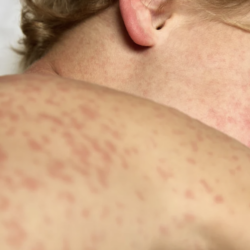
Pennsylvania has reported four measles-associated deaths since late August. After a Lancaster County commissioner relayed the coroner’s view that an infant died “WITH measles, but not FROM measles,” the CDC left the first two deaths out of its national update. It has since added one, but still doesn’t list the other three.
New CDC head Erica Schwartz defended the decision by pointing back to COVID, saying that when someone with the virus was hit by a bus, “often that was called a COVID-related death.”
The authors say this misreads how death certificates work. Certifiers record a chain of causes that ends with the underlying cause, “the disease or injury that initiated the chain of events.” That’s why a bus victim isn’t a COVID death, and why a child who dies of pneumonia brought on by measles is a measles death. The CDC’s own handbook tells physicians not to list cardiac arrest as a cause of death for this reason: in the end, everyone’s heart stops.



The COVID bus story does trace back to a real case, a Florida motorcyclist briefly added to a county’s preliminary tally. He was removed after the medical examiner reviewed the death, a correction the CDC called the system working as designed. Excess mortality data also shows that inflated death certificates can’t explain the pandemic’s toll.
“Every death has something that kicked off the cascade,” the authors write. Holding measles deaths out until death certificates are final “reverses that order” of fast surveillance first, corrections later.