


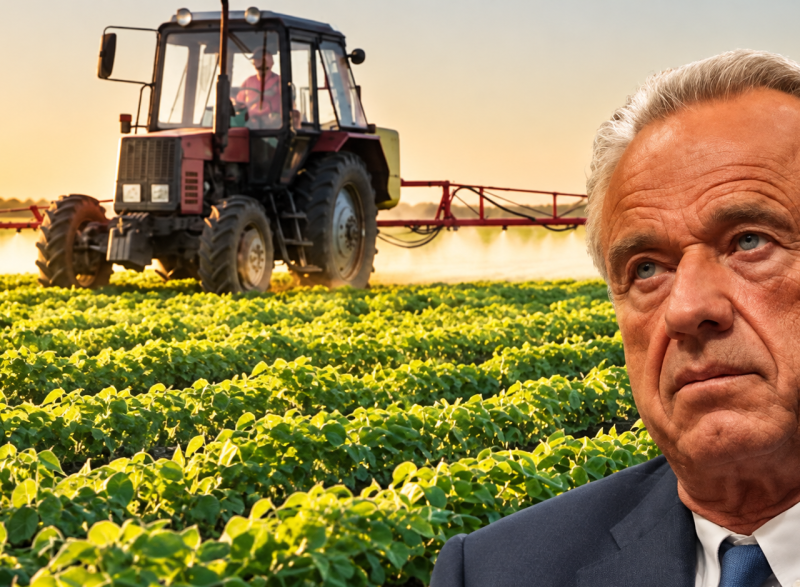

Some of America’s biggest food and farm interests have decided the best way to answer the Make America Healthy Again movement is to beat it on its home turf: social media. An industry-funded campaign called Growing a Healthier America, or GAHA, is paying influencers to push back on MAHA claims about seed oils, pesticides, raw milk and “big ag,” as The Guardian’s Rachel Leingang and Riley Messer report in an investigation conducted with the watchdog project Documented.
The effort is run by the Center for Food Integrity (CFI), a nonprofit whose board includes executives from Chick-fil-A, Cargill, Dairy Farmers of America and the National Pork Board. American Farm Bureau Federation president Zippy Duvall has taken credit for bringing the coalition together.
The industry has reason to worry. Skepticism of pesticides and processed food now crosses party lines. A May 2026 KFF Health Tracking Poll on MAHA found about four in 10 U.S. adults back the movement, while 64% say agricultural pesticides are under-regulated, and 75% say the same of chemical food additives.
Internal documents show CFI tracking MAHA narratives through regular “insight briefs,” circulating a “Say This, Not That” language guide, and matching messengers to audiences: farmers and wellness enthusiasts for those who prize authenticity, scientists and dietitians for “rationalists,” and lifestyle or faith-based creators for “comfort seekers.” Top donors earn a seat on a council that approves strategy.
In a July 2025 training video, CFI executive director Kelly Leighton laid out the stakes: “Without this coordinated response, that misinformation [from MAHA] risks undermining consumer trust, fueling new regulations and eroding confidence in agriculture as a whole.”
At least six influencers have signed on, reaching more than 2.6 million followers. Participants insist they aren’t industry mouthpieces. Jessica Steier, CEO of Unbiased Science, said her group received “a modest fee” but kept full editorial control, interviewing a farmer about why pesticides are used and how they’re regulated. Hearing that directly from a farmer, she said, “does something a fact sheet can’t.”




Steier also flipped the money question around. “If anything, the financial incentives are far stronger on the other side of this,” she said. “The wellness economy that profits from fear about food and ‘toxins’ is enormously lucrative.” Slade Wentworth, whose Instagram account thedadbriefs has more than a million followers, agreed that “many of the loudest voices in the MAHA movement and in the food/wellness spaces in general tend to push anti- and pseudo-scientific claims.”
Critics see a familiar playbook. Jerold Mande, a nutritionist and former USDA deputy undersecretary for food safety under President Obama, called the campaign “crisis management,” saying food companies “realize now that they’re facing an existential threat.” Molecular biologist and nutritionist Marion Nestle called it “nothing new.”
Yet both noted that MAHA has delivered little actual regulation, with the Trump administration largely stopping short of new rules. “You’re not going to make progress if you don’t use government’s two powerful levers: funding and rules,” Mande said.



























