



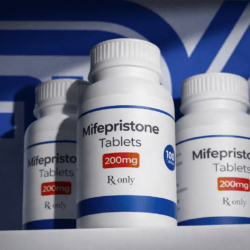
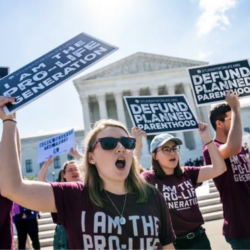
Misinformation and junk science about abortion are spreading at alarming rates and are becoming key components in legislation and litigation as well as in federal regulatory agencies. In March, anti-abortion lawmakers in Congress introduced the Clean Water for All Life Act, citing junk science to claim that mifepristone, one of the two drugs used in medication abortion, is contaminating drinking water, and seeking to prohibit telehealth dispensing of the drug, among other requirements; the bill remains in committee. Pressure from anti-abortion advocates resulted in the Environmental Protection Agency including mifepristone in a study of potential contaminants in drinking water and the Food and Drug Administration (FDA) conducting a “safety study” of the drug, citing a self-published report that has been widely debunked. The FDA approved mifepristone in 2000 for use in medication abortion, and more than a hundred peer-reviewed studies have shown it to be safe and effective.
Common false narratives about abortion include claims that it’s unsafe and causes subsequent fertility and mental health problems, and that medication abortion is often used in coerced attempts to end pregnancies. Anti-abortion advocates rely on junk science as part of their attempts to make abortion inaccessible, citing studies that don’t adhere to rigorous standards and often lack transparency about their methods or data sets, so they can’t be replicated as reputable, peer-reviewed journals require. The junk science papers about mifepristone make “conclusions that are not at all supported by the findings, so they are just calling for increased restrictions on mifepristone that don’t have anything to do with what outcomes they’ve actually looked at, which points to this political motivation rather than rigorous scientific methods,” said Anna Bernstein, principal federal policy advisor at the Guttmacher Institute. “The reason we’re seeing misinformation ramp up is because people are still able to access care post Dobbs. It’s already difficult to navigate state laws, which are often changing, and bans around abortion, and misinformation just adds further confusion to abortion seekers. These narratives trickle down and make it less clear what care is available and how safe medication abortion is.”
Providers report that patients frequently have concerns about abortion based on misinformation, including that it’s unsafe and will result in excessive hemorrhaging and infertility. “It’s something we contend with on a daily basis,” said Dr. Kassi Avent, a New Jersey–based family medicine doctor and fellow with Physicians for Reproductive Health who has provided abortions in three different states and in a variety of settings. “Probably every single one of our patients comes to us with questions based on misinformation, the most common being ‘Am I going to be able to have kids in the future?’ Their ability to conceive in the future is so important to them, so the misinformation that abortion affects fertility really impacts how they think about their decision in that moment.”
This has a direct ripple effect on the general population, not just on abortion seekers. Recent polling by KFF, a health policy research organization, found an uptick in the number of adults who have heard of mifepristone since the Dobbs decision, and now 60% of adults are aware of the drug. Yet 41% are unsure if abortion medication is safe. “This points to a lack of awareness about the safety of abortion pills,” said Audrey Kearney, senior survey analyst for the Public Opinion and Survey Research Program at KFF. Although only 22% said they believe it’s unsafe, “a large share are saying they’re unsure on this front. As the safety is called into question by high-ranking officials, it could cast doubt for people. As [mifepristone] is getting re-reviewed, why would they trust that it is actually safe?” Further, since the COVID pandemic, “the public’s trust in [public health agencies] to keep them safe and make sound decisions based on science has declined,” said Kearney. Now, “the most trusted source on health issues are people’s own doctors. And having a trusted doctor, a relationship with a provider, makes you less susceptible to misinformation. It doesn’t mean that people who don’t have trusted doctors believe misinformation, but they might be more unsure about certain claims.”
Communities that lack access to healthcare are especially vulnerable to false information. “The targeting toward communities who are pushed to the margins of the healthcare system is huge,” said Lupe M. Rodríguez, executive director of the National Latina Institute for Reproductive Justice. “When folks don’t have access to care, they’re looking for whatever resource is presented to them. Many of our communities rely on social media and messaging platforms, which are lifelines for communication, and they are also places, unfortunately, where misinformation and disinformation is rampant and unmitigated and unchecked. Many of these platforms already have problems checking mis- and disinformation in English, and they rarely have any more resources, and in many cases don’t have any, for Spanish language. It forms the basis for misinformation that folks carry in the real world. We see the consequences of this every day: rising rates of maternal mortality, shortages and delays in care. This is compounded with the fears that folks have about immigration enforcement. Misinformation on top of that has the ability to thrive.”
In several states, anti-abortion activists have brought lawsuits that use false narratives about medication abortion as justification for restricting its use. Louisiana v. FDA was filed by the Alliance Defending Freedom, an anti-abortion group, on behalf of the state and a plaintiff who alleged that she was coerced by her partner into taking abortion medication after receiving it in the mail. Louisiana is seeking to reinstate in-person dispensing of mifepristone, arguing that the FDA’s decision to allow telehealth dispensing of the drug in 2023 was unlawful and dangerous; the plaintiffs have cited faulty studies as part of their evidence. On May 1, the Fifth Circuit Court of Appeals granted Louisiana’s request to reinstate in-person dispensing while its appeal was pending, and it briefly took effect nationwide. The following day, defendants in the case, including the two drug companies that make mifepristone, filed emergency appeals with the Supreme Court, and were quickly able to preserve telehealth dispensing as the case proceeds. But the damage was done. “Confusion was the goal, and the runaround with mifepristone meant misinformation spread that it wasn’t safe or the efficacy wasn’t there,” said Vanessa Borjon, director of helpline services at the Chicago Abortion Fund. “It certainly made people question, ‘If I schedule my appointment today and then something changes by the end of the week, what am I going to do?’” The confusion may cause “people not to choose telehealth and instead travel for the procedure. Of course, everyone deserves to seek the type of procedure they want. But a lot of times, telehealth just works better for people.”



Keeping track of all the court cases is challenging even for providers themselves, and they sometimes have to pivot quickly, and struggle to keep track of what’s legal as rulings and stays are put in place. It’s even harder for abortion seekers. “Any time there’s a news report or mention that access to certain medications might be going away, people will automatically think that it has actually already gone,” said Dr. Bhaskari Burra, a North Carolina–based OB-GYN and fellow with Physicians for Reproductive Health. Pushing the message that medication abortion is unsafe is a “purposeful and manipulative scare tactic so that people are scared out of accessing an abortion.”
However, despite the efforts of the anti-abortion movement, people are still finding out how to access care. “Advocates have been doing a really great job to inform the public, and more people are learning about telehealth and self-managed abortion,” said Kwajelyn Jackson, executive director of the Feminist Center for Reproductive Liberation in Atlanta, who pointed to social media’s potential for disseminating correct and helpful information about abortion, not only the opposite. “It can be hard to discern on social media, when you’re just hearing from a lot of different voices, which ones are the right ones, so we as abortion advocates and reproductive justice leaders have to ensure that the accurate stories make their ways to the top.”
In addition to navigating misinformation, abortion seekers in states with bans and restrictions, such as Florida, which has a six-week abortion ban, are also contending with “more of an anti-abortion presence and there’s probably a little bit more stigma [than in states without bans], and they’re scared,” said Dr. Robyn Schickler, chief medical officer at Planned Parenthood of Florida. But “after all the misinformation they’ve gotten, people come in and are pleasantly surprised that everyone is really kind and everything goes very smoothly for them. Once they’ve either taken the medication or had the procedure, they’re like, ‘Oh, that was it?’”


























