[On January 14, 2025], the Senate held its first health committee hearing of the year. The topic? Whether mifepristone, the medication commonly thought of as the abortion pill, is too dangerous to prescribe via telehealth.
The answer, according to the data: no.
Mifepristone is safer than penicillin. It’s safer than ibuprofen. It’s roughly 38 times safer than continuing a pregnancy to term. And it’s been used by millions of patients across three decades with a serious complication rate well under 1%.
But with the U. S. Food and Drug Administration (FDA) now conducting a review under new HHS leadership, and political pressure building to restore restrictions lifted years ago, we thought it was worth stepping back from the talking points and looking at what the evidence actually shows. Not the rhetoric. The pharmacology. The dosing. The outcomes data.
Mifepristone is treated in policy debates as though it were uniquely dangerous, when the data suggest the opposite. The question isn’t whether mifepristone carries risk—all medications do. The question is whether it’s being held to a standard that no other drug with a comparable safety profile would ever face.
So we phoned a friend. Unbiased Scientist and OB/GYN Dr. Sarah Berg breaks down what the science actually says. Let’s discuss…
Let’s acknowledge the elephant in the room: Discussions about mifepristone can be emotionally charged. Religious beliefs, personal values, political identity—there’s a lot that shapes how people feel about this drug, and none of that is going away.
This article isn’t here to argue about any of that.
What we can do is look at the science. Specifically: Is mifepristone actually dangerous? What do the risk data show after three decades of use? And is the scrutiny this drug faces proportional to its safety profile—or is something else going on?
Mifepristone is often discussed as though it were uniquely risky and used in only one narrow clinical context. In reality, it’s a well-studied medication used across multiple medical disciplines with an extensive safety record. That profile is best understood not through political framing, but through pharmacology, dose, duration, and real-world outcomes.
What Is Mifepristone?
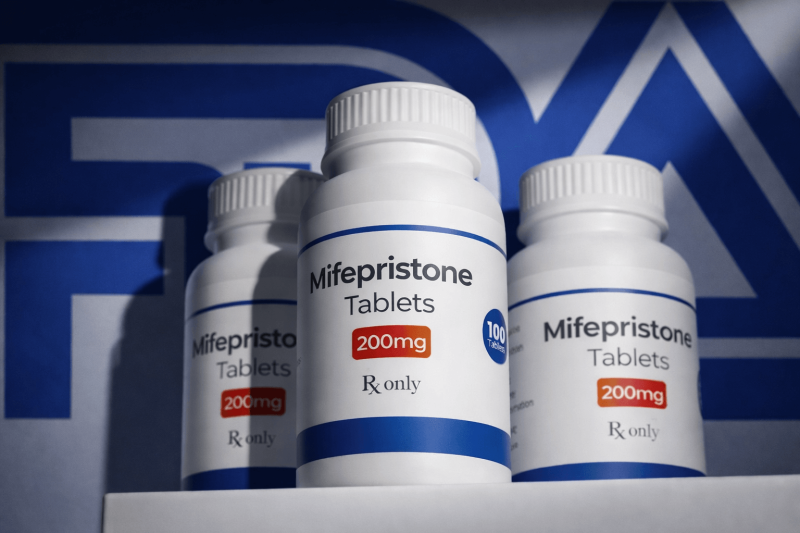
Mifepristone (formerly known as RU-486) is a progesterone receptor antagonist. Progesterone is a hormone that’s essential for maintaining pregnancy, but it also plays roles in a wide range of tissues throughout the body, including the brain, uterus, adrenal system, and immune system.
By blocking progesterone receptors, mifepristone causes predictable effects that vary depending on:
- Dose
- Duration of use
- Whether other medications are used alongside it
Mifepristone was first synthesized in the 1980s and approved in France in 1988. In the United States, it was approved by the FDA in 2000 for use in medication abortion up to 49 days’ gestation (later extended to 70 days).
Importantly, the dose used for abortion (200 mg, one time) is far lower than the doses used for many other medical purposes.
How It’s Used
For medication abortion and early pregnancy loss, mifepristone is used in combination with misoprostol. Mifepristone stops pregnancy progression and softens the cervix by blocking progesterone, while misoprostol induces uterine contractions.
This two-drug regimen has been studied extensively in clinical trials, national registries, and large health-system datasets.
Safety Data
Across hundreds of thousands of cases, medication abortion using mifepristone and misoprostol has been shown to be highly effective and very safe.
Key findings from large datasets include:
- In more than 13 000 U.S. abortions through 63 days’ gestation, the rate of serious infection requiring hospitalization was 0.01%, and blood transfusion was needed for 0.03% of patients.
- In over 95 000 abortions at Planned Parenthood clinics, only 0.22% of patients experienced any type of complication requiring medical attention.
- Mortality (death) associated with medication abortion is approximately 4.8 per one million users, far lower than the mortality associated with continuing pregnancy and childbirth.
- After Canada removed special dispensing restrictions and allowed routine pharmacy prescribing, severe adverse events remained stable at 0.03–0.04%, with no evidence of worsening safety outcomes.
These rates are comparable to—or lower than—those of many commonly prescribed medications.
Does It Cause Birth Defects?
A persistent claim is that mifepristone causes birth defects if a pregnancy continues. Current evidence does not support this claim.
A 2024 systematic review of human data found:
- No evidence that mifepristone causes birth defects
- Fetal malformation rates after first-trimester exposure were consistent with background population risk (~3–4%)
- No consistent pattern of birth defects associated with exposure
Patient counseling still appropriately includes uncertainty, but the available human data do not support claims of specific fetal harm.
Beyond Abortion: Dose and Duration Matter
One reason mifepristone’s safety profile is often misunderstood is that it is rarely discussed in the broader context of how the drug is used elsewhere in medicine. Like many medications, its risks depend less on the molecule itself and more on dose, duration of exposure, and clinical setting.
For medication abortion and early pregnancy loss, mifepristone is used as a single 200-mg oral dose, followed by misoprostol after 24–48 hours. Total exposure is brief, and the medication is not continued long-term. In this context, serious adverse events are uncommon, and life-threatening complications are rare.





In contrast, for patients with Cushing syndrome with type 2 diabetes mellitus or glucose intolerance (hypercortisolism), mifepristone is prescribed at 300–1200 mg daily, often for months or years. At these doses, side effects are expected and include hypokalemia (low potassium levels), fatigue, nausea, edema (swelling), and increased blood pressure. These risks are well described, predictable, and manageable, which is why mifepristone remains FDA-approved for this use despite its much higher cumulative exposure.
In psychiatric research, mifepristone has been studied in patients with psychotic depression using short courses (typically 600–1200 mg daily for 7 days). Across trials involving 1460 participants, rates of adverse events and treatment discontinuation were similar to placebo.
For gynecologic conditions such as uterine fibroids, mifepristone has been studied at low to moderate doses (typically 10–25 mg daily) for 3–6 months. These trials consistently report good tolerability and minimal serious adverse events, although the treatment is still considered experimental.
A consistent pattern emerges from these examples:
Short-term, low-dose use carries very low risk. Higher doses and longer exposure increase side effects—but not in unpredictable or unique ways.
This is not unusual in medicine. What is unusual is how rarely this context is included when mifepristone’s safety is discussed.
Compared to Other Drugs
Numbers change how risk feels.
For medication abortion, the estimated death rate associated with mifepristone use is approximately 4.8 per one million users. That figure is often presented without context—making it sound abstract or alarming, depending on framing. But context matters.
Consider acetaminophen (Tylenol), one of the most commonly used over-the-counter medications in the world. In the United States alone, acetaminophen toxicity accounts for approximately 30,000 hospitalizations and ~500 deaths each year. This translates to a mortality risk that is orders of magnitude higher than mifepristone when used as prescribed.
Penicillin, a cornerstone antibiotic widely regarded as safe, causes fatal anaphylaxis in approximately 139 people in a 10-year period according to the FDA’s Adverse Event Reporting System—a mortality risk higher than that of medication abortion, despite penicillin’s routine, unsupervised outpatient use.
Nonsteroidal anti-inflammatory drugs (NSAIDs) such as ibuprofen and aspirin are associated with gastrointestinal bleeding, renal failure, and cardiovascular events. NSAIDs are among the leading causes of preventable drug‑related hospitalizations and deaths; some researchers estimate that ~30% of hospital admissions for preventable adverse drug reactions are related to NSAIDs.
FDA adverse event reporting for sildenafil (Viagra) over the past decade includes 14,818 reported adverse events, with 1,824 deaths (12.3%) and 2,406 cardiovascular events (16.2%). Deaths associated with PDE5 inhibitors in general consistently account for ~5% of all reported events, yet these medications are prescribed routinely and without exceptional regulation.
In contrast, mifepristone’s serious complication rate for first-trimester abortion care is approximately 0.03–0.22% in one study of 195 183 cases. Still, another study of 11 319 Medi-Cal patients in California showed a risk of major complications at 0.31%, which included hospitalization, blood transfusion, or surgery, lower than many medications taken without hesitation or political controversy.
Perhaps most striking is this comparison: continuing a pregnancy carries a risk of death many times higher than the risk of death from medication abortion. Yet only one of these outcomes is routinely framed as medically dangerous.
Risk perception in medicine is rarely driven solely by numbers. Familiarity, social narrative, and political framing all shape what feels “safe.” When evaluated by the same standards applied to other medications, mifepristone is not an outlier—it is, if anything, unusually well studied for a drug used so briefly and so infrequently.
The Bottom Line
Medicine does not classify safety by whether something feels uncomfortable, unfamiliar, or politically charged. It does so by comparing how often harm occurs, how severe it is, and whether it is predictable and preventable.
Across decades of use and hundreds of thousands of documented patients, mifepristone—when used at standard doses for abortion and early pregnancy loss—has a very low rate of serious complications and death. Its risks are well characterized, occur infrequently, and are far lower than those associated with continuing a pregnancy. At higher doses and longer durations—as used in endocrine, gynecologic, and psychiatric care—side effects increase in expected and manageable ways.
This is not unusual. The same medication can be low-risk in one context and high-risk in another. Even substances essential to life become dangerous at sufficiently high doses. Excess water intake can cause fatal hyponatremia (low sodium levels). Exposure to high levels of oxygen can damage the lungs. Risk does not emerge from existence—it emerges from exposure.
When mifepristone is evaluated using the same evidence-based standards applied to other medications—rather than exceptional scrutiny—it does not stand out as unusually dangerous. It stands out as unusually benign.
Jess Steier is a public health scientist dedicated to bridging the gap between complex scientific evidence and public understanding. Jess is the Founder of Unbiased Science, CEO of Vital Statistics Consulting, and Executive Director of The Science Literacy Lab (a 501c3 non-profit organization).
Sarah Berg is an obstetrician-gynecologist and the Founder of Selfority. She writes evidence-based essays and personal narratives on menopause, midlife, and the intersection of biology, culture, and women’s lives. Find Sarah on Substack
A version of this article was originally posted at Unbiased Science and has been reposted here with permission. Any reposting should credit the original author and provide links to both the GLP and the original article. Find Unbiased Science on X @unbiasedscipod