Ice Storm of 1998 may have altered DNA of unborn babies

ice

Epigenetics has been used and abused in many ways – can it tell researchers that an expectant mother lived without electricity for a few days?

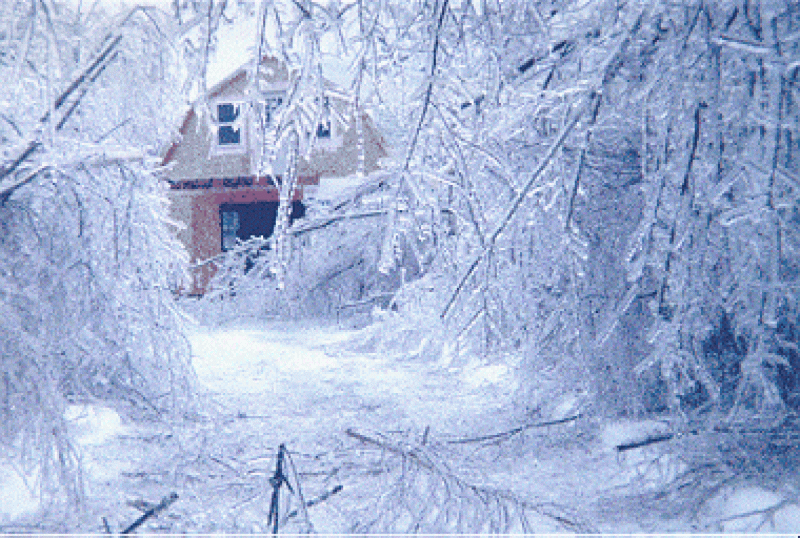
In January of 1998, what came to be called the North American Ice Storm of 1998 occurred. It knocked out power for days in cities and weeks in remote areas, impacting up to 4 million people. It was so worrisome that the government, concerned about panic among peaceful Canadians, deployed nearly 25 percent of its armed forces to keep peace in Quebec.

Did it change the DNA signature of unborn babies? Scholars from the Douglas Mental Health University Institute and McGill University say they have detected a distinctive ‘signature’ in the DNA of children born in the aftermath of the massive Quebec ice storm. Five months after the event, researchers recruited women who had been pregnant during the disaster and assessed their degrees of hardship and distress in a study called Project Ice Storm. 

Thirteen years later, the researchers found that DNA within the T cells – a type of immune system cell – of 36 children showed distinctive patterns in DNA methylation.

The researchers concluded for the first time that maternal hardship predicted the degree of methylation of DNA in the T cells. The “epigenetic” signature plays a role in the way the genes express themselves. This study is the first to find both that and that the objective stress exposure (such as days without electricity) and not the degree of emotional distress in pregnant women  causes long lasting changes in the epigenome of their babies.

Read full original article: Epigenetics Of Being Without Electricity For A Few Days


{{ reviewsTotal }}{{ options.labels.singularReviewCountLabel }}
{{ reviewsTotal }}{{ options.labels.pluralReviewCountLabel }}
{{ options.labels.noReviewsLabel }}
{{ options.labels.newReviewButton }}
{{ userData.canReview.message }}

Related Articles

Infographic: Global regulatory and health research agencies on whether glyphosate causes cancer

Infographic: Global regulatory and health research agencies on whether glyphosate causes cancer

Does glyphosate—the world's most heavily-used herbicide—pose serious harm to humans? Is it carcinogenic? Those issues are of both legal and ...

Most Popular

organic scaled
Facts & Fallacies podcast: Organic food cuts pesticide exposure? A response to Dr. Rhonda Patrick
ChatGPT-Image-Mar-10-2026-01_39_01-PM
Viewpoint—“Miracle molecule” debunked: Why acemannan supplements don’t work
kratom
Viewpoint: Kratom ‘supplement’ crisis: DEA sits on its hands while patient addictions to this ineffective drug  rise
Screenshot 2026-07-22 at 10.25
Science brain drain escalates as Trump purge extends to USDA
using genetics to reverse aging
Is the longevity obsession a new form of ageism?
Screenshot-2026-07-01-at-2.49.48-PM
Dr. TikTok and male fertility: Viral claims tout GLP-1 drugs as fertility boosters. What does the science say?
close up arabica coffee farmer s hands picking beans plant his farm colombia
Viewpoint: Why do so many ‘mainstream’ and ‘respected’ media outlets exaggerate climate change threats?
Blood blockage
High cholesterol? FDA approves effective oral medication
ChatGPT-Image-Jul-6-2026-02_25_26-PM
40 million Americans take glucosamine. If you have memory loss, it could accelerate cognitive decline.
a-mature-farmer-working-in-the-field-at-sunrise-harvesting-crops-generated-by-ai-photo
What’s the prospect of developing gene-altered crops that are more nutritious and resist climate disruption
ChatGPT-Image-Jul-22-2026-09_13_07-AM
Viewpoint—The Strategic Litigation boom: Understanding the tightening coalition among NGOs, foundations, journalists, and tort lawyers
ChatGPT-Image-Jun-25-2026-02_53_56-PM
Embryo gene editing is on the horizon, stirring mixed emotions
Screenshot-2026-07-07-at-12.55.44-PM
Viewpoint: Yes, we can adapt to a changing climate without devastating the environment and the economy
glp menu logo outlined

Get news on human & agricultural genetics and biotechnology delivered to your inbox.