Humans and dolphins: Same big brains, separate evolutionary paths

screenshot at  pm

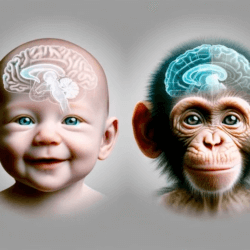
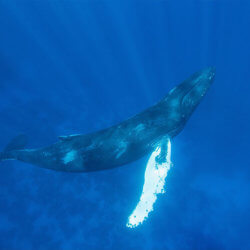
Until our upstart genus surpassed them, dolphins were probably the largest brained, and presumably the most intelligent, creatures on the planet. Pound for pound, relative to body size, their brains are still among the largest in the animal kingdom—and larger than those of chimpanzees. The last common ancestor of humans and chimps lived some six million years ago. By comparison cetaceans such as dolphins split off from the rest of the mammal lineage about 55 million years ago, and they and primates haven’t shared an ancestor for 95 million years.

This means that primates and cetaceans have been on two different evolutionary trajectories for a very long time, and the result is not only two different body types but also two different kinds of brains. Primates, for example, have large frontal lobes, which are responsible for executive decision-making and planning. Dolphins don’t have much in the way of frontal lobes, but they still have an impressive flair for solving problems and, apparently, a capacity to plan for the future. Dolphins also have an extremely well developed and defined paralimbic system for processing emotions. One hypothesis is that it may be essential to the intimate social and emotional bonds that exist within dolphin communities.

“A dolphin alone is not really a dolphin,” says Lori Marino, a biopsychologist and executive director of the Kimmela Center for Animal Advocacy. “Being a dolphin means being embedded in a complex social network. Even more so than with humans.”
The GLP aggregated and excerpted this blog/article to reflect the diversity of news, opinion and analysis. Read full, original post: It’s Time for a Conversation

Related Articles

Infographic: Global regulatory and health research agencies on whether glyphosate causes cancer

Infographic: Global regulatory and health research agencies on whether glyphosate causes cancer

Does glyphosate—the world's most heavily-used herbicide—pose serious harm to humans? Is it carcinogenic? Those issues are of both legal and ...

Most Popular

ChatGPT-Image-Sep-17-2026-12_28_43-PM
Vitamin D, omega-3 fish oil and glucosamine supplements could cause brain damage 
ChatGPT-Image-Mar-10-2026-01_39_01-PM
Viewpoint—“Miracle molecule” debunked: Why acemannan supplements don’t work
ChatGPT-Image-Sep-17-2026-10_17_15-AM
Viewpoint: Why are the less intelligent more likely to be conservative—and smarter people more socially liberal?
Screenshot-2026-09-10-at-12.20.19-PM
'Jet fuel didn't melt the steel': 9/11 conspiracy theories debunked
Screenshot-2026-09-16-at-12.07.47-PM
The heated debate over trans athletes in the WNBA
Screenshot-2026-09-10-at-11.50.46-AM
Did COVID vaccines kill 2,500 service members? RFK Jr. hires an investigator who compares vaccine promoters to Nazi doctors
Screenshot-2026-09-17-at-10.24.54-AM
Viewpoint: Dubious environmental fears: Why the AI buildout is critical to America’s ecological future
ChatGPT-Image-Sep-9-2026-02_48_24-PM
Viewpoint: Trump-RFK Jr. report on “Gender Ideology & Left-wing Ideology’ targets LGBTQ community—and science
Screenshot 2026-07-29 at 10.40
The COVID vaccine turbo cancer scare is back. Science still proves it’s wrong.
Screenshot-2026-08-12-at-11.31.46-AM
AI is helping develop new vaccines
glp menu logo outlined

Get news on human & agricultural genetics and biotechnology delivered to your inbox.