


Ancestry & Evolution
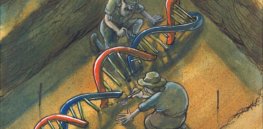
How germs and ancient migrations help explain our world of ‘haves’ and ‘have nots’
The Gökhem graves provide hard evidence for the ancient community's demise: genetic traces of the plague bacterium, Yersinia pestis ...
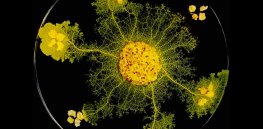
Evolution is not linear: Here’s why Darwin believed there are no ‘higher’ or ‘lower’ creatures
Why is our species almost universally seen as the logical endpoint of evolution, with all other species serving as inferior ...
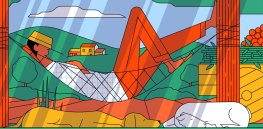
Siesta science: Sleepy during the heat of summer? Evolution may be the cause
On the hottest summer days, you may find yourself dozing off in the middle of the day. In some parts ...

Book review: ‘In Quest of the Historical Adam’ reviews tension between science and biblical accounts
In Quest of the Historical Adam is one of several books published in recent years that attempts to grapple with ...
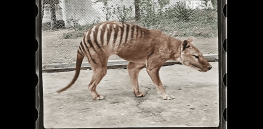
Does de-extinction fervor distract from saving endangered species?
Since the 1990s, the endless searches for the marsupial in the wilds of Tasmania and Victoria have run alongside another ...
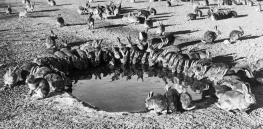
Australia’s rabbit invasion: DNA analysis reveals how the European rabbit ‘colonized’ a continent
COVID and monkeypox seem to have come out of nowhere and exploded across continents. But the phenomenon of natural selection ...

South African tribes recover ancient heritage using DNA and genetic analysis
Scientists believe Africa is where modern humans first emerged. For the past decade, our team of genetic researchers from the Henn Lab have worked among the ...
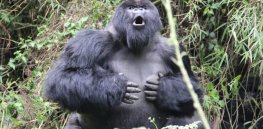
’Ahem’? Captive gorillas created a sound specifically to get humans’ attention
In a fascinating discovery, western lowland gorillas (Gorilla gorilla gorilla) at Zoo Atlanta have been caught summoning their keepers using ...

Does the culture we grow up in influence the way we walk?
A child's manner of walking can tell a doctor a lot about their health and development. But the transition from ...

Whales reproduce into their 90s and elephants into their 60s. Why do humans hit menopause so much younger?
There is no reason to suppose that age and reproduction are necessarily incompatible. Female African elephants breed into their 60s, ...

‘Cognitive evolution’: How our brains learned to quickly adapt to jarring new environments
I am positive that every person reading this is fundamentally different from when the pandemic started. Because that's how our ...
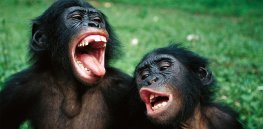
Why do humans speak while apes do not? An evolutionary explanation
Scientists have identified evolutionary modifications in the voice box distinguishing people from other primates that may underpin a capability indispensable ...

Human brain shrank 3,000 years ago? Long accepted theory challenged by University of Nevada anthropology team
Did the 12th century B.C.E. — a time when humans were forging great empires and developing new forms of written ...

Mars may once have housed life. Did it come from Earth?
In all the Universe, only Earth is known to be inhabited. But even among the Milky Way, billions of other ...
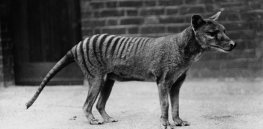
Tasmanian tiger: Scientists hope to revive this marsupial from extinction
Scientists in Australia and the US have launched an ambitious multimillion-dollar project to bring back the thylacine, a marsupial that ...

Germs implicated in fall of great ancient civilizations, bone analysis shows
Thousands of years ago, across the Eastern Mediterranean, multiple Bronze Age civilizations took a distinct turn for the worse at ...

Lactose tolerance: Early humans couldn’t easily process milk and cheese. How, why and when did that change?
Just 5,000 years ago, even though it was a part of their diet, virtually no adult humans could properly digest ...

Categorizing people based on physical traits like hair texture feeds racial stereotypes. Genetics challenges that prejudice
In an undergraduate biological anthropology class in 2011, Tina Lasisi heard a lesson about human skin tones that would change the course ...

Could alien life survive harsh environments? Green slime dug up in lava caves offers an intriguing theory
Deep within the lava caves of Hawaii, microbial life thrives. In fact, a recent study has found that the life ...

Are there evolutionary benefits to celibacy?
Evolution is often perceived as an individual affair: Traits that are helpful to the individual get passed on and eventually ...

Why do we yawn? Here are several theories on the evolution of this sleepy signal
Obviously, people and other animals yawn when they are tired; we all know that. But there must be more to ...
What the latest highly-contagious omicron variant signals about COVID evolution in the months and years ahead
What is driving the evolution of omicron sublineages? The answer to that is a well-known process called natural selection ...

Could celibacy have an evolutionary advantage?
Many religious institutions around the world require celibacy. The practice has led anthropologists to wonder how celibacy could have evolved ...

Differences between human and Neanderthal brains are minimal — so why are we so much smarter?
Our closest human relatives are Neanderthals (split from modern humans at least 500,000 years ago) and their Asian relatives the ...

Discovering ‘ghost footprints’: Did humans come to North America tens of thousands of years earlier than we thought?
Recent discoveries of mammoth bones and “ghost” footprints left behind by ancient peoples are adding fuel to a scientific debate ...
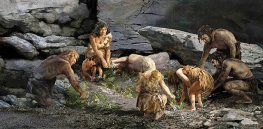
Humans arrived in Europe significantly earlier than previously estimated
Perched about 325 feet (100 meters) up the slopes of the Prealps in southern France, a humble rock shelter looks ...

Did the prevalence of gonorrhea in early humans lead to long-living and protective grandmothers?
The arms race between the human immune system and gonorrhea might have had the useful side effect of promoting healthy ...
