


Ancestry & Evolution

Podcast: Humans may not be the evolutionary peak of consciousness. Here’s why
Researchers are endlessly fascinated by questions of consciousness. Ogi Ogas was a Department of Homeland Security fellow at the Department ...

Laughing our way through the tree of life: How dopamine may have shaped early human evolution
Most historians are interested to understand the most important factor when it comes to human evolution. As debated in many ...

Podcast: BMI useless? Lab-grown meat a ‘pipe dream;’ Did early humans eat each other?
Using body mass index (BMI) to assess a patient's health may yield misleading results and undermine public trust in medicine, ...
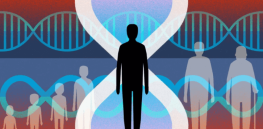
Nature, nurture and old age: How much is the human lifespan driven by our genes?
The research used our old friend, the UK Biobank, a repository of genetic information on a large number of Brits, ...

How climate chaos shaped human evolution
We owe much of our understanding of the human family tree to decades of fossil finds in East Africa. But ...

Viewpoint: Evidence does not support ‘plant good, animal bad’ mantra. Humans are hard-wired to eat meat
While some question whether humans are supposed to eat meat, a University of Melbourne professor in food science and human ...
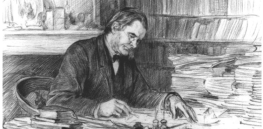
An Intimate History of Evolution: Inside the influential Huxley family’s research into natural selection
Few concepts have had as important — and vexed — a role in the relationship between science and society as ...
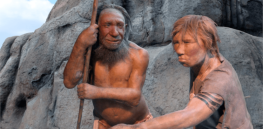
Who surivived in England after the last ice age? DNA analysis reveals two distinct groups
Scientists have sequenced the oldest human DNA discovered in Britain and discovered two unique population groups that lived in Britain ...
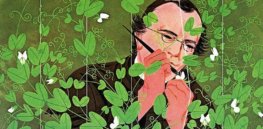
Adapting plants to our needs: From rudimentary hand pollination by ancient farmers to CRISPR, humans have always been genetically modifying crops
People have been taking plants from the wild and growing/cultivating them to both meet their needs and their pleasures for ...
Is human intelligence an evolutionary dead end?
The German Philosopher Friedrich Wilhelm Nietzsche was, by all accounts, a miserable human being. He famously sought meaning through suffering, ...

Podcast: Evolution of hair texture — Did curls help early humans survive?
In the latest episode of the Tracking Traits podcast, postdoctoral researcher Tina Lasisi relayed her aims as a scientist working ...
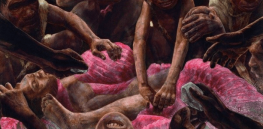
Ancient homo sapiens diets included grains, veggies… and other people? Cannibalism was the norm in early human societies
Our Paleolithic ancestors ate each other. We (Homo sapiens) did it. Neanderthals did it. Homo erectus and Homo antecessor did ...

Treatment-resistant triple-negative breast cancer disproportionately affects Black women. African genetic ancestry may explain why
Researchers in the US have found a genetic link between people with African ancestry and an aggressive type of breast ...

‘Children of Omicron’: What public health threats lie ahead as COVID evolves?
Throughout the pandemic, the virus that causes COVID-19 has been evolving fast, blindsiding the world with one variant after another ...

Viewpoint: Challenging perceptions — The 21st century so far is the most peaceful time in human history
It is a common perception that we are living in the most unstable and disturbing circumstances amidst inequality, class differences, ...
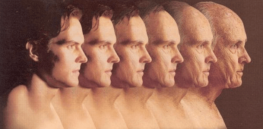
Biological tipping point: At a certain point in life, environmental factors and age are more important to disease risk than DNA
In 1952, Nobel-prize winner Dr. Peter Medawar put forward the hypothesis that aging processes may be a result of evolution’s ...
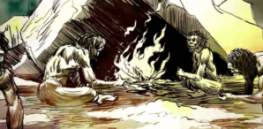
The increasingly bushy human family tree and five other paradigm-altering changes in our understanding of human evolution
From archaeological reconstructions of Neanderthals as stooped, hairy and brutish, to “cavemen” movies, our ancient ancestors got a bad press ...
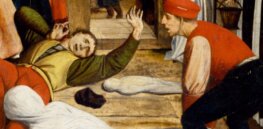
Autoimmune disorders: Here’s how the Black Death altered evolution and left permanent scars on survivors’ descendants
When the Black Death swept through northern Africa and Eurasia in the mid-fourteenth century, it killed up to half of ...

‘So much more than cave-dwelling thugs with clubs’: Neanderthal DNA gives us a look into ancient family life
One of the things that makes us special as a species is our ability to form communities, but we humans ...

Allergy epidemic: Up to 10% of children have food intolerances. Where did they come from?
Food allergies are becoming increasingly common, in children and in adults. Yet it’s surprisingly difficult to get a handle on ...
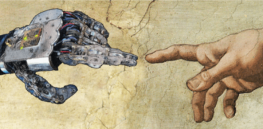
Here is when and how humans attained ‘behavioral modernity’
For 200,000-300,000 years after Homo sapiens first appeared, tools and artefacts remained surprisingly simple, little better than Neanderthal technology, and simpler than ...

New method that could help spot alien life: Tracking oxygen levels across the universe
Are we alone in the universe? This is a question that has intrigued humans for centuries and inspired countless studies ...
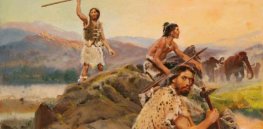
‘Apex predators’: For 2.5 million years, early humans stood atop the food chain, eating mostly meat
Paleolithic cuisine was anything but lean and green, according to a study on the diets of our Pleistocene ancestors. For ...

Ancestry vulnerability: Inherited metabolic differences key to understanding disease patterns
Our ancestry can be detected not only in our genes, but also in our metabolism, a new Yale-led study has ...
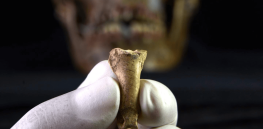
Ancient exchange of ideas: Modern humans and Neanderthals shared designs for jewelry and stone tools
Modern humans lived alongside Neanderthals for more than 1,000 years in Europe, according to research that suggests the two species may have ...
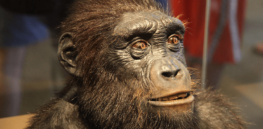
Why did humans evolve bigger brains than our hominid cousins?
Changes in the size and organization of the brain distinguish the emergence of modern humans, but we know little about ...
Diversity, inclusion and the Human Pangenome Project: Why capturing human genome diversity in our 4-letter language is such a big deal
“Pan” has several meanings. As a noun, it refers to “a round metal container that often has a long handle ...
