


Science Literacy Project Daily Digest

Can we recode the human genome to resist viruses?
[T]wo years in, an ambitious project to synthesize genomes — including human ones — is moving on from its shaky ...

Identification of 10,000 new rice genes could speed up crop breeding
A new study published in the Nature journal opens the possibility to accelerate rice breeding to achieve food security for some of ...

Ohio governor candidate Dennis Kucinich got $120,000 from anti-GMO group
Democratic gubernatorial candidate Dennis Kucinich received $122,000 in consulting fees in 2016 from a group that works for food sustainability ...

CRISPR patent dispute is back in court. What should we expect?
It’s baaaaack, that reputation-shredding, stock-moving fight to the death over key CRISPR patents. On [April 30] in Washington, D.C., the ...

Golf legend Jack Nicklaus tries experimental stem cell therapy for ‘debilitating’ back pain
For much of his professional golf career [Jack] Nicklaus has had aggravating back pain that he describes as an eight ...

Indian university’s insect-resistant GMO Bt cotton ready for field trials
A Bt cotton variety developed by the Punjab Agricultural University (PAU) is ready for trials. It took the university ten ...

Genetic engineering has ‘enormous potential’ to solve environmental problems in Africa, scientists say
[S]cientists and government officials, in a series of exclusive interviews with the Alliance for Science, opined that biotechnology is one ...

44 genetic variants linked to depression — and we may all carry some of them
Depression is a tricky beast. Symptoms vary widely from person to person, as does the response to treatment. But there’s no ...

Viewpoint: Why is the Guardian publishing anti-GMO activist Carey Gillam’s glyphosate lies?
Carey Gillam is an anti-GMO activist who once wrote for Reuters, but no longer does. An e-mail obtained from a FOIA ...

Ancient DNA suggests South Asians descended from 3 Eurasian groups—hunter-gatherers, farmers, herders
[A] study of the first ancient DNA recovered from South Asia shows that populations there mingled repeatedly thousands of years ...

Royal quest: Chinese DNA tests driven by desire to find evidence of imperial descent
Li Jiewen’s family might seem pretty ordinary, but according to a long-held family belief, they’re descended from royalty. … Last ...

Can governments, public keep up with gene-editing revolution in agriculture?
A mushroom that doesn't brown. White flour with as much fiber as whole-wheat flour. Corn that can fend off northern ...

‘Anti-vaxxers’ are starting to focus on pets—even though they can’t get autism
Dogs cannot get ‘autism’, the British Veterinary Association has warned, after the ‘anti-vaccine’ movement spread to pets. 'Anti-vaxxers' believe that ...

Adolf Hitler’s grandson? French plumber hopes DNA test proves his claim
A French plumber is taking a DNA to prove he is Adolf Hitler's grandson after his grandmother had a fling with ...

The ambitious effort to sequence the DNA of earth’s 1.5 million animals, plants and fungi
In what will undoubtedly be the largest genomic sequencing effort of all time, an international consortium of researchers is organizing ...

How CRISPR gene editing could unlock resistance to destructive citrus greening disease
Researchers at the University of California, Riverside have made an important step in understanding the molecular mechanism of huanglongbing (HLB), ...

Viewpoint: It’s time to stop ‘connecting race to intelligence’
The race-and-IQ debate is back. The latest round started a few weeks ago when Harvard geneticist David Reich wrote a ...

Viewpoint: David Suzuki’s views on GMOs ‘well outside the scientific mainstream’
Mr. Suzuki is known by most as a twinkly-eyed old sage with a harmless message about living in tune with ...

Genetics may explain why elite divers of Southeast Asia can hold their breath so long
When a human is submerged in water, within seconds the body begins to reflexively adjust. The heart rate slows; blood ...

What’s behind public’s fear of glyphosate?
As cases in federal court and several state courts delve into whether there is evidence that glyphosate causes cancer, a ...
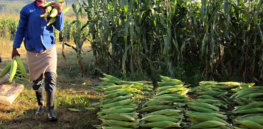
Developing countries slowly embrace GMO crops to fight food insecurity, climate change
Developing countries are slowly increasing approved legislation and opening the door to research and commercialization of GMO crops. As these countries ...

Boosting production of key malaria drug with genetically engineered plant
Scientists have modified a plant's genetic sequence to make it produce high levels of a key malaria drug, potentially helping ...

Viewpoint: Brazil GMO label shows need to balance transparency and science
Since 2003, Brazilian law has required all consumer products containing genetically modified material to carry a scary-looking label that depicts ...

How does the science of Rachel Carson’s ‘Silent Spring’ stand up more than 50 years later?
Carson’s detractors accuse her of misrepresenting the science. Wrong: Carson wrote that pesticides and herbicides disorder ecosystems because they kill ...

How artificial intelligence could push us closer to nuclear war
As AI slowly erodes the foundations that made the Cold War possible, we may find ourselves hurtling towards all-out nuclear ...

Defining ‘normal’ in an era of precision medicine is challenging
The definition of “normal” values for common laboratory tests often governs the diagnosis, treatment, and overall management of tested individuals ...

Geneticist Alison Van Eenennaam: ‘I’m not going to let the fearmongers dominate the conversation’ on CRISPR gene-edited food
Animal geneticist Alison Van Eenennaam has six calves that are rather unusual. Most people might not pick up on what’s ...
