Twenty-year review: GM crops are safe

gm crops
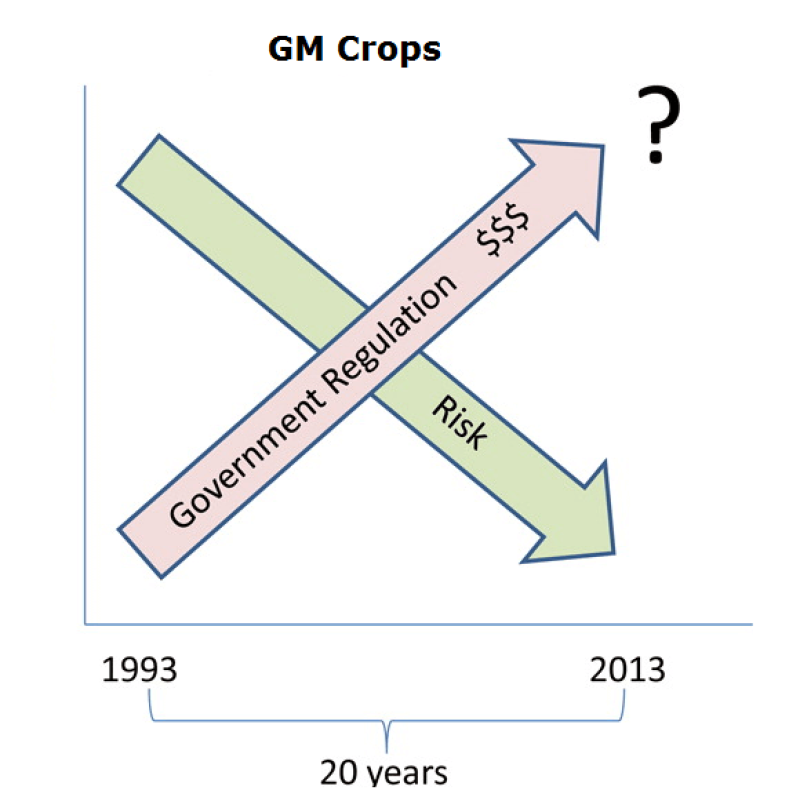
Adapted from Fig 1 in paper. See link below.

A comprehensive review of the last 20 years of peer-reviewed research on the compositional equivalency of transgenic crops — that is, the relative safety of food from genetically modified (GM) crops to their unmodified equivalents — has found that not only are transgenic crops no less safe than their traditional counterparts, but that the creation of transgenic crops is “less disruptive of composition compared with traditional breeding.”

This meta-study was conducted by a former USDA official, William D. Price, and Dow Chemical scientist Rod A. Herman. It was published on February 15, 2013 in The Journal of Agricultural and Food Chemistry.

Over the past 20 years, the U.S. FDA found that every one of the 148 transgenic events that they evaluated to be substantially equivalent to their conventional counterparts, as have the Japanese regulators studying 189 examples, including foods with combined-traits. These studies spanned a broad range of crops, including corn, soybean, cotton, canola, wheat, potato, alfalfa, rice, papaya, tomato, cabbage, pepper, raspberry, and a mushroom, and traits of herbicide tolerance, insect resistance, virus resistance, drought tolerance, cold tolerance, nutrient enhancement, and expression of protease inhibitors. “Hence,” the authors write, “compositional equivalence studies uniquely required for GM crops may no longer be justified on the basis of scientific uncertainty.” In other words: no special studies are required of GM crops on the basis of scientific uncertainty; unintended health consequences have failed to manifest in GM crops.

You can view the original paper here: “Unintended Compositional Changes in Genetically Modified (GM) Crops: 20 Years of Research,” Journal of Agricultural and Food Chemistry


{{ reviewsTotal }}{{ options.labels.singularReviewCountLabel }}
{{ reviewsTotal }}{{ options.labels.pluralReviewCountLabel }}
{{ options.labels.newReviewButton }}
{{ userData.canReview.message }}

Related Articles

Infographic: Global regulatory and health research agencies on whether glyphosate causes cancer

Infographic: Global regulatory and health research agencies on whether glyphosate causes cancer

Does glyphosate—the world's most heavily-used herbicide—pose serious harm to humans? Is it carcinogenic? Those issues are of both legal and ...

Most Popular

Screenshot-2026-03-13-at-12.14.04-PM
The FDA wants to make many popular prescription drugs OTC—a great idea. Here’s why it’s unlikely to happen
Screenshot 2026-05-06 at 2.56
Singularity crisis ahead? Can super babies save us from rogue AI geniuses?
Screenshot-2026-05-04-at-12.54.32-PM
How Utah became the country’s supplement capital  — and a haven for unregulated, ineffective and fake products
Screenshot-2026-04-20-at-2.26.27-PM
Viewpoint — Food-fear world: The latest activist scientists campaign: Cancer-causing additives
Screenshot-PM-24
Viewpoint: The herbicide glyphosate isn’t perfect. Banning it would be far worse.
images
The never-ending GMO debate: Pros and cons
Screenshot-2026-05-01-at-11.56.24-AM
‘Science moves forward when people are willing to think differently’: Memories of DNA maverick Craig Venter
Screenshot-2026-04-03-at-11.15.51-AM
Paraben panic: How a flawed study, media hype, and chemophobia convinced the public of the danger of one of the safest classes of preservatives
Screenshot-2026-04-30-at-2.19.37-PM
5 myths about summer dehydration that could damage your health — or even kill you
79d03212-2508-45d0-b427-8e9743ff6432
Viewpoint: The Casey Means hustle—Wellness woo opportunism dressed up as medical wisdom
ChatGPT-Image-May-1-2026-02_20_13-PM
How RFK, Jr.’s false vaccine claims are holding up $600 million to fight diseases in poor countries
glp menu logo outlined

Get news on human & agricultural genetics and biotechnology delivered to your inbox.