Can science self-correct, in effect protect against sloppy or politicized research? Scientists can try—but the success of those efforts depends in large measure upon the integrity of journalists and advocates to address their own reporting mistakes.
But as GLP executive director Jon Entine reports in Forbes, the Union of Concerned Scientists, Consumers Union and prominent anti-GMO journalists are discouragingly but predictably silent after multiple science publications severely challenged an alarmist RNA study they had hyped.
A great illustration of the challenge of controlling ‘metastasizing misinformation’ has emerged with the publication of a fascinating and important article in Nature Biotechnology that sharply challenges the credibility a study that had made controversial claims that dramatically raised the fear factor about GMOs. The controversy began when a Chinese research team led by Chen-Yu Zhang reported in Cell Research in 2011 that microRNAs from rice and other commonly eaten plants altered animal’s physiology in ways that could be harmful. The small pieces of RNA showed up in the bloodstream of both mice and humans, and in mice livers. The Nanjing University-based team concluded that this genetic material could bind to receptors in human liver cells and block the blood’s natural ability to remove LDL or “bad” cholesterol.
As biology PhD student Anne-Marie C. Hodge wrote in her Scientific American blog, “the revelation that plant microRNAs play a role in controlling human physiology highlights the fact that our bodies are highly integrated ecosystems.” To some degree, she suggested, ‘we are what we eat.’



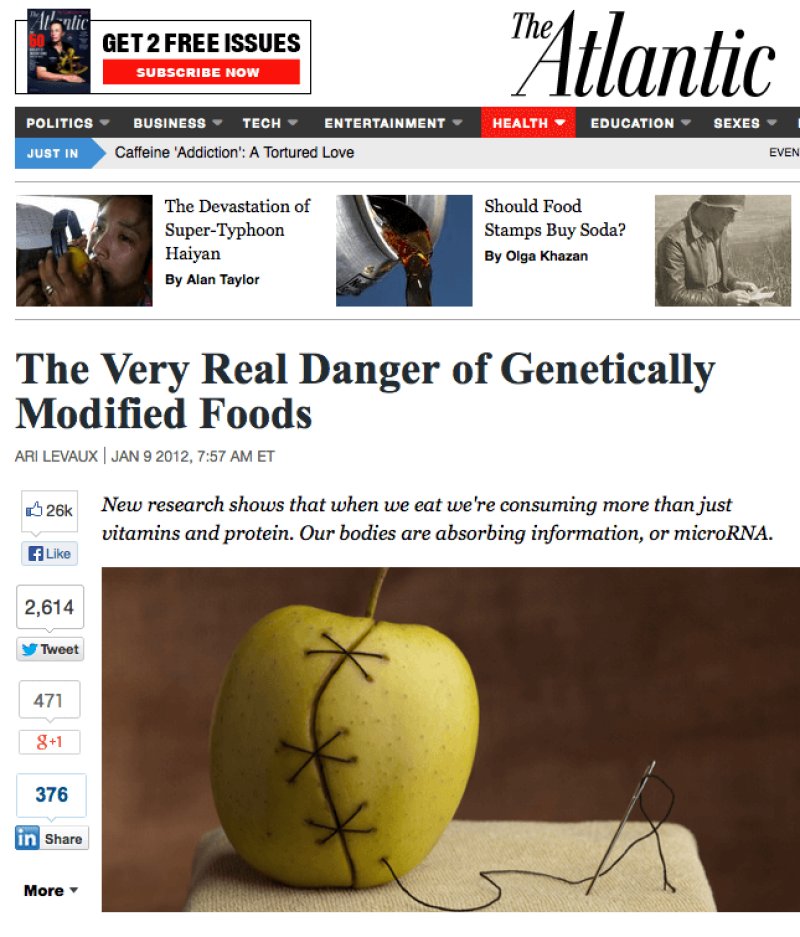
But right from the start, prominent scientists and journalists found raised questions and pointed out potential flaws in the research—at the very same time The Atlantic, Grist and other publications heralded these findings as confirmation of their favorite thesis, that GMOs were potentially dangerous to humans. The science ultimately self-corrected and both the study and the alleged dangers have been rebuked. But the longtime damage to genetic literacy has been done.
GLP’s Jon Entine provides the backstory in Forbes in an intriguing look at how the anti-GMO industry and sycophant journalists work—and the consequences of flogging single studies to score ideological points.