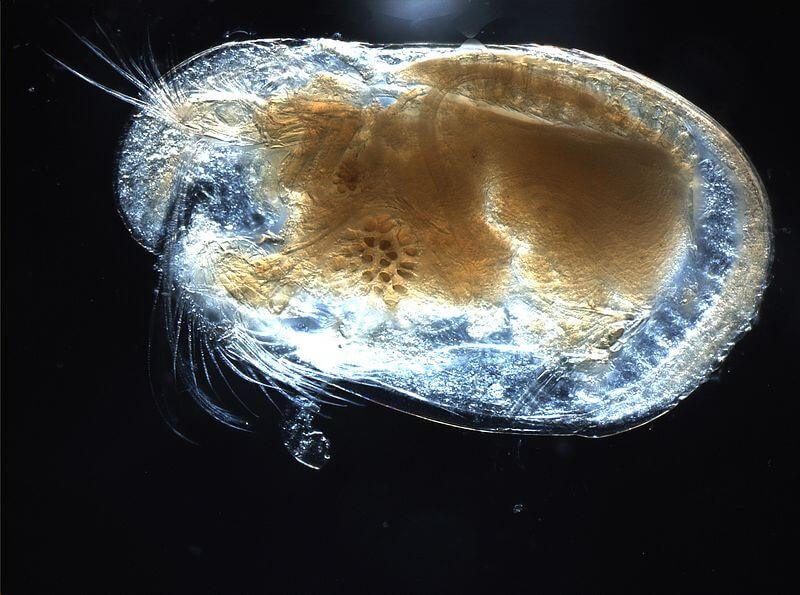
The world’s oldest fossilized sperm has been discovered, and it’s longer than the animal that made it. The 17 million-year-old sperm was found preserved with uncanny perfection in the body cavity of one male and four female ostracods inside of a bat-riddled cave in Queensland, Australia.
Ostracods are small crustaceans known as seed shrimp for their round shape and hard outer shells. They are, according to the University of California Museum of Paleontology, “little more than a head.” Yet concealed beneath their superficial simplicity lies a secret: proportionately gigantic sperm cells. Their sperm cells can be up to a centimeter long (that’s about the width of your fingernail), are shaped like noodles, and lack the tadpole-tail we associate with the popular image of sperm cells.
Other groups of animals have giant sperm (the familiar fruit fly, Drosophila melanogaster, is one), but the ostracods are the only ones that have this particular giant, noodle-like sperm. Their mere existence raises evolutionary questions: why would any species put so much energy into such an unusual sex cell? (Imagine if you were a seed shrimp, balancing the need to reproduce with the need to eat and avoid being eaten: it’s not a small investment to produce sex cell longer than yourself.)
Scientists still don’t know, but the fact that these gigantic sperm existed, virtually the same, 17 million years ago strongly implies that there is some reason the ostracods kept their bizarre reproductive traits.
The Washington Post spoke to paleontologist Michael Archer, one of the researchers who discovered these fossilized shrimp, about the mating habits of his subjects:
“The sperm was clearly wound up in knots within this weird ‘zenker’ organ [i.e. ‘sperm cannon‘], balled up like a ball of string, then literally shot at and into a female and the female catches it. It’s like they were playing catch,” Archer said.
And, as noted previously, the sperm was discovered in one male and four females. Which means that fossilization happened in a flash within moments of a game of “catch” between these tiny crustaceans. (For added salaciousness, one of the females was of a different species of ostracod.)




The scientists were as shocked by their discovery as you and I are, though to them it was the 17 million-year preservation of these tiny crustaceans and their sex cells that was the main point of surprise. The discovery not only deepens the mystery of why ostracods have such outsized sperm, but raises questions about what other tiny surprises might be hiding in the fossils.
Kenrick Vezina is Gene-ius Editor for the Genetic Literacy Project and a freelance science writer, educator, and naturalist based in the Greater Boston area.
Sources:
- “Subcellular preservation in giant ostracod sperm from an early Miocene cave deposit in Australia,” Proceedings of the Royal Society B
- “World’s oldest sperm discovered. And it’s gigantic.” Terrence McCoy | Washington Post
- “Scientists discover world’s first fossilized sperm, and they’re humongous (+video),” Fabien Tepper | Christian Science Monitor
Additional Resources:
- “Sperm are Cool #3: Giant sperm and the Zenker organ,” Molecular Love (and other facts of life)
- “Friday Weird Science: GIANT SPERM need a giant sperm cannon,” scicurious | Neurotic Physiology
- “Are RNA fragments making gene tweaks in descendants?” Andy Coghlan | New Scientist