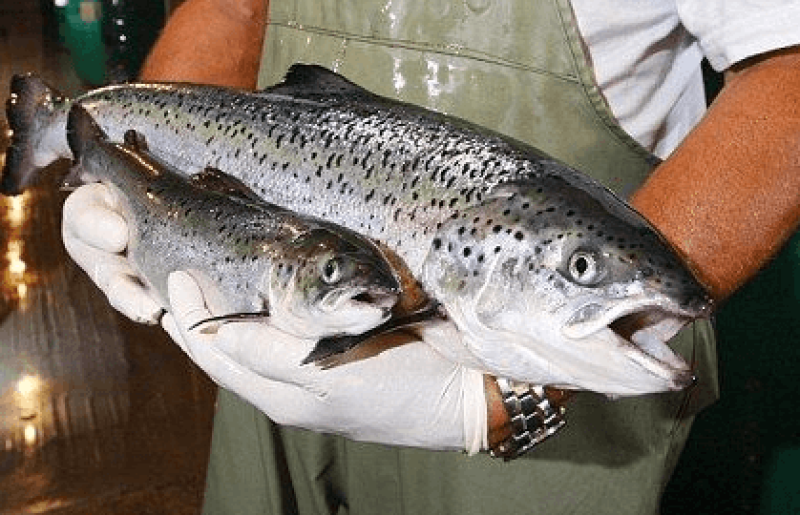
Those already afraid of genetically engineered crops are even more so of genetically engineered fish. In a recent article for Toronto Star, Michele Henry is the first Canadian journalist to get a rare, no-holds-barred tour of AquaBounty Technologies’ fast-growing genetically engineered salmon fish hatchery. She describes her experience:
Drive too fast and you’ll miss the fish prison. Ron Stotish coasts right past the unassuming beige building perched along the banks of a quiet bay about an hour outside Charlottetown. He reverses his rental car, veers through AquaBounty Technologies’ gates and into a parking spot. He steps outside. The snow’s glare on this sunny winter day makes his white moustache gleam even whiter. “This is an aquatic Fort Knox,” he says. “Nothing’s getting out of here.”
Stotish, the publicity-wary CEO of this small, Massachusetts-based company is about to give a rare no-holds-barred tour — the first to a Canadian journalist — of the fish hatchery where he keeps one of the world’s most controversial creatures: a transgenic salmon that is destined, he hopes, for the dinner plate.
About 25 years ago, Canadian scientists made a tiny modification to the DNA of its ancestor in a Newfoundland laboratory, turning a regular fish into generations of fast-growing super salmon. Call it AquaBounty AquAdvantage Salmon or call it “Frankenfish” — if it’s approved by the U.S. government, this creature will become the first genetically modified animal to be used for human consumption. Cue the hysteria.
AquaBounty salmon has met fierce criticism and opposition from anti-GMO activists despite its well-intentioned beginnings as a response to overfishing of Atlantic salmon. The salmon passed every regulatory review hurdle in the US, but as the GLP’s Jon Entine reported in Slate in December 2012, final approval was held up by the White House for political reasons.
Henry reports:
Garth Fletcher, an energetic Scottish transplant and physiologist, is the scientist who got the ball rolling on AquaBounty’s transgenic salmon — a long journey of serendipity and experimentation that began in 1982. Back then, overfishing had landed the wild Atlantic salmon, native to the Bay of Fundy and south coast Newfoundland, on the extinction list. The salmon-hungry world turned to aquaculture and the great salmon race began with Norway, Scotland, Chile and Canada jockeying for dominance. Dietitians started urging North Americans to eat more of the omega-3 rich fish but Canada’s fledgling fish farmers were having trouble growing salmon. The ocean-farmed fish kept dying in chilly winter waters off the coast of New Brunswick. The Canadian government was offering a grant to researchers to solve this problem and Fletcher was intrigued.
But public fears of the ‘Frankenfish’ remain a big hurdle. Tillmann Benfey, professor of biology at the University of New Brunwick, explains why the fish should not be feared:
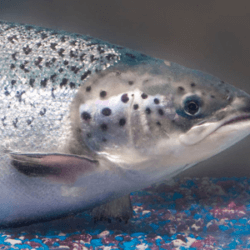
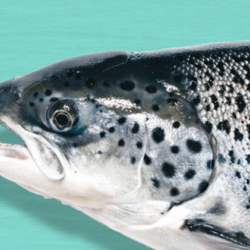



Given that faster growth and improved feed conversion efficiency are heritable traits in salmon, the gains made through the transgenic approach could likely also be achieved through traditional breeding programs. But such programs take more time, which is the beauty of the transgenic approach. There is nothing inherently dangerous in genetic engineering compared to traditional breeding programs. In fact, the two approaches ought to be viewed as complementary. Any science-based evaluation of GMOs should focus on the safety of the product rather than the process, per se. There is no reason to suspect that faster-growing AquAdvantage salmon are any more or less harmful or beneficial than faster-growing salmon produced through traditional selection programs. In fact, the two species from which genes have been transferred into AquAdvantage fish—Chinook salmon and ocean pout—are themselves recognized as edible species.
And in her reporting, Henry got a chance to taste the genetically engineered salmon.
Transgenic salmon three ways, prepared by an unnamed chef who didn’t want to be associated with the controversy, waits on the dining table: salmon flecked with sesame seeds, salmon smothered in pesto and classic smoked with a pleasingly brown, crunchy exterior. The company isn’t allowed to sell or advertise this fish, but staff and the odd visitor, can indulge from time to time. The flesh is exquisite, buttery, light, juicy — just as Atlantic salmon should be. “We’re very proud,” Stotish says.
Read the full, original article: Should we fear this fish?