Last month in Silicon Valley, biologists Jennifer Doudna and Emmanuelle Charpentier showed up in black gowns to receive the $3 million Breakthrough Prize, a glitzy award put on by Internet billionaires including Mark Zuckerberg. They’d won for developing CRISPR-Cas9, a “powerful and general technology” for editing genomes that’s been hailed as a biotechnology breakthrough.
Not dressing up that night was Feng Zhang (see 35 Innovators Under 35, 2013), a researcher in Cambridge at the MIT-Harvard Broad Institute. But earlier this year Zhang claimed his own reward. In April, he won a broad U.S. patent on CRISPR-Cas9 that could give him and his research center control over just about every important commercial use of the technology.
How did the high-profile prize for CRISPR and the patent on it end up in different hands? That’s a question now at the center of a seething debate over who invented what, and when, that involves three heavily financed startup companies, a half-dozen universities, and thousands of pages of legal documents.
“The intellectual property in this space is pretty complex, to put it nicely,” says Rodger Novak, a former pharmaceutical industry executive who is now CEO of CRISPR Therapeutics, a startup in Basel, Switzerland, that was cofounded by Charpentier. “Everyone knows there are conflicting claims.”
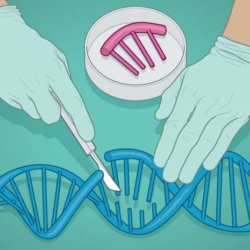
At stake are rights to an invention that may be the most important new genetic engineering technique since the beginning of the biotechnology age in the 1970s. The CRISPR system, dubbed a “search and replace function” for DNA, lets scientists easily disable genes or change their function by replacing DNA letters. During the last few months, scientists have shown that it’s possible to use CRISPR to rid mice of muscular dystrophy, cure them of a rare liver disease, make human cells immune to HIV, and genetically modify monkeys (see “Genome Surgery” and “10 Breakthrough Technologies 2014: Genome Editing”).




The control of the patents is crucial to several startups that together quickly raised more than $80 million to turn CRISPR into cures for devastating diseases. They include Editas Medicine and Intellia Therapeutics, both of Cambridge, Massachusetts. Companies expect that clinical trials could begin in as little as three years.
Read full, original article: Who Owns the Biggest Biotech Discovery of the Century?