PGD–preimplantation genetic diagnosis–dramatically increases disease prevention

Conoce el sexo del bebe
The building materials for a new life came from outer space. Woman carrying a fetus in her womb. Digital illustration.

Preventing disease is a standard goal of medicine. But a new technology takes it farther than we normally do by preventing a potential person with a genetic disease from being born at all, George Annas, a bioethicist and health lawyer at Boston University and author of “Genomic Messages,” tells Business Insider.

“It’s an extreme,” Annas says.

The technology, called preimplantation genetic diagnosis (PGD), can be used in conjunction with in-vitro fertilization to test for genetic disease and genetic predispositions, and can even determine sex — all before a woman is actually pregnant.

In vitro fertilization (IVF) is a procedure in which eggs are taken from a woman’s ovaries and fertilized with sperm in a petri dish. Then one or more fertilized embryos are placed in the woman’s uterus, where one will hopefully implant and grow into a baby.

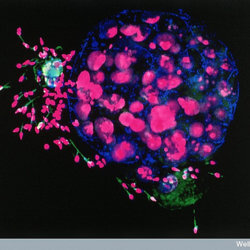
During the process of IVF, multiple embryos are created in the lab from a couple’s eggs and sperm. Before transferring any embryos to the woman’s uterus, doctors can perform PGD by taking one cell from each embryo and analyzing the DNA for disease-causing mutations.

‘An extreme’ in action

Today, if a couple affected by Huntington’s disease doesn’t want to risk passing the disease down to a child, they can try to conceive through IVF, using PGD. That special layer of genetic testing, however “extreme” it may seem, changes everything: It can all but ensure they won’t have child who suffers from the disease.

The GLP aggregated and excerpted this blog/article to reflect the diversity of news, opinion and analysis. Read full, original post: Genetic testing is taking medicine to an all new extreme

Related Articles

Infographic: Global regulatory and health research agencies on whether glyphosate causes cancer

Infographic: Global regulatory and health research agencies on whether glyphosate causes cancer

Does glyphosate—the world's most heavily-used herbicide—pose serious harm to humans? Is it carcinogenic? Those issues are of both legal and ...

Most Popular

Screenshot-2026-11-17-at-12.18.09-PM
Challenging glyphosate fear-mongering: Statewide Nebraska study finds no link between weedkiller use and non-Hodgkin lymphoma
Screenshot-2026-11-16-at-2.37.32-PM
30 years of GMO farming: Is the boom in glyphosate and glufosinate use harming the environment? Data show they’re the most sustainable choice
Soybean Harvest in Cupped Hands
30 years of GMO farming: Defying cynics, we’ve had larger harvests, lower costs, and $385 billion in added global farmer income
ChatGPT-Image-Mar-10-2026-01_39_01-PM
Viewpoint—“Miracle molecule” debunked: Why acemannan supplements don’t work
Stormlit Portrait Over Golden Mountains
Searching for life where no one thought to look: A renowned astrophysicist’s seemingly quixotic quest to explore Venus’s clouds
Wholewheat Bread and Yogurt Ingredients
Viewpoint: RFK Jr.’s reckless good intentions: Do we really want to ban whole-wheat bread and yogurt?
Screenshot-2026-11-13-at-10.02.02-AM
Viewpoint: Why it’s such a big deal that under Trump-RFK Jr., the U.S. has lost its ‘measles-free’ status  
Screenshot-2026-11-09-at-3.01.19-PM
Are Texas data centers killing calves? Debunking viral AI claims
Screenshot-2026-11-19-at-7.54.57-PM
European General Court sides with scientists, dismisses activist claims that glyphosate is toxically dangerous
Screenshot-2026-11-18-at-12.42.18-PM
Viewpoint: MAHA/MAGA/RFK Jr. kook health disinformation crackup is coming. Beware as Bhattacharya, Makary, Prasad, and Oz seek lucrative second acts
glp menu logo outlined

Get news on human & agricultural genetics and biotechnology delivered to your inbox.