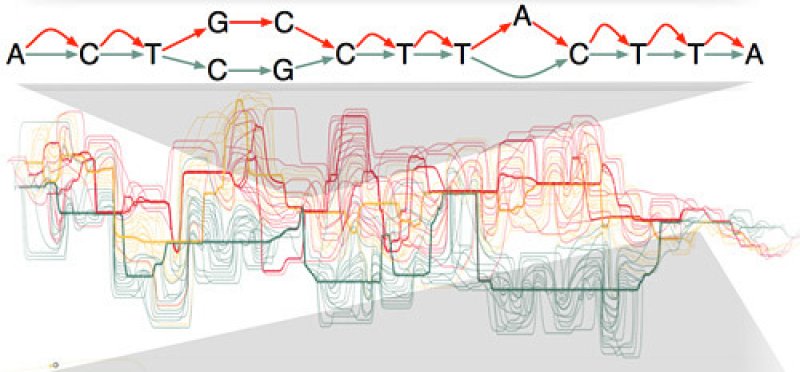

[I]t’s becoming painfully clear that the original method that scientists used to compare genomes to each other…is rapidly becoming obsolete. When scientists sequence a new genome, their reconstructions are far from perfect. And those imperfections sometimes cause geneticists to miss a mutation known to cause a disease.
[Benedict] Paten, a computational biologist at the University of California, Santa Cruz, belongs to a cadre of scientists who are building the tools to look at genomes in a new way: as a single network of DNA sequences, known as a genome graph.…
A genome graph should, in theory, be a lot smarter…If a read doesn’t match anything in one genome, it may match one of the others. And once you’ve assembled that new genome, you can add it to the graph, too.





…
“This graph-based way of thinking is fundamentally a new way of thinking about the genome,” said [the Broad Institute’s Daniel MacArthur]. “I think long-term this is likely to be the direction that the field is heading. But right now, I’m in no hurry.”
The GLP aggregated and excerpted this blog/article to reflect the diversity of news, opinion, and analysis. Read full, original post: As DNA reveals its secrets, scientists are assembling a new picture of humanity