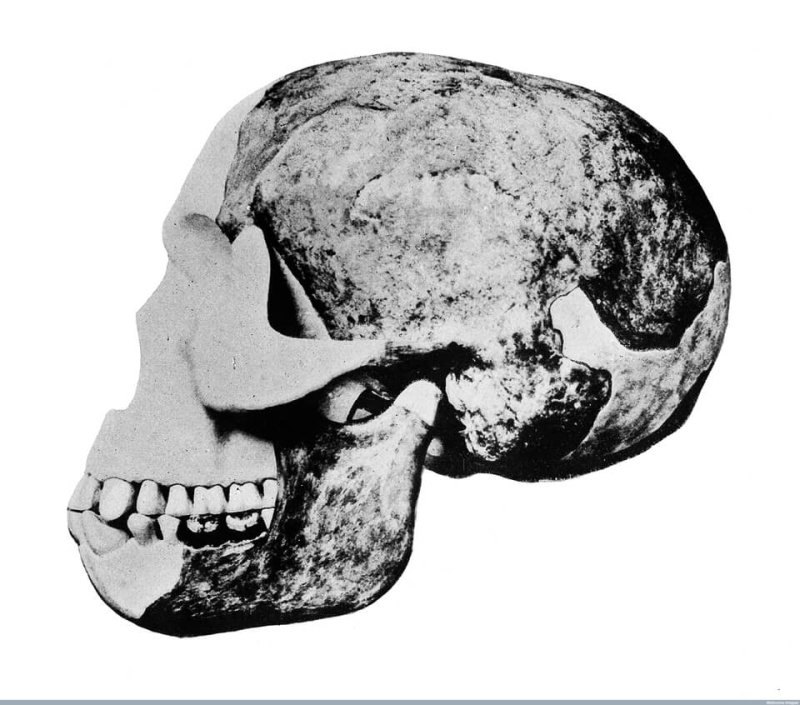
Rivalry, jealously, con artistry, practical jokes, grand scale bias, and patriotism compounded by World War I era geopolitics. we’re not talking about an episode of the PBS drama Downton Abbey, a daily soap opera or even a classic old film–this is the background story about the discovery of Piltdown Man, perhaps the most notorious hoax in the history of modern science. It was a dark event, and has been relegated to the footnotes of history books. But occasionally the story surfaces, as it did last year when DNA extracted from bones revealed new information on how the hoax was orchestrated.
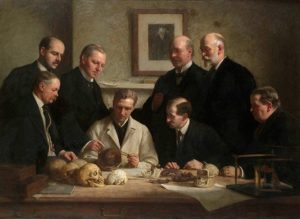
The setting was England. The key players were the scientific community itself, especially the scientists at London’s prestigious Natural History Museum. At the time, dozens of paleoanthropologists, anatomists and geologists were engaged in various research projects, but they all knew of a sure pathway to global recognition: identifying the “missing link,” the elusive, presumably extinct species representing the transition between humans and apes.
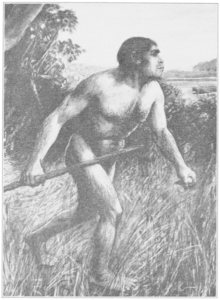
People of the time had a very specific idea of what an ancient “ape man” should look like. That pre-determined conviction left them vulnerable to the trap of confirmation bias–paying attention only to data that seem to support one’s beliefs. Today, we see the same thing happening with the
anti-GMO, anti-vaccine, and other activist movements. They cherry pick studies for nuggets of information that support their views. During the Piltdown affair, however, it was not activist fringe groups, but respected scientists who fell into the trap.
They were convinced that our human ancestors had grown large brains and smartened up while continuing to walk around in an apelike way, with matching jaws and teeth. And while they embraced the Piltdown Man as the real thing, they ignored major discoveries of authentic extinct species – hominids that today we know were real-life transitional forms between us and our apelike ancestors.
A tale of two skulls
The Piltdown incident started when amateur archaeologist Charles Dawson got hold of a few fragments of a human skull, probably around 1908. Dawson’s day job as a solicitor took him around England’s Sussex region, and in the town of Piltdown he had noticed a gravel pit that he thought might hold fossils. By 1911, Dawson had recruited two partners – Teilhard de Chardin and Arthur Smith Woodward, the latter being chief of geology at the natural history museum. By 1912, they had more skull fragments and an assortment of uniformly-darkened fossils (bones and teeth) from various animals, many from the Ice Age. AND They eventually found a mandible that looked decidedly non-human.
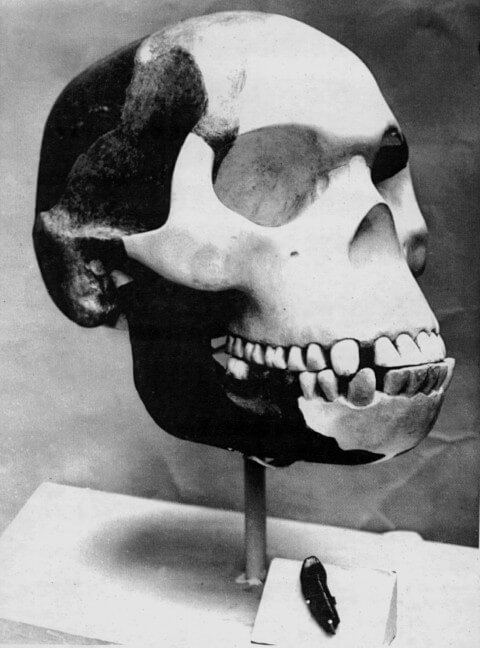
It just happened that the parts of the mandible that would have shown it to be from a modern ape were missing, so Smith Woodward proposed it had once gone together with the skull. This implied the existence of species with a human like cranium and an ape-like jaw. This supported the popular idea of the brain growing first as the jaw and teeth lagged behind in evolution. Such a creature also implied something else: the ‘missing link’ had lived in England. That was how Dawson and Smith Woodward presented their find to the British Geological Society at the end of 1912.
There were anatomists and dentists suggesting that putting the jaw and cranium together made no sense at all, which lead to debate that culminated in the summer of 1913. Naysayers proposed that the Piltdown hypothesis would be stronger had the mandible included a canine tooth with certain characteristics. Within two weeks, de Chardin found a tooth at the site matching the predicted features. In 1916, Dawson died, but only after telling Smith Woodward of a second skull at another site, three kilometers from the first. Smith Woodward never found that second site, but he did obtain Dawson’s second skull, and this silenced any remaining criticism.
Fooled
But everything had changed by 1953, when the hoax was fully exposed. It turned out that someone had collected bones, teeth and even created primitive looking flint tools, staining them with various chemicals, and planting them, to create the fictional skull and setting. The perpetrator had gathered authentic fossils from extinct animals, from multiple dig sites around the globe and placed the specimens together in the pit with the human skull fragments and a mandible from an orangutan. The perpetrator also made sure to break off the parts of the mandible that would have revealed its ape origin. There also were primitive flint tools and everything was stained multiple times to create a kind of uniformity.
Some of the chemical tests performed in the middle of the century to blow the hoax were new for the era, but there were other analyses that Smith Woodward could have done that would have revealed the fraud. He could have tested the bones for nitrogen content, for instance, or examined the teeth with a magnifying glass to see that they’d been filed down. He didn’t bother with any of this, despite being a top researcher of his period. Smith Woodward would spend more than 30 years (he died in 1948) digging at the Piltdown gravel pit looking for more specimens that would never appear.
Ignoring more impressive evidence
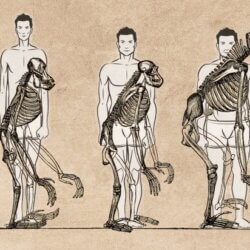
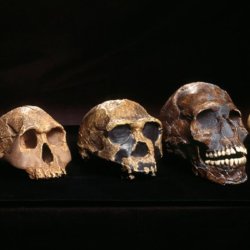



In the years leading to the Piltdown ‘discovery’ and in the years that followed, scientists made other fossil discoveries that we now recognize as milestones. The finds were not in England and, importantly, they didn’t support the favored hypothesis of the time, namely that brain growth had led the way in human evolution while the jaw and progression to upright walking had lagged behind.
The H. heidelbergensis discovery of 1907 was a major find, as the species is the suspected common ancestor of modern humans (Homo sapiens) and Neanderthal man. However, in the 1890s, Dutch researcher Eugène Dubois discovered ‘Java Man’, the first in a series of finds establishing the presence of a human ancestor called Homo erectus, more ancient than H. heidelbergensis. Java Man came with lower extremity specimens, including a knee that locked, proving that he had walked upright, and yet the brain volume was intermediate between modern humans and the chimpanzee. Because the idea of a small-brained human ancestor walking upright really bothered paleoanthropologists of the time, Dubois was treated pretty much as a quack –until the late 1920s, when H. erectus fossils started appearing at various sites around the world.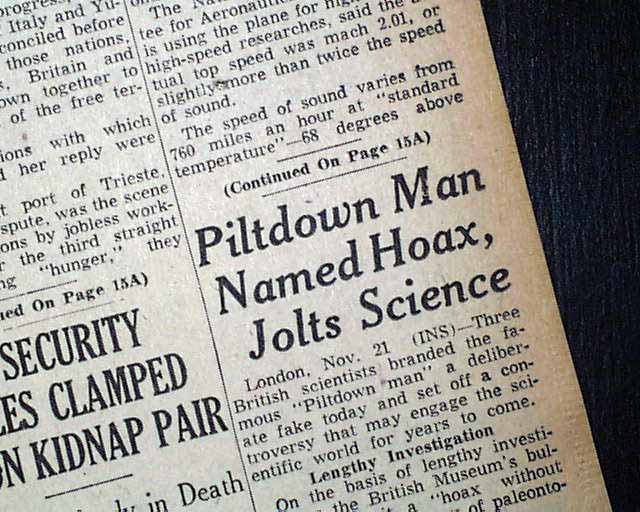
In 1924, as Piltdown Man was still being hailed in England as solid evidence that brain enlargement had led the way in human evolution, Australian Raymond Dart discovered a skull in South Africa of a hominid species even older than H. erectus. Known as Taung Child, Dart’s specimen represented a distinct genus that he called Australopithecus. The brain was not significantly bigger than that of a chimpanzee, but the face and jaw showed major progression in the pathway from ape to human. His finding was viewed skeptically by many.
Like Dubois, Dart was eventually vindicated, but only after nearly two decades of having his papers rejected for publication in leading peer reviewed journals. Before the Natural History Museum in London officially blew the lid off the Piltdown hoax in 1953, the proposed E. dawsoni, species already looked like a sideline show, alongside a series of fossils from around the planet that painted a very different picture of human evolution.
How could this have happened?
To be sure, the hoax was extremely elaborate. But there were other scientists who had devoted large segments of time to the Piltdown excavation and analysis, including de Chardin. The canine tooth that he discovered in 1913 turned out to be one of the more bogus specimens planted at the site. And when checking it in the early 1950s, researchers at the museum found brown paint that simply scratched off.
How could this be? How could trained fossil hunters fail for something so basic? The hoax was not uncovered because of simple reason: The specimens were not fully vetted, perhaps because researchers wanted it to be true. Confirmation bias. Englanders wanted to believe that humanity had emerged in England. That was relevant not just scientifically but also politically, because England’s rival, Germany, had cornered the market in human fossil research until this point. Germany, after all, had the famous Neanderthal Man, plus it had another ancient human species just recently unearthed —Homo heidelbergensis, discovered in 1907, just one year before Dawson’s ‘discovery’ of the first skull fragments.
The main protagonist in exposing the hoax was Kenneth Page Oakley, chief of anthropology at the Museum. Employing a test for fluorine content, Oakley showed in 1953 that the cranial bones were not from the same time period as the mandible, and that cranial bones and mandible were no more than a few hundred years old. By 1959, carbon dating was available and narrowed down the ages of the bones further, but the real intrigue since that time has surrounded the search for the hoax perpetrator.
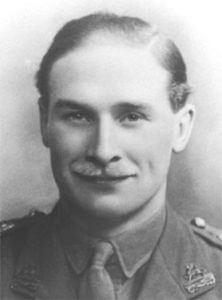
It’s not surprising, of course, that Dawson remains a prime suspect. He was mentioned in that capacity even in the new study, but researchers and historians also suspect that others were messing around at the gravel pit. Very suspiciously in this regard, one of the last specimens ‘discovered’ was in 1915, an elephant bone shaped–clearly by chipping away with a steel knife–into the form of a cricket bat.
To illustrate the power of confirmation bias, it’s noteworthy that Smith Woodward took the cricket bat-shaped object seriously and wrote a paper proposing it to be a Stone Age Implement. But it looks more like a message from somebody — either the hoaxer or somebody who suspected the hoax and wanted to blow it — that in fact the entire collection of bones was a scam.
It turns out that there were practical jokers in England’s science community. de Chardin had a reputation in that capacity, but he was back in France when the cricket bat seems to have been planted. But at the Natural History Museum there was a fossil authenticator, a zoologist, Martin Hinton, who also engaged in practical jokes. Early in his career, Hinton had a falling out with Smith Woodward over a funding issue, but later rose to high ranks at the Museum. Shortly after Hinton’s death in the middle of the century, researchers found a trunk among Hinton’s possessions. Inside the trunk were bones that Hinton had stained and then cut, apparently to see how deep the stain could penetrate. Hinton also wrote to a suspicious American colleague that indeed Piltdown was a hoax.
Was Hinton actually the hoax perpetrator? Or was he experimenting with the bone stains, merely to figure out what the perpetrator had done? It’s really hard to know, but one thing is clear. Both the creation of the hoax and the planting of the cricket bat made Smith Woodward look pretty silly. So at minimum Hinton is a character in a tale of vicious rivalry and spite. We may never know the answer in this case, but perhaps confirmation bias could form the basis of a soap opera, as a warning to anyone who might fall into the trap.
David Warmflash is an astrobiologist, physician and science writer. Follow @CosmicEvolution to read what he is saying on Twitter.