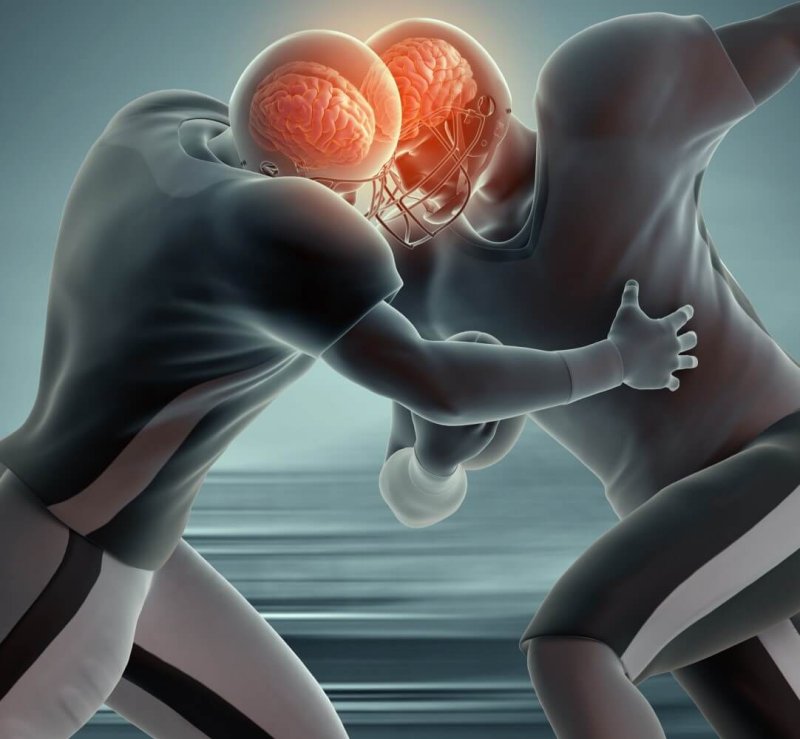
Even mild brain trauma could be dangerous for those at risk for Alzheimer’s Disease

o CONCUSSION facebook

Moderate-to-severe traumatic brain injury is a known risk factor for diseases that gradually destroy the brain – such as late-onset Alzheimer’s disease. Now, a new study links mild traumatic brain injury, or concussion, in people at genetic risk for Alzheimer’s to accelerated brain deterioration and mental decline associated with the disease.

Researchers, from Boston University School of Medicine (BUSM) in Massachusetts,…suggest that their study shows that there is a need to record even mild head injuries because, when combined with genetic risk, they may lead to long-term health problems, such as brain diseases.

Researchers also calculated a genetic risk score for Alzheimer’s disease for each participant…The results show that concussion appears to influence the link between genetic risk for Alzheimer’s disease and cortical thickness.

The results also highlight the importance of documenting concussion events and their symptoms, “even if the person reports only having their ‘bell rung’ and is able to shake it off fairly quickly,” notes Prof. Hayes, a research psychologist at the National Center for PTSD, VA Boston Healthcare System.

The GLP aggregated and excerpted this blog/article to reflect the diversity of news, opinion, and analysis. Read full, original post: Concussion linked to brain changes in people at genetic risk for Alzheimer’s

{{ reviewsTotal }}{{ options.labels.singularReviewCountLabel }}
{{ reviewsTotal }}{{ options.labels.pluralReviewCountLabel }}
{{ options.labels.newReviewButton }}
{{ userData.canReview.message }}

Related Articles

Infographic: Global regulatory and health research agencies on whether glyphosate causes cancer

Infographic: Global regulatory and health research agencies on whether glyphosate causes cancer

Does glyphosate—the world's most heavily-used herbicide—pose serious harm to humans? Is it carcinogenic? Those issues are of both legal and ...

Most Popular

Screenshot-2026-04-23-at-11.00.36-AM
Regulators' dilemma: Thalidomide, Metformin, and the cost of getting drug approvals wrong
Picture1-5
Science Disinformation Gap: The transatlantic battle over social media and censorship
ChatGPT-Image-May-13-2026-11_56_08-AM
After slashing global health aid by $19 Billion, Trump moves to tap $2.1 billion more—to cover shutdown costs
ChatGPT-Image-May-12-2026-08_39_41-PM
GLP podcast: Big Pharma, Big Ag, Big Food—health harming industries or life-saving innovators?
ChatGPT Image May 10, 2026, 08_16_59 PM 2
Overmedicalization? RFK Jr.’s antidepressant crackdown raises conflict questions over his fee stake in Wisner Baum, the tort firm built on suing drug makers
Screenshot-2026-05-12-at-9.58.31-PM
'He seems fine': Marty Makary out as FDA commissioner
ChatGPT-Image-Apr-13-2026-02_20_22-PM
Viewpoint: Misinformation infodemic? Why assessing evidence is so challenging 
Screenshot-2026-05-01-at-1.29.41-PM
Viewpoint: What happens when whole grains meet modern food manufacturing? Labels don’t tell the whole story.
Picture1-1
Cooling the planet with balloons: Could a geoengineering gamble slow global warming?
Screenshot-2026-05-11-104424
Hantavirus outbreak research: Trump administration shut down study last year on rodent-to-human transmission
S
As vaccine rejectionism spreads, measles may be taking a more dangerous turn
images
The never-ending GMO debate: Pros and cons
glp menu logo outlined

Get news on human & agricultural genetics and biotechnology delivered to your inbox.