Did migration to America take long enough for humans to evolve?

first Americans

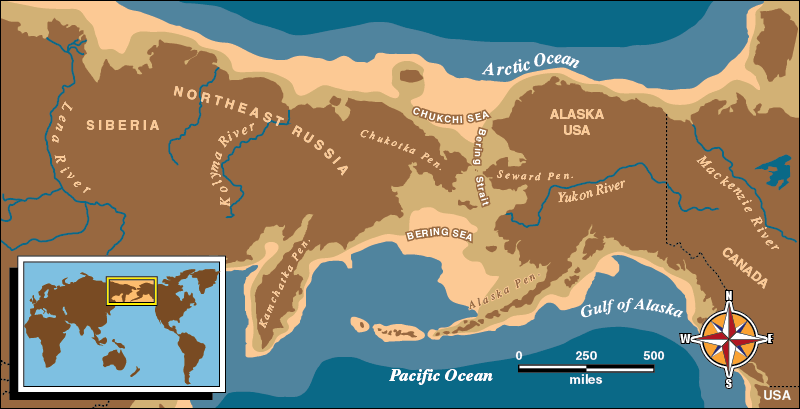
The Bering land bridge plays a central role in our picture of how humans reached the Americas…Current estimates suggest that people lived [on this bridge called Beringia] for between 5,000 and 8,000 years, starting about 23,000 years ago.

That is a long enough time for natural selection to have had an effect on the genome of people who lived there, according to a [recent study].

[A] genetic survey of 191 Greenlandic Inuit people found some genetic patterns that are so common that the best explanation for them is natural selection. Specifically, there’s evidence to suggest that three genes involved in metabolizing fatty acids (FADS genes) show changes that might be the result of adaptation to a diet high in protein and fats.

It’s possible that the adaptations took place on Beringia itself—in which case they would predate the peopling of all the Americas.

[The researchers confirmed this hypothesis when they] found variants in the FADS genes that were much more common in the Native American genomes.

map x
The Bering land bridge. Credit: National Park Service.

If the evidence keeps piling up that the FADS genes affect how we process our food, they could ultimately be important in medical research…[It may show that] the best diet might be different for different people, depending on their genetics.

[The study can be found here.]

The GLP aggregated and excerpted this blog/article to reflect the diversity of news, opinion, and analysis. Read full, original post: Migration to America took long enough for evolution to happen on the way

{{ reviewsTotal }}{{ options.labels.singularReviewCountLabel }}
{{ reviewsTotal }}{{ options.labels.pluralReviewCountLabel }}
{{ options.labels.newReviewButton }}
{{ userData.canReview.message }}

Related Articles

Infographic: Global regulatory and health research agencies on whether glyphosate causes cancer

Infographic: Global regulatory and health research agencies on whether glyphosate causes cancer

Does glyphosate—the world's most heavily-used herbicide—pose serious harm to humans? Is it carcinogenic? Those issues are of both legal and ...

Most Popular

ChatGPT-Image-May-28-2026-12_56_54-PM
Viewpoint: Vaccines' non-specific effects? The ‘shoddy’ Danish couple whose 'research’ inspires RFK, Jr.’s health delusion
Credit: ACSH
Viewpoint: Who and what’s to blame for the surge in vaccine-preventable diseases?
Screenshot-2026-06-08-at-10.19.30-AM
‘Natural’ wellness supplements linked to liver injury
ChatGPT Image Jun 3, 2026, 03_14_43 PM
Viewpoint: How Earthjustice became the poster child for the abuse of special interest activist funding
Screenshot-2026-06-05-at-2.12.30-PM
Some plants can poison you. So how did humans figure out what is safe to eat?
Screenshot-2026-06-05-at-3.30.20-PM
Republican lawmakers spread misinformation claiming solar farms permanently destroy potato farms
Screenshot-2026-06-08-at-11.05.51-AM
Can vaping lead to cancer? New ‘association study’ raises questions of “links"
Organic-Produce
Viewpoint: Why you should ignore organic food advocates’ advice to avoid ‘pesticide soaked’ conventional fruits and vegetables
Screenshot 2025-08-25 203032
Mazzenga’s 20-year old muscles: How a still-going-strong 92-year old sprinter wins every race she enters
edb7f6d7-2370-418f-9578-74e29678e35c
Facts & Fallacies Podcast: Nicotine vaping—public health miracle, or risk to children? Professor Cliff Douglas
Screenshot 2025-07-30 at 10.48
Can gene editing eliminate Down syndrome? Scientists have done it in lab-grown cells
ChatGPT-Image-Mar-10-2026-01_39_01-PM
Viewpoint—“Miracle molecule” debunked: Why acemannan supplements don’t work
ChatGPT-Image-Jun-5-2026-02_48_23-PM
Viewpoint: How Dr.TikTok (falsely) convinced me that cortisol was running my health
glp menu logo outlined

Get news on human & agricultural genetics and biotechnology delivered to your inbox.