Discovery of 315,000-year old human fossils may rewrite history of our ancestors

f ad
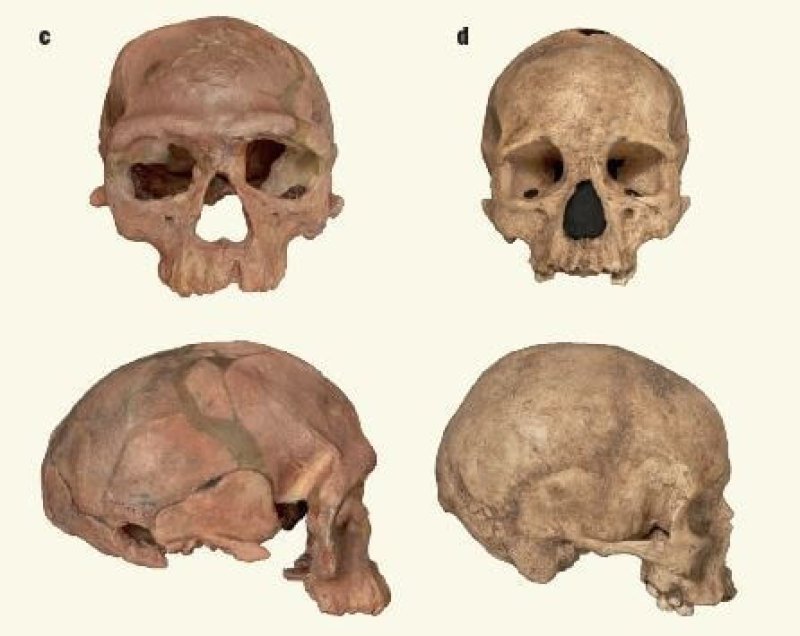
Comparison of the skulls of a Jebel Irhoud human (lleft) and a modern human (right). Credit: NHM London.
[B]ones of the former occupants [of a Moroccan cave called Jebel Irhoud] have been recently unearthed by an international team of scientists. They mark the earliest fossilized remains of Homo sapiens ever found. Until now, that honor belonged to two Ethiopian fossils that are 160,000 and 195,000 years old respectively. But the Jebel Irhoud bones, and the stone tools that were uncovered with them, are far older—around 315,000 years old, with a possible range of 280,000 to 350,000 years.

…

It’s not just when these people died that matters, but where.

“What people, including myself, used to think was that there was a cradle of humankind in East Africa about 200,000 years ago, and all modern humans descend from that population,” says Philipp Gunz from the Max Planck Institute for Evolutionary Anthropology. “The new finds indicate that Homo sapiens is much older and had already spread across all of Africa by 300,000 years ago.”

…
These people had very similar faces to today’s humans, albeit with slightly more prominent brows. But the backs of their heads were very different…Their brains, though already as large as ours, must also have been shaped differently.

[Read the full study here]

The GLP aggregated and excerpted this blog/article to reflect the diversity of news, opinion, and analysis. Read full, original post: Scientists Have Found the Oldest Known Human Fossils


Related Articles

Infographic: Global regulatory and health research agencies on whether glyphosate causes cancer

Infographic: Global regulatory and health research agencies on whether glyphosate causes cancer

Does glyphosate—the world's most heavily-used herbicide—pose serious harm to humans? Is it carcinogenic? Those issues are of both legal and ...

Most Popular

ChatGPT-Image-Sep-23-2026-02_36_39-PM
Viewpoint: After firing the entire National Science Board, Trump reshapes funding initiatives. Here’s the good and the bad.
ChatGPT-Image-Mar-10-2026-01_39_01-PM
Viewpoint—“Miracle molecule” debunked: Why acemannan supplements don’t work
sorghum farmers in kenya FARMERS TREND
Here are all the ways CRISPR gene editing is transforming Africa’s staple crops—and there’s a lot more innovation to come
ChatGPT-Image-Sep-10-2026-10_36_07-AM
Viewpoint: Even lousy scientific articles can shield authors when they hype dubious health claims and products
ChatGPT-Image-Sep-30-2026-01_38_36-PM
Viewpoint: Died “with measles” vs. died “from measles”: RFK, Jr.’s dangerously subversive word games
ChatGPT-Image-Sep-30-2026-01_25_34-PM
Blood tests for Alzheimer’s? The latest grifter, social media scam.
ChatGPT-Image-Sep-30-2026-01_11_07-PM
How U.S. teamed with Russia to block global human AI weapons oversight
Screenshot-2026-10-01-at-11.21.27-AM
Vaccine hesitancy, like malaria, surges globally, topping 35% in some countries
ChatGPT-Image-Sep-21-2026-03_15_09-PM
Viewpoint: Chipotle-inspired lesson: 10,000 sick customers suggest that processed foods can be safer than fresh ones
glp menu logo outlined

Get news on human & agricultural genetics and biotechnology delivered to your inbox.