How genetics helps make cows more profitable and environmentally friendly

AP

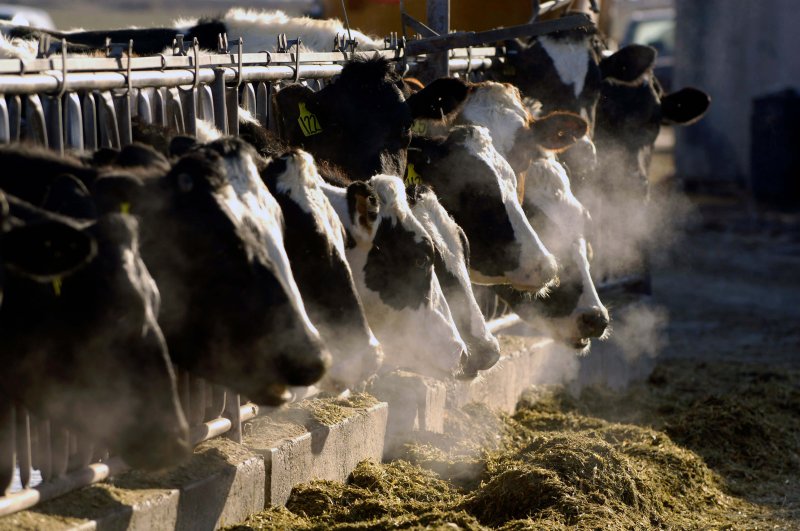
[J. P.] Brouwer, along with his father and two brothers at Sunalta Farms in central Alberta, runs the first commercial dairy farm contributing data to the Genome Canada project. One part of the project aims to increase feed efficiency—growing cows as big as possible with as little food as possible—and reduce emissions of methane, a greenhouse gas that traps 30 times more heat per molecule than carbon dioxide. Eight years after scientists from the National Institutes of Health and the US Department of Agriculture sequenced the first cow genome, this project is trying to turn that information into more profitable, environmentally friendly cattle. They’ll be like Number 1995, but better.

Bovine livestock are responsible for about 9.5 percent of global greenhouse gas output, according to the Food and Agriculture Organization of the United Nations. … Some scientists at Pennsylvania State University are even genetically modifying the bacteria in cow guts.

But scientists are also tweaking the cows themselves. The Genome Canada project … harnesses labs in the US, UK, Denmark, Australia, and Switzerland to help identify cows that produce fewer greenhouse gases, with the ultimate goal of distributing the responsible genes—conveniently transported in the form of bull semen—to areas that don’t have the resources to develop their own greener cows.

The GLP aggregated and excerpted this blog/article to reflect the diversity of news, opinion, and analysis. Read full, original post: Canada is using genetics to make cows less gassy

{{ reviewsTotal }}{{ options.labels.singularReviewCountLabel }}
{{ reviewsTotal }}{{ options.labels.pluralReviewCountLabel }}
{{ options.labels.newReviewButton }}
{{ userData.canReview.message }}

Related Articles

Infographic: Global regulatory and health research agencies on whether glyphosate causes cancer

Infographic: Global regulatory and health research agencies on whether glyphosate causes cancer

Does glyphosate—the world's most heavily-used herbicide—pose serious harm to humans? Is it carcinogenic? Those issues are of both legal and ...

Most Popular

ChatGPT-Image-Jul-7-2026-12_01_35-PM
Viewpoint: 21 worthless wellness trends inspired by RFK, Jr.’s ill-informed MAHA followers that can harm or even kill you.
ChatGPT-Image-Jun-30-2026-10_27_31-AM
Viewpoint: Europe clears the way for gene-edited crops — but fear-driven restrictions still slow their full potential
d a ca e c c beb x
Facts & Fallacies podcast: The 'woke' crusade against anthropology? Dr. Elizabeth Weiss
ChatGPT-Image-Jul-1-2026-03_33_49-PM
‘Alternative’ cancer treatments that could kill you
Screenshot-2026-07-06-at-12.30.23-PM
2,300 endangered species: Controversial de-extinction company Colossal Biosciences joins U.S. effort to preserve their DNA
ChatGPT-Image-Jul-9-2026-10_36_24-AM
Deeply-flawed ivermectin study revives scientifically unsupported miracle cancer drug myth
Screenshot 2026-07-08 at 10.13
What happens when a pro-life congresswoman needs an abortion?
ChatGPT-Image-Mar-10-2026-01_39_01-PM
Viewpoint—“Miracle molecule” debunked: Why acemannan supplements don’t work
ChatGPT-Image-Jul-7-2026-11_19_20-AM
Signal or noise? Study links GLP-1 drugs to slowing the aging process
ChatGPT-Image-Jul-1-2026-12_37_08-PM
Viewpoint: Trump poised to politicize all U.S.-supported science research
Screenshot-2026-07-09-at-9.48.49-AM
Do cold plunges and contrast therapy work?
ChatGPT-Image-Jul-8-2026-04_10_51-PM-1
Kennedy-founded Children's Health Defense doubles down on support for Idaho mother charged by a grand jury with murdering her twins last year after claiming vaccines killed them
ChatGPT-Image-Jun-25-2026-12_23_17-PM
No, Bill Gates did not secretly engineer ticks to promote veganism
glp menu logo outlined

Get news on human & agricultural genetics and biotechnology delivered to your inbox.