Darwin’s mystery animal: Camel-like creature linked to ancient horses finally added to tree of life

Screen Shot at PM

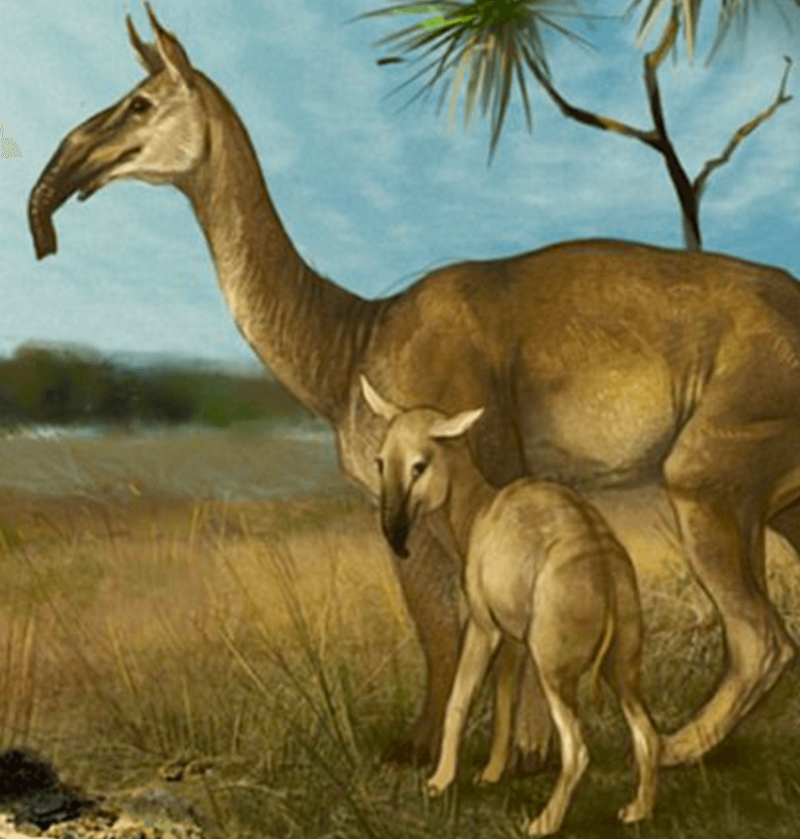
After the last of its kind died out about 12,000 years ago, a strange animal that stumped Charles Darwin is finally being added to the tree of life, according to a new study in the journal Nature Communications. Macrauchenia patachonica lived during the last ice age. It resembled a bulky camel without a hump, with a long neck like that of a llama and a short trunk for a nose.

Legendary British scientist Darwin found the first fossil of this creature, as well as those of other extinct animals that fall under the “South American native ungulates” category, in 1834. The fossils were given to Richard Owen, a British paleontologist, to study. Neither Owen nor Darwin could clarify the Macrauchenia’s combination of features to a modern-day counterpart or a distinct mammal lineage. But they had only a few limb bones and vertebrae to study.
mpskeleton e

A previous study tried to place Macrauchenia on the tree of life by using ancient collagen. The new study, led by [Ross MacPhee, curator at the American Museum of Natural History] and [Michi Hofreiter, paleogenomics expert at the University of Potsdam], built on the 2015 collagen study by extracting mitochondrial DNA from a fossil found in South America.

Macrauchenia now belongs to a sister group of Perissodactyla, which includes horses, rhinos and tapirs. The two groups split about 66 million years ago, around the time a mass extinction occurred when an asteroid struck the Earth.

The GLP aggregated and excerpted this blog/article to reflect the diversity of news, opinion, and analysis. Read full, original post: DNA solves ancient animal riddle that Darwin couldn’t

{{ reviewsTotal }}{{ options.labels.singularReviewCountLabel }}
{{ reviewsTotal }}{{ options.labels.pluralReviewCountLabel }}
{{ options.labels.newReviewButton }}
{{ userData.canReview.message }}

Related Articles

Infographic: Global regulatory and health research agencies on whether glyphosate causes cancer

Infographic: Global regulatory and health research agencies on whether glyphosate causes cancer

Does glyphosate—the world's most heavily-used herbicide—pose serious harm to humans? Is it carcinogenic? Those issues are of both legal and ...

Most Popular

circular-bioeconomy-should-focus-on-sustainable-wellbeing
GLP podcast: What's wrong with 'doomsday' environmentalism? It's false.
d-b
Blocked arteries, kidney stones, nausea, constipation, fatigue: Long list of health problems caused by too much vitamin D 
Screenshot-PM-24
Viewpoint: The herbicide glyphosate isn’t perfect. Banning it would be far worse.
Screenshot 2026-02-25 at 11.20
Why the herbicide glyphosate is key to sustainable agriculture
ChatGPT-Image-Apr-28-2026-12_46_14-PM-2
Kennedy has quietly stopped touting problematic raw milk. Health concerns aren’t why
screen shot at pm
Word games: How Moderna is selling its newest vaccine without using the “v” word
ChatGPT-Image-Apr-22-2026-11_06_18-AM
Wellness influencer nonsense: No, nicotine does not boost cognition and productivity, but it can damage your health 
ChatGPT-Image-Feb-16-2026-01_57_31-PM
Viewpoint: ‘Science-as-Satan’ unites the MAHA—MAGA movements. Is a breakup in the works?
ChatGPT-Image-Feb-16-2026-01_04_32-PM
Raw milk myth wake-up call
glp menu logo outlined

Get news on human & agricultural genetics and biotechnology delivered to your inbox.