Consumer opposition stalls GM feed crops that could revolutionize Australia’s dairy industry

bef b f

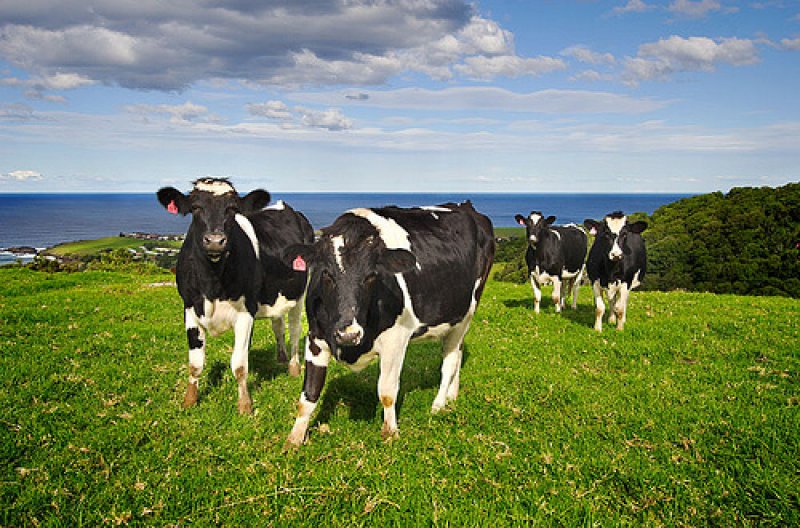
The [Australian] dairy industry’s greatest innovations in a generation — genetically modified high-energy ryegrass and virus-resistant clover — have still not been released after almost 20 years of research.

Despite promises they would lift milk production by 25 percent, and earn farmers up to $750 a hectare extra, the developed pastures have not been commercialized amid continuing consumer opposition to GM foods. In 1998, local field trials proved the value of GM clover, showing it maintained resistance to the alfalfa mosaic virus, while conventional cultivars suffered losses of up to 60 percent.

High-energy ryegrass was developed in 2003 … saying at the time it should be available within five years and would enable cows to produce up to 25 percent more milk from the same amount of fodder.

[Field trials] showed GM ryegrass produced an extra megajoule of metabolisable energy per kilogram of dry matter and could boost dairy farm productivity by $450-$750 a hectare.

“When gene technology is more broadly accepted in the marketplace, then there’s a market for (GM) white clover,” [said DairyBio co-director David Nation.]

The long delay in getting GM pastures into dairy and other livestock producers’ paddocks seems to be based on dairy processor resistance amid fears of a consumer backlash.

The GLP aggregated and excerpted this blog/article to reflect the diversity of news, opinion, and analysis. Read full, original post: GM ryegrass: Consumer opposition stalls next-gen fodder release

{{ reviewsTotal }}{{ options.labels.singularReviewCountLabel }}
{{ reviewsTotal }}{{ options.labels.pluralReviewCountLabel }}
{{ options.labels.newReviewButton }}
{{ userData.canReview.message }}

Related Articles

Infographic: Global regulatory and health research agencies on whether glyphosate causes cancer

Infographic: Global regulatory and health research agencies on whether glyphosate causes cancer

Does glyphosate—the world's most heavily-used herbicide—pose serious harm to humans? Is it carcinogenic? Those issues are of both legal and ...

Most Popular

ChatGPT Image May 10, 2026, 08_16_59 PM 2
Overmedicalization? RFK Jr.’s antidepressant crackdown raises conflict questions over his fee stake in Wisner Baum, the tort firm built on suing drug makers
Picture1-5
Science Disinformation Gap: The transatlantic battle over social media and censorship
Picture1-1
Cooling the planet with balloons: Could a geoengineering gamble slow global warming?
ChatGPT-Image-Apr-13-2026-02_20_22-PM
Viewpoint: Misinformation infodemic? Why assessing evidence is so challenging 
Screenshot-2026-05-11-104424
Hantavirus outbreak research: Trump administration shut down study last year on rodent-to-human transmission
Picture1-14
When superbugs threaten vulnerable children: Can AI help solve antibiotic resistance?
S
As vaccine rejectionism spreads, measles may be taking a more dangerous turn
Screenshot-2026-05-08-at-3.40.33-PM
Seeds of power: China turns to genetic engineering to become global superpower
Screenshot-2026-05-01-at-1.29.41-PM
Viewpoint: What happens when whole grains meet modern food manufacturing? Labels don’t tell the whole story.
Screenshot-2026-04-12-135256
Bixonimania: The fake disease scam that AI swallowed whole
Screenshot 2026-05-11 at 11.30
Despite politicized disinformation, Midwest AI data centers are fueling a solar energy boom
Screenshot 2026-05-08 at 3.01
Transforming farming and nutrition with AI and robotics? Larry Ellison’s half-billion-dollar Hawaii greenhouse dream goes bust
glp menu logo outlined

Get news on human & agricultural genetics and biotechnology delivered to your inbox.