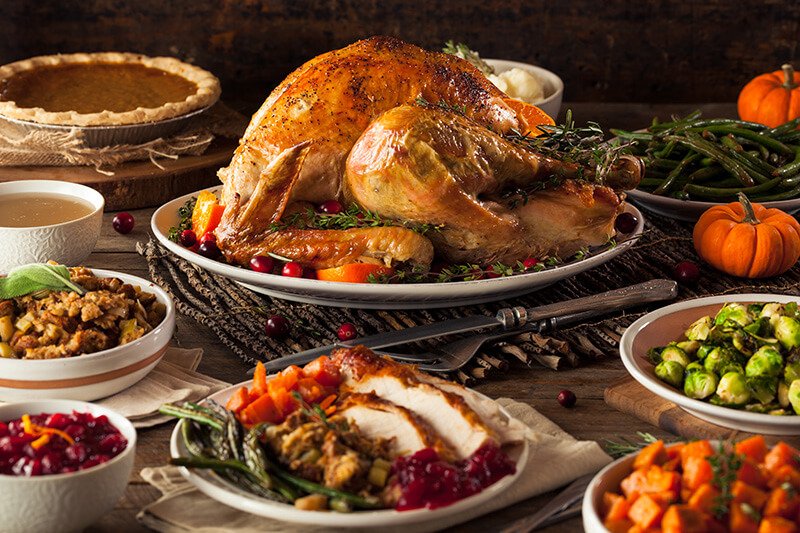
Farmers’ choice: GMOs help make Thanksgiving food abundant and affordable

thanksgiving dinner

Farmers utilizing choices in seed technology, such as GMOs, allow us to have an abundance of food choices at affordable prices. Americans spend just under 10 percent of disposable income on food, the lowest in the world, according to the U.S. Department of Agriculture.

For those not familiar, a GMO plant has a desired gene or portion of a gene, such as drought or pest resistance placed from one plant or organism to another plant. American farmers have choices to raise a total of 11 GMO crops depending on their climate and soil types, including corn (field and sweet), alfalfa, canola, soybeans, sugar beets, potatoes, cotton, squash, papaya and most recently, apples. This fall, Arctic Apples started being sold in limited U.S. grocery stores.

Farmers can choose to grow non-GMO and organic options of crops that have GMO versions. Non-GMO and organic options often offer a premium but require more intensive management.

Beyond value-added pricing, farmers choose crops to improve soil health, reduce passes over the fields, decrease compaction, reduce labor and resources and increase the overall sustainability of their farms.

Farming and food choices create affordable meals to be shared with family, friends, neighbors and even strangers. Celebrate the choices. Happy Thanksgiving!

The GLP aggregated and excerpted this article to reflect the diversity of news, opinion and analysis. Read full, original post: Like your food choices this Thanksgiving? GMOs help with that.

{{ reviewsTotal }}{{ options.labels.singularReviewCountLabel }}
{{ reviewsTotal }}{{ options.labels.pluralReviewCountLabel }}
{{ options.labels.newReviewButton }}
{{ userData.canReview.message }}

Related Articles

Infographic: Global regulatory and health research agencies on whether glyphosate causes cancer

Infographic: Global regulatory and health research agencies on whether glyphosate causes cancer

Does glyphosate—the world's most heavily-used herbicide—pose serious harm to humans? Is it carcinogenic? Those issues are of both legal and ...

Most Popular

ChatGPT-Image-Mar-10-2026-01_39_01-PM
Viewpoint—“Miracle molecule” debunked: Why acemannan supplements don’t work
afb-a-b
As the EU loosens restrictions on agricultural gene editing, it remains years behind the rest of the world on equally-safe GMO foods
ChatGPT-Image-Jul-8-2026-12_32_48-PM
Viewpoint: SCOTUS strikes a blow against junk science in Bayer glyphosate case. Will it deter mass tort litigators?
Screenshot-2026-07-10-at-2.02.54-PM
Viewpoint: In abortion-restricting Florida, misinformation abounds when Republican congresswoman faces an ectopic pregnancy
ChatGPT-Image-Jul-7-2026-01_57_55-PM
Viewpoint: Europe’s rejection of air conditioning is the poster child for misunderstanding how to mitigate the impact of climate change
Screenshot-2026-07-10-at-3.10.50-PM
Snake-oil cures throughout history
ChatGPT-Image-Jun-25-2026-12_23_17-PM
No, Bill Gates did not secretly engineer ticks to promote veganism
Screen-Shot-at-PM-pe-vra-kipgaprbdo-vd-ms-jpule-n-jqqaxf-l-e
Viewpoint: Will new breeding techniques help make European agriculture more competitive?
Screenshot-2026-07-10-at-12.55.21-PM
Cancer health facts are particularly susceptible to online misinformation
Screenshot-2026-07-10-at-3.25.10-PM
Using AI for health questions? Here are 4 tips for the most accurate answers.
Viewpoint: Consensus as truth? How ‘misinformation police’ control policy narratives
Which among war, weather and cyber attacks is the biggest world threat? None of the above. It’s misinformation, and here’s why.
ChatGPT-Image-Jul-1-2026-03_33_49-PM
‘Alternative’ cancer treatments that could kill you
Screenshot-2026-07-08-at-9.36.03-AM
Viewpoint: Long-contained diseases are on the rise in the U.S. Are Trump cuts to blame?
glp menu logo outlined

Get news on human & agricultural genetics and biotechnology delivered to your inbox.