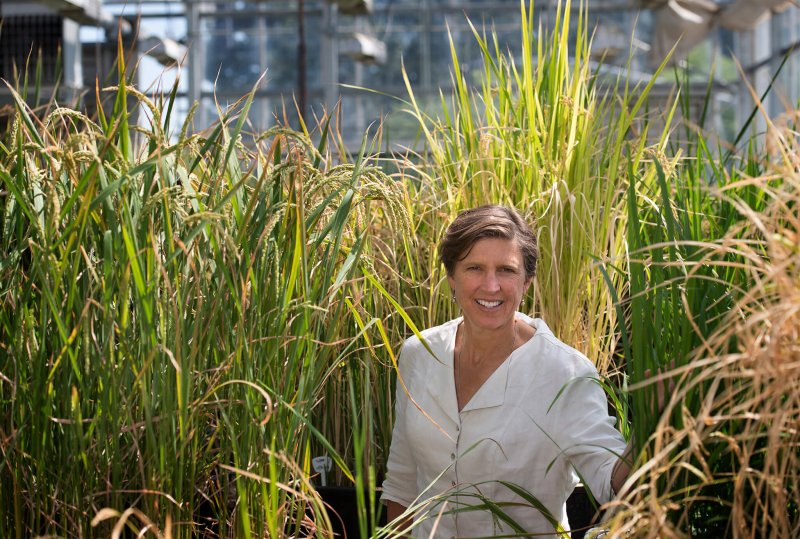
Women in science: Geneticist Pamela Ronald, developer of GMO flood-resistant rice

pamronald
[T]he breakthrough that finally created rice seeds strong enough to stand up to blight and flood came when Pamela Ronald (b. 1961), a plant biologist and geneticist at UC Davis, combined the know-how of evolution with the rigor of molecular biology and genetics to solve at last a problem as old as written history.

A strain was discovered … in Egypt that could withstand up to two weeks of complete submersion. Teaming up with David Mackill, Ronald set out to discover precisely what part of this strain’s genome conveyed the extra resilience to flooding, and to use the techniques of genetic engineering to introduce that gene into the rice varieties grown throughout Asia, where it is the overwhelming food staple. Suffice to say, she and her lab succeeded, found the gene, characterized what it did, and as of 2014 over four million farms are enjoying the benefits of her remarkable work.

Ronald is a passionate advocate for greater education about what genetic engineering is and is not. Her book, Tomorrow’s Table (2007), co-written with her organic farming husband Raoul Adamchak, makes an elegant case for how [GE] techniques … can be used to create crops that are naturally resistant to all manner of traditional pests, dramatically lessening the need for toxic pesticides.

Read full, original post: Going With the Grain: Pamela Ronald… Plant Biologist, Geneticist And Rice Savior

{{ reviewsTotal }}{{ options.labels.singularReviewCountLabel }}
{{ reviewsTotal }}{{ options.labels.pluralReviewCountLabel }}
{{ options.labels.newReviewButton }}
{{ userData.canReview.message }}

Related Articles

Infographic: Global regulatory and health research agencies on whether glyphosate causes cancer

Infographic: Global regulatory and health research agencies on whether glyphosate causes cancer

Does glyphosate—the world's most heavily-used herbicide—pose serious harm to humans? Is it carcinogenic? Those issues are of both legal and ...

Most Popular

Screenshot 2025-07-30 at 10.48
Can gene editing eliminate Down syndrome? Scientists have done it in lab-grown cells
ChatGPT-Image-Mar-10-2026-01_39_01-PM
Viewpoint—“Miracle molecule” debunked: Why acemannan supplements don’t work
ChatGPT-Image-May-26-2026-07_51_21-AM-2
Viewpoint: There are more than 1,000 chemicals in a cup of coffee—including many substances that can cause cancer. Why isn’t it banned?
Screenshot-2026-06-04-at-12.05.08-PM
Cases of brain inflammation surge as U.S. measles pandemic approaches 2000
Screenshot 2026-05-26 at 10.15
Viewpoint: Double standard—Why does the wellness industry get a free pass while Big Healthcare is treated as morally suspect?
Screenshot-2026-05-28-at-1.36.28-PM
Viewpoint: Can mRNA research survive the Trump administration?
Picture1
Sounds we can’t hear — the hidden planetary signals behind science, fear, and misinformation
downsyndrome_compilation_MID_1
CRISPR breakthrough that can remove the chromosome responsible for Down syndrome raises ethical questions
ChatGPT Image May 26, 2026, 08_42_17 AM (1)
Viewpoint: Greenpeace and poison: How environmental advocacy groups rely on compliant (and often ignorant) journalists to spread disinformation and spark litigation
glp menu logo outlined

Get news on human & agricultural genetics and biotechnology delivered to your inbox.