Why Ugandan farmers are blocked from growing biotechnology crops

be ba z e

Editor’s Note: This article, written by crop scientists Micheal Otim, discusses a recent print article called “MPs who visited Namulonge fields did not get clear picture”, published in the New Vision of December 24, 2016.

The writer questioned the capacity and qualifications of Members of Parliament to learn and understand issues surrounding biotechnology and genetic engineering so that they can correctly decide on the pending Biotechnology and Biosafety Bill. The writer, a university don, questions whether the honourable MPs have the capacity to discern what a good scientific experiment should constitute and attempts to discredit the MPs’ learning tour and other such engagements with researchers, on biotechnology, as efforts at “conversion”.

Apparently, the writer is opposed to anyone seeking to know more about biotechnology or genetic engineering- a component of the former.

In Uganda, several biotechnology products have either been developed or are still in the pipeline. Unfortunately, Ugandans cannot yet use these products because we need a law to regulate the biotechnology used to develop them and ensure that products are safe for consumption … Therefore, it’s surprising for a scientist to insinuate that the National Agricultural Research Organization (NARO) is an employer of “science crooks” and yet NARO has openly invited member of the public, including MPs, students, clergymen, farmers, and those opposed to biotech to learn about these products and solutions they offer to crop problems.

NARO does public research, not in secrecy, but under the strict supervision of bodies such as UNCST and the Ministry of Agriculture, Animal Industry and Fisheries. Since its establishment, NARO scientists have developed hundreds of improved varieties of crops including cassava, rice beans, maize, and banana to help raise farmers’ incomes.

The GLP aggregated and excerpted this blog/article to reflect the diversity of news, opinion, and analysis. Read full, original post: Why Ugandans Don’t need more lies about biotechnology

Ambiguities remain as USDA and FDA set to draw up new GMO labeling law

Screen Shot at PM

Congress has effectively preempted the states from imposing different labeling requirements for GE foods than what the USDA eventually requires, but it has left the states wide discretion to impose additional state remedies for violations of these new federal labeling requirements. Thus, there remains a distinct possibility that non-conforming GE food manufacturers will face different levels and kinds of liability across the 50 states if they fail to properly label their GE foods, even though those labeling requirements will be nationally uniform.

In addition, states retain considerable latitude regarding whether and how stringently they wish to police GE food manufacturers who choose label their products “organic.” However, what will happen with “natural” labeling is unclear as this article goes to press, including the basic issue of whether states will have any role whatsoever in policing the use of “natural” in connection with GE foods.

Given the long history of relative legal peace between the FDA’s and USDA’s food labeling authorities and GE product authorities, … the two agencies optimally should work out an agreement before the USDA’s new regulations go into effect regarding how they will blend their labeling authorities regarding GE foods.

By working together immediately, the USDA and FDA can foreclose much of the confusion and controversy that might otherwise arise under the new Act, perhaps finally bringing the GE food labeling controversy in the United States to a legal conclusion.

The GLP aggregated and excerpted this blog/article to reflect the diversity of news, opinion, and analysis. Read full, original post: Labeling Genetically-Engineered Foods: An Update from One of the Front Lines of Federalism

Former Georgia governor Sonny Perdue tapped as next agricultural secretary

Screen Shot at AM

Donald Trump has chosen former Georgia governor Sonny Perdue to be his secretary of agriculture, completing a protracted search with implications for how the president-elect plans to deliver on his promises to the army of rural voters widely credited with helping him win the election.

A transition official confirmed the pick — the final traditional Cabinet department chief to be selected — which could be formally announced as early as [January 19].

Perdue, a former Democrat who switched to the Republican Party before governing Georgia for two terms from 2003 to 2011, has a strong agricultural background, having grown up on a farm and earned a doctorate in veterinary medicine.

Trump Perdue jpg c
Former Georgia governor Sonny Perdue

Although Perdue’s Georgia is not among the nation’s top 10 agricultural states, it is home to 42,000 farms, with a strong focus in the cattle industry.

Trump has said that environmental regulations are “undermining our incredible farmers,” and some observers expect cuts to environmental and conservation programs at the Agriculture Department on his watch, as a Republican-controlled Congress moves to pass a new farm bill.

The GLP aggregated and excerpted this blog/article to reflect the diversity of news, opinion, and analysis. Read full, original post: Trump picks Sonny Perdue for agriculture secretary

Addressing GMO concerns: Are foods “made in labs” the same as those “made by nature”

Screen Shot at AM

Editor’s Note: This is the first article in a three-part series exploring some common concerns heard about GMOs. Part two examines herbicide use.

An article might make some nod to the fact that genetic engineering and traditional breeding both modify the genetics of plants and they lie on a continuum – and that humans have been modifying the genetics of crops for 12,000 years. The common response is something along the lines of: “I don’t want to eat a tomato that has fish DNA. Breeding in a laboratory is not the same as breeding that happens in nature over hundreds of years.”

There are a number of problems with this. The first of which is that no one is saying that using recombinant DNA breeding methods are the same as traditional breeding methods. It’s just a simple observation to put things in context – we have been manipulating the genetics of our food for 12,000 years and there really isn’t any reason for getting worked up about the fact that we are doing it in laboratories now.

Understand that tomatoes and fish share around 60 percent of their DNA already, so it’s too late to avoid that mashup. Nature already put the chocolate in the peanut butter and the peanut butter in the chocolate. The question is, why would one more gene out of thousands be the deal breaker? Would you eat grapes with human DNA? Too late. Humans share around 25 percent of our DNA with grapes. We share 50 percent of our DNA with a banana. It doesn’t matter where the DNA comes from, it’s just the basic building blocks. What matters is what the DNA does.

While sentiment also stems from a lack of understanding of genetics, there are also some naive assumptions about plant and animal breeding in general. People making the “I don’t want to eat something made in a lab” or “Genetic engineering isn’t the same as the slow process of changing plants over thousands of years” are almost always unaware of just how specific and technically sophisticated contemporary plant breeding has become. Traditional breeders are going after traits which are just as specific as the traits sought by breeders using genetic engineering. This is something that few people are aware of. Nor do they realize just how sophisticated current methods are.

Consider marker assisted breeding:

[F]ruit and vegetable breeders at both universities and private companies have been turning to an alternative way of modifying the food we eat: a sophisticated approach known as marker-assisted breeding that marries traditional plant breeding with rapidly improving tools for isolating and examining alleles and other sequences of DNA that serve as “markers” for specific traits. Although these tools are not brand-new, they are becoming faster, cheaper and more useful all the time. “The impact of genomics on plant breeding is almost beyond my comprehension,” says Shelley Jansky, a potato breeder who works for both the U.S. Department of Agriculture (USDA) and the University of Wisconsin–Madison. “To give an example: I had a grad student here five years ago who spent three years trying to identify DNA sequences associated with disease resistance. After hundreds of hours in the lab he ended up with 18 genetic markers. Now I have grad students who can get 8,000 markers for each of 200 individual plants within a matter of weeks. Progress has been exponential in last five years.”

[see also: Backcrossing]

Meanwhile, to avoid the regulations that bog down development of genetically engineered crops, a company like BASF is using the Atomic Age method of radiation mutagenesis breeding to develop crops.

Mutation breeding, after booming in the 1950s with the dawn of the Nuclear Age, is still used by seed developers from BASF SE to Dupont Co. to create crops for markets that reject genetic engineering. Regulators don’t demand proof that new varieties are harmless. The U.S. National Academies of Science warned in 1989 and again in 2004 that regulating genetically modified crops while giving a pass to products of mutation breeding isn’t scientifically justified.

“The NAS hits the nail on the head and I don’t think that any plant- or crop-scientist will disagree,” said Kevin M. Folta, a molecular geneticist and interim chairman of the horticultural sciences department at the University of Florida. “Mutation breeding is absolutely the least predictable.”

That isn’t to say that mutation breeding is particularly dangerous. If you’ve ever had a Rio Star Grapefruit or Calrose rice, you’ve eaten the fruits of mutagenic breeding. It’s just to point out that, today almost no breeding happens that doesn’t involve a laboratory and it’s been a long time since it resembled anything that happens in nature. But that’s the point. Even the breeding that we did 12,000 years ago wouldn’t have happened in nature. The crops we’ve bred would not have happened in ‘nature’ and they wouldn’t survive in ‘nature’ if we turned them loose. So the statement “We’ve been genetically modifying crops for 12,000 years” makes a lot more sense if you understand genetics a little better and if you understand breeding a little better.

There is also a really basic error of conflation going on here. People are often conflating the selective breeding of the modern Mendelian era with neolithic trial and error. In setting up a contrast between biotech and neolithic trial and error, they can be forgiven for thinking they are onto something. The problem is the current methods of selective breeding are nothing like the slow process of neolithic trial and error. The slow process of neolithic breeding did happen on a time frame of millennia that a non-scientist could be forgiven for seeing as akin to co-evolution.  It took trial and error over generations for crops to evolve as they were slowly domesticated by humans.  And humans, through a long process of trial and error, adapted to crops as crops adapted to them.

This obviously is a slower more natural process than biotech, but modern selective breeding doesn’t work through a generations-long process of trial and error either – crop improvements are brought from concept to market in a decade or so. Sometimes it takes as little a few years, sometimes few decades, but not slowly over hundreds or thousands of years. Contemporary selective breeding has much more in common in terms of time frames and novel outcomes with biotech than it does with neolithic trial and error breeding.

People should stop making this argument as a gotcha.

There are two versions of the “We’ve been genetically modifying crops for 12,000 years”. The first version is meant to engage in a dialogue that walks someone through the case I’ve made here: all breeding “modifies” the genetics of a crop – even the act of our ancestors just saving the seed from the plants that were most useful, that biotech lies on a continuum of increasing specific breeding techniques, that it doesn’t matter where a gene comes from – it matters what it does. The first version is patient and aims to educate.

The second version is far more common. In fact it is 99 percent more common. It’s not patient and it doesn’t aim to educate. It’s a semantic gambit aimed at ending a conversation and making the other person look foolish. It takes the unfortunate fact that the term for plants or animals bred with biotech techniques that the world settled on happens to be “Genetically Modified Organisms” which couldn’t be any vaguer from a semantic point of view. Here’s the problem. “Genetically Modified Organisms” clearly is meant to refer to organisms created through genetic engineering. What the term means, when you take the word literally, is any organism with modified genetics, i.e.  ANY domesticated plant or animal.

So you end up with people playing a game where one person is using the term “Genetically Modified Organisms” in the colloquial (and in many regulatory frameworks, legal) sense and along comes someone else picking a fight by insisting on taking the term “Genetically Modified Organisms” in the most literal sense WITHOUT acknowledging what you are doing.

Here’s the problem. By ‘genetically modification’, the GMO critic that you are debating clearly means the use of recombinant DNA in plant breeding. This has become the accepted popular use of the term. You, on the other hand, are using ‘genetic modification’ in the non-colloquial, but the technically correct meaning of the term.

So now you are trying to play gotcha by taking the word the other person is using but ignore the meaning to try and make them look foolish. This doesn’t change many minds or make many friends. In fact, the person who ends up looking foolish is you.

Consider:

JANE: We haven’t been genetically modifying food long enough to understand the long-term effects.

DICK: Well considering that we’ve been genetically modifying foods for 12,000 years, how long is long enough?

Here’s what really happened.

JANE: We haven’t been breeding plants with recombinant DNA long enough to understand the long-term effects.

DICK: Well considering that we’ve been changing the genetics of plants through the use of selective breeding for 12,000 years, how long is long enough?

Nice going, Dick.

Don’t be a Dick. If you don’t have the time and patience (or the science communication chops) to engage in the first, patient, educational version; then don’t bother with the second dickish version. It doesn’t change minds, in fact it pisses people off, convinces them that you aren’t operating in good faith. If you don’t have good faith arguments to offer and are resorting to semantic gambits, then the case you are trying to make must be weak and you seem manipulative and therefore suspicious. What you’ve done is confirmed their worst fears about the kinds of people advocating for biotech, pushed them harder into their confirmation bias, and closed their minds further. That science communication malpractice.

Read part two here.

A section of this article previously appeared on Food and Farm Discussion Lab under the title “3 Most Common Internet Objections to GMOs” and has been republished with permission from the author.

Marc Brazeau is a writer on food and agriculture. He blogs at Food and Farm Discussion Lab. Follow Marc on Twitter @realfoodorg.

Glyphosate found in urine poses no health risk in German study

Screen Shot at PM

Glyphosate sales in Germany have increased substantially from … 2000 to … 2014. The interim peak of approx. 7600 t in 2008 might be interrelated with the abolishment of EU set-aside requirements announced in 2007 (BBC News, 2007 and European Commission, 2008). … The possible reduction in exposure since 2013 indicated by [German Environmental Specimen Bank; ESB] data may be due to changes in application of glyphosate in agriculture: Austria, for example, banned the pre-harvest use of glyphosate in 2013 (GTF, 2014). Also in Germany, intended glyphosate uses as pre-harvest treatment have been restricted (e.g. to partial applications instead of whole field treatments) from 2014 onwards.

Glyphosate and [aminomethylphosphonic acid; AMPA the main metabolite of glyphosate] concentrations were generally higher in samples from male ESB participants compared to samples from female participants. … there is no satisfactory explanation for the differing urinary glyphosate and AMPA levels in males and females. The differences in urinary glyphosate might be due to differences in exposure patterns between males and females or to sex-related differences in physiological determinants of glyphosate and AMPA in urine.

The quite low – yet significant – correlation between BMI and glyphosate deserves attention when further investigating glyphosate exposure via food consumption.

3.4. Health-relevance of observed internal exposure

The acceptable daily intake (ADI) for glyphosate derived by the European Food Safety Authority (EFSA) is 0.5 mg/kg/d (EFSA, 2015). Assuming a bodyweight of 60 kg, an oral absorption of 20% with fast elimination via urine, and a daily urine excretion of 1500 to 2000 mL, the concentration in 24 h-urine associated with this ADI results in 3000 to 4000 μg/L. This concentration is higher than the maximum concentration observed in this study (2.8 μg/L) by a factor of 1000. Considering EFSA’s risk assessment, no glyphosate concentration measured in ESB samples is problematic for human health. The International Agency for Research on Cancer (IARC), however, classified glyphosate in Group 2A (“probably carcinogenic to humans”) (IARC, 2016). Taking this assessment into account, especially the increasing trend in internal glyphosate exposure documented by ESB samples deserves attention with regard to human health.

The GLP aggregated and excerpted this blog/article to reflect the diversity of news, opinion, and analysis. Read full, original post: Glyphosate in German adults – Time trend (2001 to 2015) of human exposure to a widely used herbicide

Foodie movement leaders call for aggressive ‘progressive’ agenda to counter Trump

Screen Shot at PM

As of today, the president-elect has yet to nominate an agriculture secretary, but the food movement is rightly aghast at the agriculture transition team … the majority of farmers are clearly not being served by the current system, and the only sector of the food industry that’s actually growing today is the one that produces good food.

How can the food movement best navigate this treacherous new environment? Two years ago, we outlined the need for a national food policy, a critical yardstick in determining whether legislation helps or harms farmers, eaters, the land, animals, and more.

As people who care not only about food but related progressive issues, our task should be to join together to actively resist efforts to roll back the public protections we have gained, and in favor of the social justice issues we will continue to fight for. This means that important but parochial food issues, such as the labeling of GMOs or the formulation of national nutritional standards, are bound to be overshadowed as the larger fight for social justice becomes more urgent.

Of course we want real food to be available to everyone. That means challenging misdirected government subsidies, monoculture farming, and all that stems from this.

The GLP aggregated and excerpted this blog/article to reflect the diversity of news, opinion, and analysis. Read full, original post: Food and More: Expanding the Movement for the Trump Era

EFSA head: Debate over banning glyphosate not about science, herbicide’s safety

Screen Shot at PM

Editor’s Note: This article discusses comments made by Bernard Url, the head of the European Food Safety Authority (EFSA) surrounding the possibility of a glyphosate ban.

Glyphosate, the active substance in Monsanto’s best-selling herbicide Roundup, is a case in point where the initial debate on the substance’s carcinogenic properties and risk for humans has moved beyond the scientific realm to become a societal discussion with wider ramifications, Url said.

“With glyphosate we have seen so many different aspects of the discussion come together,”

“That is legitimate, but it is nothing to do with safety. It is about the way we produce agricultural goods,” Url added. “It is a highly political decision that can only be taken by risk managers.”

“This was the big argument: people saw that it was a possible or probable carcinogen and immediately thought that such a substance should not be authorised. But the thing is that the carcinogenicity, if it exists at all, is seen at such levels that you would have to eat the food of 20,000 people every day in order to reach it. And this is unlikely to happen,” Url said.

The GLP aggregated and excerpted this blog/article to reflect the diversity of news, opinion, and analysis. Read full, original post: EFSA: Glyphosate ban debate ‘legitimate’ but not about science

Why is cotton production falling in Pakistan?

Screen Shot at PM

[T]he highest cotton produce recorded so far was in 2004 registered 11,138 million bales while the nearest spike was in 2014 at 10,600. Why on earth is the country’s signature cash crop registering steady decline when technology and seed both should have helped otherwise. The year 2015 was the worst since 1998 as production fell to 7,000 million bales.

During the Zardari regime in 2010, the GM seeds legitimately entered the Pakistani market after being smuggled from India for almost a decade. While smuggling of cheaper and vulnerable GM seed sees its highs and lows, it is basically driven by weak pricing regime the cotton crop has been facing over the years. The trend raises questions about Pakistan’s seriousness to evaluate GM or BT (Bacillus Thuriengisis) seeds from the perspective of its peculiar climate, soil and fertilisers etc.

Sans stringent GM seed evaluation criteria along with incentive to the farmers, the produce will increasingly become unpredictable and vulnerable. Moreover, local research on cotton seeds has been a crucial guiding star until funding crunch hit it hard. The ugly reality is that the existing GM seed is too weak against the pest and worms, which have evolved strong immunity to its toxins.

The GLP aggregated and excerpted this blog/article to reflect the diversity of news, opinion, and analysis. Read full, original post: Curious case of Pakistan’s falling cotton production

Will DuPont-Dow merger raise global food prices?

Screen Shot at PM

The gigantic Dow Chemical-DuPont merger is experiencing some serious antitrust pushback in Europe and some Washington insiders feel it could get blocked…A merger of Dow, with a $65 billion market cap, and DuPont, worth $64 billion, would create a new entity called DowDuPont, the world’s largest chemical company.

The merger, which will reorder and concentrate power in the biotech seed industry, has been the subject of intense scrutiny in the US, as well. At least 10 states and the Justice Department are weighing the deal.

Sen. Charles Grassley (R-Iowa), who heads the Judiciary Committee, held a hearing last September on the wave on consolidation in the sector that will affect five of the “Big Six” players in the seed and agrochemical business.

“I’m concerned that further concentration in the industry will reduce choice and raise the price of chemicals and seed for farmers, which ultimately will affect choice and costs for consumers,” the farm state lawmaker said.

“We are continuing to work constructively with the European Commission and all other relevant regulatory authorities to address their questions and to obtain clearance for the merger,” [Dow and DuPont] said in a joint statement.

The GLP aggregated and excerpted this blog/article to reflect the diversity of news, opinion, and analysis. Read full, original post: Dupont-Dow merger faces stiff EU resistance

Manufacturing could be revolutionized by synthetic biology

biolog

The emerging discipline of synthetic biology sits at the crux of the intersection between design, biology, computing and manufacturing…[I]t appears more and more probable that we are on the cusp of a paradigm shift, where…biology is adopted as the next big manufacturing technology.

[The objective of Ginkgo Bioworks, an “organism design” company,] is to take synthetic biology techniques to an industrial level, machine-injecting DNA sequences into baker’s yeast creating “living organism” products like perfumes, sweeteners, cosmetics and other things that are typically extracted from plants.

There are two main potential benefits from the technology. Replacing consumption of finite natural resources with lab-grown alternatives, and the potential to replicate actual genes to produce authentic fragrances replacing chemical synthetic scented products that currently dominate the marketplace.

Genetic modification and DNA sequencing has traditionally been shrouded by a lack of transparency and questions around health and safety, though…it is worth noting that health concerns around food and various other consumer products are not exclusive to genetically modified products. Still, clearly overcoming the attached societal stigma remains a challenge for synthetic biology startups and researchers alike.

The GLP aggregated and excerpted this blog/article to reflect the diversity of news, opinion, and analysis. Read full, original post: Why Biology Holds the Key to the Future of Design and Manufacturing

5 unsolved mysteries about CRISPR

Cqnt P WgAENEDf
[Despite knowing a lot about CRISPR, scientists] are still puzzling over some basic questions about the system and how it works.

How does it work?

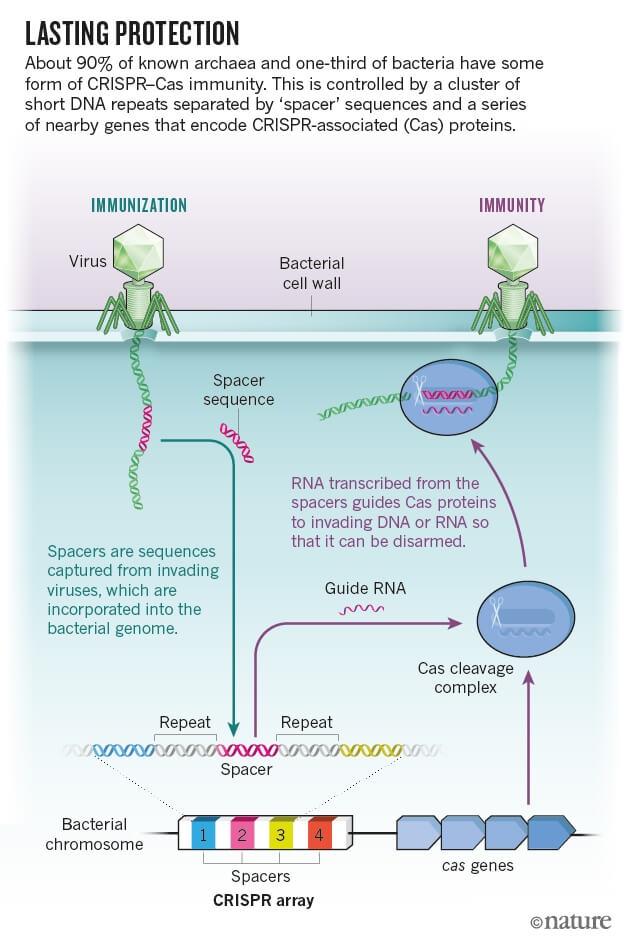
[V]iral DNA is chemically nearly identical to host DNA. How, in a cell packed with DNA, do the proteins know which DNA to add to the CRISPR–Cas memory?

Where did it come from?

How did bacteria and archaea come to possess such sophisticated immune systems? That question has yet to be answered, but the leading theory is that the systems are derived from transposons — ‘jumping genes’ that can hop from one position to another in the genome.


crispr graphic ONLINE
DNA in the spaces between CRISPR’s palindromic repeats sometimes matches sequences in viral genomes. Researchers have found that certain CRISPR-associated (Cas) proteins add these spacer sequences to the genome after bacteria and archaea are exposed to specific viruses or plasmids. Credit: NIK Spencer/Nature

What else might it be doing?

The origin of some spacers presents another mystery. Less than 3% of spacers observed so far match any known sequences in DNA databases. It could be a reflection of how little is known about viruses.

Why do only some microbes use it?

Whatever other functions CRISPR–Cas has, it is clear that some microbes use it more than others. More than 90% of archaea have CRISPR-based immunity…and no non-prokaryotic organisms…have been caught troubling with CRISPR–Cas at all.

How many flavours of CRISPR–Cas exist?
Humans tend to focus on the CRISPR–Cas9 system,…but microbes don’t play favorites…Researchers have officially recognized 6 different types of CRISPR system, with 19 subtypes.

The GLP aggregated and excerpted this blog/article to reflect the diversity of news, opinion, and analysis. Read full, original post: Five big mysteries about CRISPR’s origins

Even mild brain trauma could be dangerous for those at risk for Alzheimer’s Disease

o CONCUSSION facebook

Moderate-to-severe traumatic brain injury is a known risk factor for diseases that gradually destroy the brain – such as late-onset Alzheimer’s disease. Now, a new study links mild traumatic brain injury, or concussion, in people at genetic risk for Alzheimer’s to accelerated brain deterioration and mental decline associated with the disease.

Researchers, from Boston University School of Medicine (BUSM) in Massachusetts,…suggest that their study shows that there is a need to record even mild head injuries because, when combined with genetic risk, they may lead to long-term health problems, such as brain diseases.

Researchers also calculated a genetic risk score for Alzheimer’s disease for each participant…The results show that concussion appears to influence the link between genetic risk for Alzheimer’s disease and cortical thickness.

The results also highlight the importance of documenting concussion events and their symptoms, “even if the person reports only having their ‘bell rung’ and is able to shake it off fairly quickly,” notes Prof. Hayes, a research psychologist at the National Center for PTSD, VA Boston Healthcare System.

The GLP aggregated and excerpted this blog/article to reflect the diversity of news, opinion, and analysis. Read full, original post: Concussion linked to brain changes in people at genetic risk for Alzheimer’s

Genetically engineered killer zombie mice? Not quite

killahmouse

Neuroscientists at Yale University published a paper  [On Jan. 12, 2017,] in the journal Cell showing how they could trigger a mouse’s predatory instincts with a clever genetic trick. Key word: instinct. They’re not engineering mice to be mindless killers, roaming cages in search of their next target. They’re prompting the mice to do something they already do in the wild: hunt.

And yes, they did turn the mice into unusually efficient hunters,…[b]ut it’s a totally natural instinct that wild mice have to have in order to survive—we just don’t normally observe it, because we see mice in cages chowing on food pellets.

One of the most powerful, technologically-advanced tools in the neurobiology arsenal is a technique [called optogenetics, which], when described broadly, sounds a lot like mind-control.

To use optogenetics to activate a mouse’s predatory instinct is as simple as identifying a set of neurons that are sufficient to trigger the predatory behavior. This helps scientists understand how the brain controls hunting. It doesn’t make mice into zombies.

The GLP aggregated and excerpted this blog/article to reflect the diversity of news, opinion, and analysis. Read full, original post: No, Scientists Didn’t Turn Mice Into Killer Zombies

Are we slowly breeding our way to stupidity?

A study from Iceland is the latest to raise the prospect of a downwards spiral into imbecility…The scientists used a database of more than 100,000 Icelanders to see how dozens of gene variants that affect educational attainment appeared in the population over time. They found a shallow decline over the 65 year period, implying a downturn in the natural inclination to rack up qualifications.

But the genes involved in education affected fertility too. Those who carried more “education genes” tended to have fewer children than others. This led the scientists to propose that the genes had become rarer in the population because, for all their qualifications, better educated people had contributed less than others to the Icelandic gene pool.

Spending longer in education and the career opportunities that provides is not the sole reason that better educated people tend to start families later and have fewer children, the study suggests.

But the effect is very small…[The] researchers estimate that it corresponds to a drop in IQ of about 0.04 points per decade…Nevertheless, Kari Stefansson, who led the study, believes that if the trend continued for centuries, the impact could be serious.

The GLP aggregated and excerpted this blog/article to reflect the diversity of news, opinion, and analysis. Read full, original post: Natural selection making ‘education genes’ rarer, says Icelandic study

Stem cell revolution trudges forward

stem cells

[Editor’s note: The following is excerpts from an interview with Shinya Yamanaka, who won the 2012 Nobel Prize in Physiology or Medicine, for reprogramming mature cells into what are now called induced pluripotent stem cells.]

We are still in the early stages [of stem cell treatment]. In 2014, Dr. Masayo Takahashi and her colleagues at the Riken Center for Developmental Biology had great success using iPS cells to treat macular degeneration.

In some ways, yes, [the promise of stem cells] is overstated. For example, target diseases for cell therapy are limited. There are about 10: Parkinson’s, retinal and corneal diseases, heart and liver failure, diabetes and only a few more — spinal cord injury, joint disorders and some blood disorders…The number of human diseases is enormous….

I think the science has moved too far ahead of talk of ethical issues. When we succeeded in making iPS cells, we thought, wow, we can now overcome ethical issues of using embryos to make stem cell lines.

But soon after, we realized we are making new ethical issues. We can make a human kidney or human pancreas in pigs if human iPS cells are injected into the embryo. But how much can we do those things?

It is very controversial. These treatments may help thousands of people. So getting an ethical consensus is extremely important.

The GLP aggregated and excerpted this blog/article to reflect the diversity of news, opinion, and analysis. Read full, original post: The Stem-Cell Revolution Is Coming — Slowly

Days before inauguration, Trump’s secretary of agriculture pick still unclear

United States Department of Agriculture Jamie L Whitten Federal Building Washington DC June

A behind-the-scenes fight between agribusiness tycoons and members of Donald Trump’s camp who want more diversity in the Cabinet has turned the selection process for Agriculture secretary into a months-long battle.

The usually low-profile post remains the only Cabinet-level job without a nominee in the final days before Trump is inaugurated. Word leaked out two weeks ago that Trump was poised to pick former Georgia Gov. Sonny Perdue, but the announcement never came.

Now, sources say Perdue’s status as the favorite may be in doubt amid a last-minute push for former California Lt. Gov. Abel Maldonado, who offers Trump one last chance to put a Hispanic in the Cabinet.

The parade of candidates to Mar-a-Lago and Trump Tower range from Texas agriculture commissioner Sid Miller — who’s also a rodeo cowboy — to Susan Combs, a former Texas agriculture commissioner who penned a steamy romance novel and supported abortion rights. Most recently, Indiana Agriculture Director Ted McKinney and Kip Tom, an Indiana farmer who ran for Congress last year, have also visited Trump Tower.

Elsa Murano, a Cuban-born professor at Texas A&M University who once served as the food safety undersecretary at USDA also made visits but it’s unclear whether she remains in contention.

The GLP aggregated and excerpted this blog/article to reflect the diversity of news, opinion, and analysis. Read full, original post: Trump’s missing Cabinet secretary

How bacteria inspired the birth of CRISPR gene editing

CRISPR

Within a few years, the study of CRISPR had moved beyond fundamental research into a full-fledged gene-editing revolution that enabled scientists to fashion novel plants and animals with thrilling—and sometimes troubling—ease.

Humans learned these gene-editing techniques from bacterial species that used CRISPR to fight off their viral attackers…Whenever such a bacterial cell kills off a virus, it inserts a fragment of the viral DNA into its own genome, which allows it to identify that virus easier in the future. To make that genomic self-edit, bacteria cut their own DNA using two CRISPR-associated proteins (Cas1 and Cas2), insert the virus’s genetic signature, and stitch the DNA back together with DNA-repairing enzymes.

Gene editing also quickly raised a gamut of medical, legal, and ethical questions. The steady stream of studies in which scientists used CRISPR to change over a dozen plant and animal genomes, brought up an uncomfortable question: Are humans next? Would it be ethical and beneficial to apply gene-editing techniques to ourselves?

The GLP aggregated and excerpted this blog/article to reflect the diversity of news, opinion, and analysis. Read full, original post: How Bacteria Taught Us to Edit Genes

Genetics say your perfect mate is someone just like you

x

If your genes can’t have you all to themselves, they’ll seek out the next best thing: A recent study on assortative mating has uncovered statistical evidence that you’re more likely to lock things down with someone just like, well, you.

By analyzing three studies with publicly available genetics data on more than 24,000 heterosexual couples of European ethnicity, the researchers discovered that most couples were highly likely to date someone of a similar height, body mass index (BMI), and even blood pressure.

The researchers also tested correlations between other metrics of desirability, such as education level. [As a result, they found that two] PhDs are more likely to date each other than they are someone without a college education. While you could easily chalk this up to a matter of life choices or socioeconomic effects, the researchers found that genes associated with pursuing more education…were more often than not shared between mates.

The new research represents a continuation of the growing field of science that studies assortative mating—basically, how we choose our partners—in human beings.

The GLP aggregated and excerpted this blog/article to reflect the diversity of news, opinion, and analysis. Read full, original post: Your Genes Influence Who You Settle Down With

Wine with no hangover? CRISPR gene-edited yeast could make that happen

Screen Shot at AM
[R]esearchers working at the University of Illinois College of Agricultural, Consumer, and Environmental Services (ACES) claim to have produced a yeast that could vastly increase the quality of wine while also reducing its hangover-inducing properties.

…researchers developed what they call a “genome knife,” which allowed them to slice across multiple copies of a target gene until all the copies were cut, thereby making it impossible for any remaining genomes to correct any altered ones.

After being completely cut, the enzyme RNA-guided Cas9 nuclease was then employed to carry out precise metabolic engineering on strains of polyploid Saccharomyces cerevisiae, a species of common yeast instrumental in winemaking, bread baking, and beer brewing.

This newly-modified strain, the team believes, is a breakthrough of “staggering” proportions. The applications of this compound possibly range in the thousands, given the ubiquity of the species of yeast and its use in a myriad different industries.

if winemakers were to clone this new enzyme, then they could use it to improve malolactic fermentation (the conversion of bitter malic acid, naturally present in freshly pressed grapes, into softer-tasting lactic acid) to produce a consistently smoother wine while also removing the toxic byproducts that can cause hangovers.

The results of this research was recently published in the journal Applied and Environmental Microbiology.

The GLP aggregated and excerpted this blog/article to reflect the diversity of news, opinion, and analysis. Read full, original post: New innovations in biotechnology mean good news for wine drinkers