[A] potential ban or suspension of NNi [neonicotinoid seed treatment] technology would have tremendous economic implications…. To take few examples: over a five-year period, the EU could lose 17 billion EUR and more; 50,000 jobs could get lost economy-wide; and more than a million people engaged in arable production and their livelihoods would certainly suffer if NNi were lost.
In addition, if NNi were no longer available in the EU, there would be a significant reduction of food production considerably altering the agricultural trade balance. Moreover, any reduction in agricultural productivity in the EU would need to be compensated by making new arable land available outside of the EU. … The environmental cost of converting this land for arable use would be substantial….
Growers across the EU would lose a significant part or their economic margins, or entirely lose profitability on some major crops. Large agricultural industries, such as European sugar producers, or seed companies would be exposed to significant risks and become far less competitive and entire regions could suffer negative socio-economic consequences, or be deprived of important growths opportunities.
The study also underlines the importance of looking holistically at agriculture. An action taken in one area, not fully considered, can have major unintended consequences elsewhere. In addition, the study shows, perhaps surprisingly, that NNi has become an integral part of European agriculture and significantly contributes to European food production. If this technology were no longer available, food production would decline by an amount sufficient to feed many millions of people.
The GLP aggregated and excerpted this blog/article to reflect the diversity of news, opinion and analysis. Read full, original post: The value of Neonicotinoid seed treatment in the European Union A socio-economic, technological and environmental review
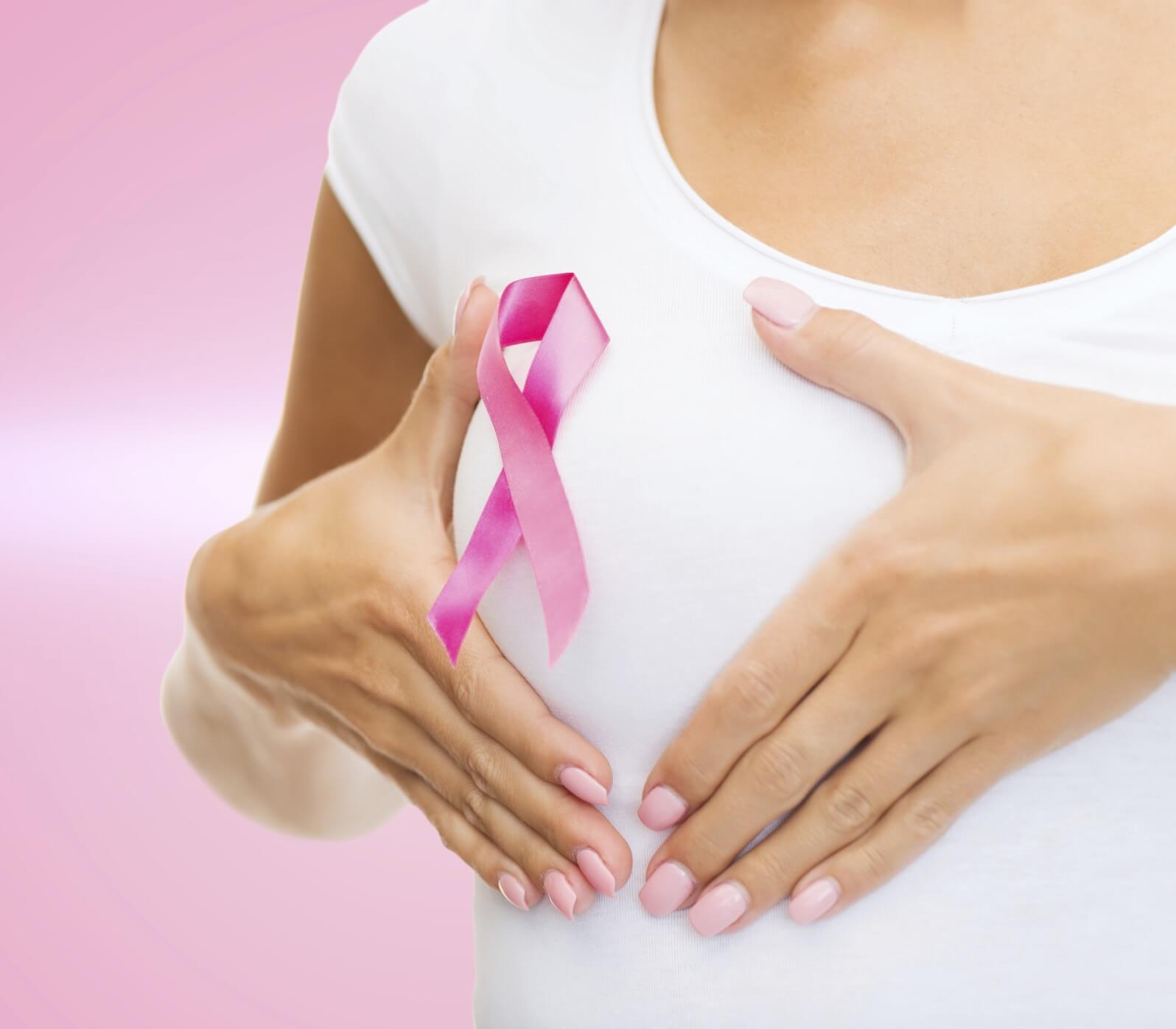
While mutations of the BRCA gene can increase a woman’s chances of developing breast and ovarian cancers, the presence of the gene made no difference in survival for women aged 40 years or younger who were diagnosed with early-stage breast cancer, according to a recent study….
…
According to the lead author of the study, Diana Eccles, a professor of Cancer Genetics, these results are important because there is a commonly held misconception that carrying a BRCA mutation worsens the prognosis of a patient who develops breast cancer.
…
Eccles went on to explain that the results of the study highlight the notion that younger, BRCA-positive patients diagnosed with breast cancer can at least temporarily put off decisions about preventive bilateral mastectomy and rely on regular screening for recurrence instead.
“Younger women will (tend to) take the most extreme treatment anybody will offer, because they think it will give them a better chance of surviving,” she said.
…
Eccles added that having non-essential surgery while being treated for cancer might compromise the body’s immune system, jeopardizing the response to therapy.
ADHD is highly genetic, and [the ADGRL3 gene] in particular has long been implicated it its development…Now, a new study goes even further, finding a specific malfunction on the gene that is highly associated with [attention deficit hyperactivity disorder] and related disorders — clearing the way for specialized medications and greater understanding of the neural pathways behind ADHD.
Researchers identified one specific section of the gene…that worked differently in the brains of those with ADHD. They found that a malfunction in ECR47 caused the ADGRL3 gene to be expressed less in the thalamus…and was linked to decreased sensory processing abilities, as well as to classic ADHD symptoms like impulsivity and inattention.
…
The results provide just a small piece of the puzzle of the genetic components that control ADHD, the researchers said, but the progress is promising — particularly when it comes to the development of new medications.
This means that medications could be created that specifically target the ADGRL3 gene — or even the ECR47 mutation — to benefit patients for whom traditional stimulants don’t work.
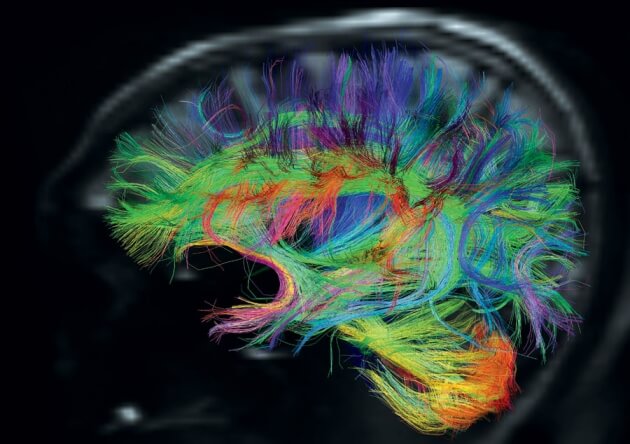
Over millions of years, retroviruses have been incorporated into our human DNA, where they today make up almost 10 per cent of the total genome. A research group at Lund University in Sweden has now discovered a mechanism through which these retroviruses may have an impact on gene expression. This means that they may have played a significant role in the development of the human brain as well as in various neurological diseases.
Retroviruses are a special group of viruses [that]…can be found in a part of DNA that was previously considered unimportant, so called junk-DNA….
“[R]etroviruses account for 8-10 per cent of the total genome. If it turns out that they are able to influence the production of proteins, this will provide us with a huge new source of information about the human brain,” says Johan Jakobsson [from Lund University]. And this is precisely what the researchers discovered.
…
The differences between mice and humans are particularly important in this context. Many of the retroviruses that have been built into the human DNA do not exist in species other than humans and our closest relatives….
The GLP aggregated and excerpted this blog/article to reflect the diversity of news, opinion, and analysis. Read full, original post:Viruses in genome important for our brain
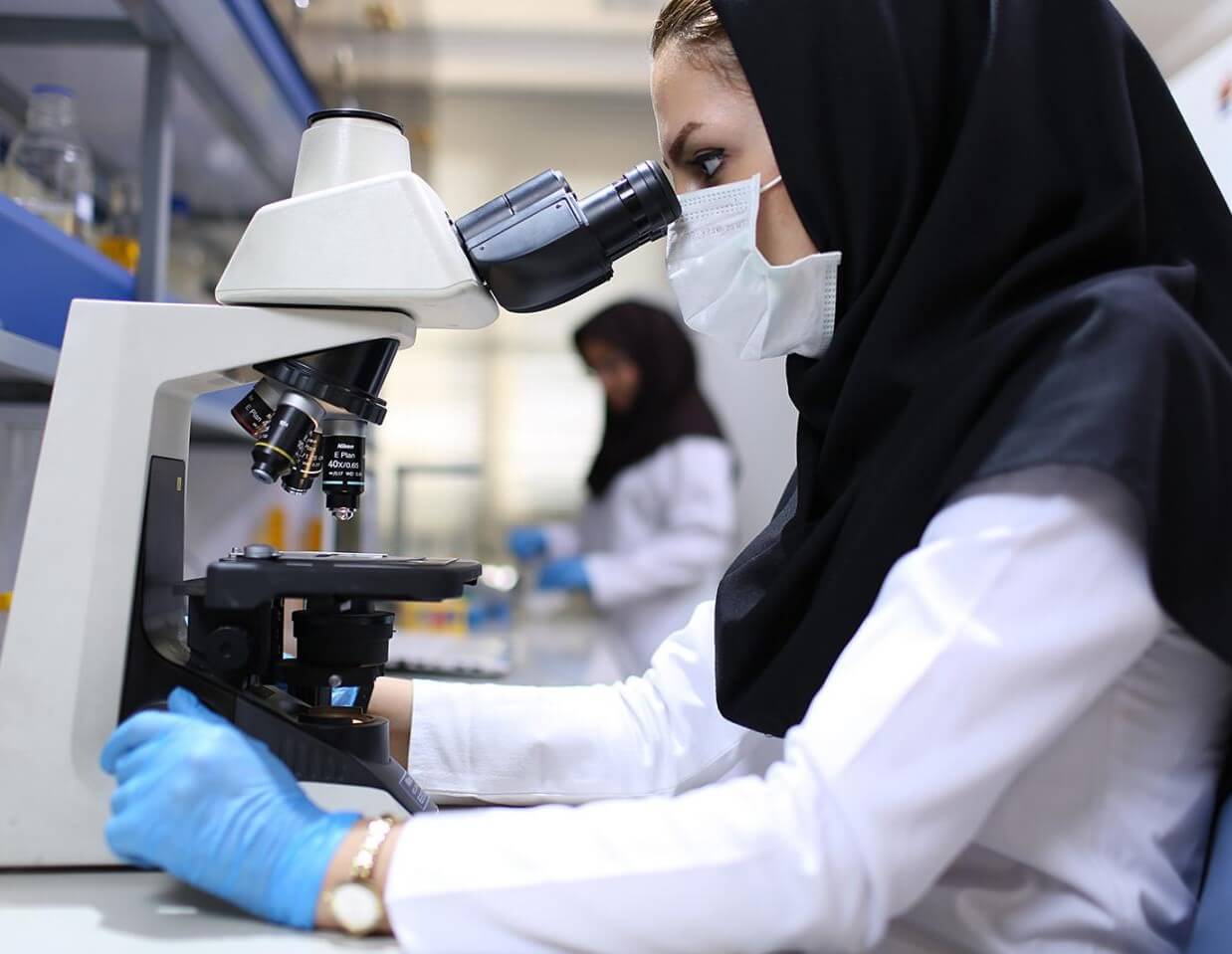
[In the past 14 years, Iran has] made great strides in stem cell research. And now that Iran is losing its pariah-state status after sanctions were lifted, there are opportunities for collaborations with non-Iranian scientists….
…
Iran didn’t view stem cell research as problematic because under Islamic law life is defined not at conception, but when one can distinguish a heartbeat…While the world scrutinized Iranian nuclear advances, the country’s stem cell embryonic research had risen to the scientific forefront.
…
Partnering with Iranian colleagues offers many advantages, said [Ali Brivanlou, who leads the Stem Cell Biology and Molecular Embryology lab at The Rockefeller University]…Their technologies can help countries neighboring Iran, which face similar medical and environmental challenges but aren’t as advanced.
…
Richard Stone, who oversees international coverage at the journal Science, said that because Iranian scientists had to play by tougher rules, they learned to think about every little detail of a study or experiment.
…
Joining forces in research would unlock the untapped potential the Iranian stem cell scientists hold, Brivanlou said. It would also allow Western and Iranian scientists to share and exchange research materials, allowing for greater genetic diversity in experiments.
[According to new research into fruit flies, a] high-sugar diet actually reprogrammed how genes function — genes that are closely related to those that help determine the human life span.
If that’s the case, then it doesn’t really matter if the body repairs itself or the fruit fly switches to a healthier diet. Even if everything else about the fly gets back to a healthier baseline, those genetic changes means the fly’s body can no longer properly respond to or process what “normal” is.
…
Of course, we’re talking a truly heroic amount of sugar here, as the flies consumed about eight times the healthy daily amount….
Since almost nobody is consuming that much sugar, it’s not clear how applicable these results are to humans. But the researchers point out that the gene, dubbed FOXO, affected by the flies’ high-sugar diet has a direct evolutionary counterpart in humans, and our FOXO gene is important in determining longevity. While genetic effects of too much sugar likely aren’t shaving an entire half-decade off people’s lives, they could still be shortening how long people live.
[S]oon, stem cells swabbed from human beings’ cheeks or skin could be cultured to create germ cells (sperm and eggs), and from there used to create a human being.
The process, known as in vitro gametogenesis (IVG), has never been completed with cells from people…But there have been real, live mice…created through this process. Every indication is that human beings will soon follow.
…
With IVG, there would be no need for the complicated and expensive process of retrieving a donor egg from a third person. Instead, a swab of the cheek and some time to culture in a laboratory could produce as many eggs as the woman might need.
…
And if large groups of embryos are created, whether for purposes of creating children or for research, it’s likely that many [embryos] will be destroyed, intentionally or otherwise. And there are people who believe deeply that destroying an embryo is murder.
This isn’t a new issue…But IVG does present a new potential flashpoint for this debate, with the real possibility of conflict between activists who would attribute human rights to embryos and parents seeking fertility treatments.
…
[Eli Adashi, a professor of medical science at Brown University,] warns that if scientists don’t begin that conversation, the results will be bad for science.
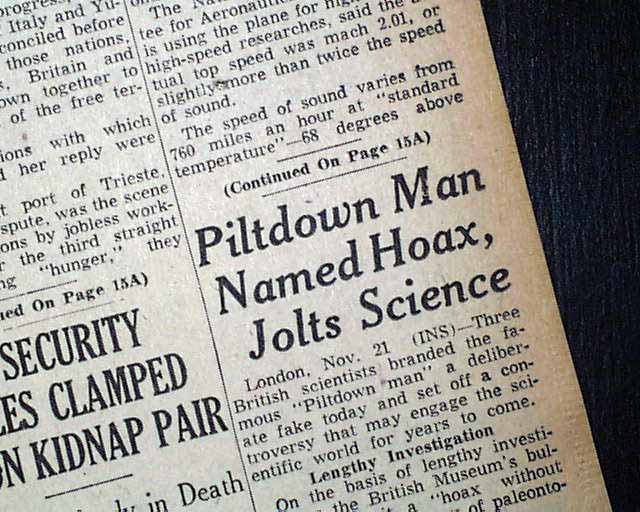
Rivalry, jealously, con artistry, practical jokes, grand scale bias, and patriotism compounded by World War I era geopolitics. we’re not talking about an episode of the PBS drama Downton Abbey, a daily soap opera or even a classic old film–this is the background story about the discovery of Piltdown Man, perhaps the most notorious hoax in the history of modern science. It was a dark event, and has been relegated to the footnotes of history books. But occasionally the story surfaces, as it did last year when DNA extracted from bones revealed new information on how the hoax was orchestrated.
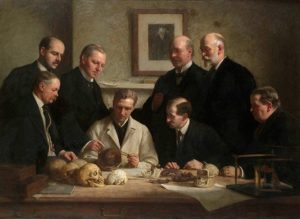
Portrait of Piltdown skull being examined. Back row (from left): F. O. Barlow, G. Elliot Smith, Charles Dawson, Arthur Smith Woodward. Front row: A S Underwood, Arthur Keith, W. P. Pycraft, and Ray Lankester
The setting was England. The key players were the scientific community itself, especially the scientists at London’s prestigious Natural History Museum. At the time, dozens of paleoanthropologists, anatomists and geologists were engaged in various research projects, but they all knew of a sure pathway to global recognition: identifying the “missing link,” the elusive, presumably extinct species representing the transition between humans and apes.
People of the time had a very specific idea of what an ancient “ape man” should look like. That pre-determined conviction left them vulnerable to the trap of confirmation bias–paying attention only to data that seem to support one’s beliefs. Today, we see the same thing happening with the
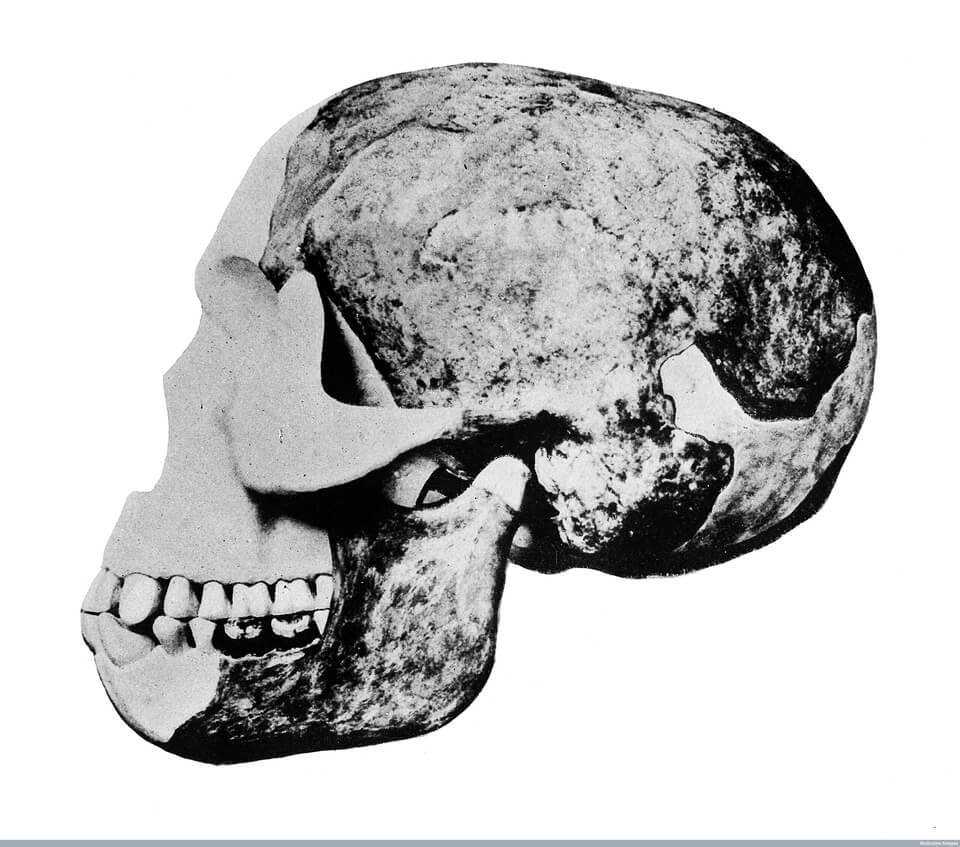
A 1913 reconstruction of “Eoanthropus dawsoni”
anti-GMO, anti-vaccine, and other activist movements. They cherry pick studies for nuggets of information that support their views. During the Piltdown affair, however, it was not activist fringe groups, but respected scientists who fell into the trap.
They were convinced that our human ancestors had grown large brains and smartened up while continuing to walk around in an apelike way, with matching jaws and teeth. And while they embraced the Piltdown Man as the real thing, they ignored major discoveries of authentic extinct species – hominids that today we know were real-life transitional forms between us and our apelike ancestors.
A tale of two skulls
The Piltdown incident started when amateur archaeologist Charles Dawson got hold of a few fragments of a human skull, probably around 1908. Dawson’s day job as a solicitor took him around England’s Sussex region, and in the town of Piltdown he had noticed a gravel pit that he thought might hold fossils. By 1911, Dawson had recruited two partners – Teilhard de Chardin and Arthur Smith Woodward, the latter being chief of geology at the natural history museum. By 1912, they had more skull fragments and an assortment of uniformly-darkened fossils (bones and teeth) from various animals, many from the Ice Age. AND They eventually found a mandible that looked decidedly non-human.
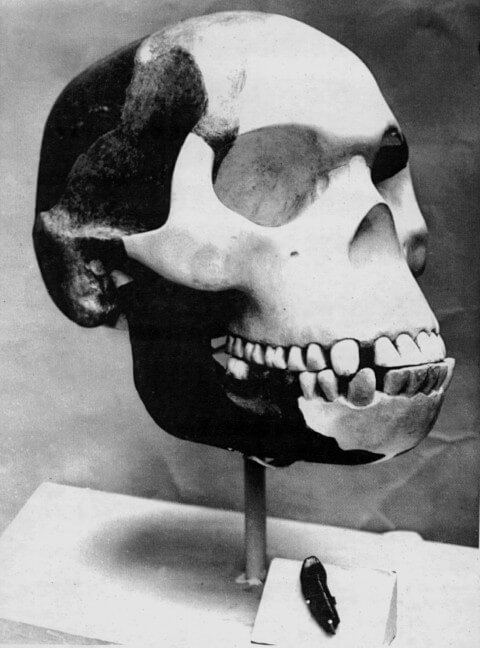
Cast of the Piltdown Man’s skull.
It just happened that the parts of the mandible that would have shown it to be from a modern ape were missing, so Smith Woodward proposed it had once gone together with the skull. This implied the existence of species with a human like cranium and an ape-like jaw. This supported the popular idea of the brain growing first as the jaw and teeth lagged behind in evolution. Such a creature also implied something else: the ‘missing link’ had lived in England. That was how Dawson and Smith Woodward presented their find to the British Geological Society at the end of 1912.
There were anatomists and dentists suggesting that putting the jaw and cranium together made no sense at all, which lead to debate that culminated in the summer of 1913. Naysayers proposed that the Piltdown hypothesis would be stronger had the mandible included a canine tooth with certain characteristics. Within two weeks, de Chardin found a tooth at the site matching the predicted features. In 1916, Dawson died, but only after telling Smith Woodward of a second skull at another site, three kilometers from the first. Smith Woodward never found that second site, but he did obtain Dawson’s second skull, and this silenced any remaining criticism.
Fooled
But everything had changed by 1953, when the hoax was fully exposed. It turned out that someone had collected bones, teeth and even created primitive looking flint tools, staining them with various chemicals, and planting them, to create the fictional skull and setting. The perpetrator had gathered authentic fossils from extinct animals, from multiple dig sites around the globe and placed the specimens together in the pit with the human skull fragments and a mandible from an orangutan. The perpetrator also made sure to break off the parts of the mandible that would have revealed its ape origin. There also were primitive flint tools and everything was stained multiple times to create a kind of uniformity.
Some of the chemical tests performed in the middle of the century to blow the hoax were new for the era, but there were other analyses that Smith Woodward could have done that would have revealed the fraud. He could have tested the bones for nitrogen content, for instance, or examined the teeth with a magnifying glass to see that they’d been filed down. He didn’t bother with any of this, despite being a top researcher of his period. Smith Woodward would spend more than 30 years (he died in 1948) digging at the Piltdown gravel pit looking for more specimens that would never appear.
Ignoring more impressive evidence
In the years leading to the Piltdown ‘discovery’ and in the years that followed, scientists made other fossil discoveries that we now recognize as milestones. The finds were not in England and, importantly, they didn’t support the favored hypothesis of the time, namely that brain growth had led the way in human evolution while the jaw and progression to upright walking had lagged behind.
The H. heidelbergensis discovery of 1907 was a major find, as the species is the suspected common ancestor of modern humans (Homo sapiens) and Neanderthal man. However, in the 1890s, Dutch researcher Eugène Dubois discovered ‘Java Man’, the first in a series of finds establishing the presence of a human ancestor called Homo erectus, more ancient than H. heidelbergensis. Java Man came with lower extremity specimens, including a knee that locked, proving that he had walked upright, and yet the brain volume was intermediate between modern humans and the chimpanzee. Because the idea of a small-brained human ancestor walking upright really bothered paleoanthropologists of the time, Dubois was treated pretty much as a quack –until the late 1920s, when H. erectus fossils started appearing at various sites around the world.
In 1924, as Piltdown Man was still being hailed in England as solid evidence that brain enlargement had led the way in human evolution, Australian Raymond Dart discovered a skull in South Africa of a hominid species even older than H. erectus. Known as Taung Child, Dart’s specimen represented a distinct genus that he called Australopithecus. The brain was not significantly bigger than that of a chimpanzee, but the face and jaw showed major progression in the pathway from ape to human. His finding was viewed skeptically by many.
Like Dubois, Dart was eventually vindicated, but only after nearly two decades of having his papers rejected for publication in leading peer reviewed journals. Before the Natural History Museum in London officially blew the lid off the Piltdown hoax in 1953, the proposed E. dawsoni, species already looked like a sideline show, alongside a series of fossils from around the planet that painted a very different picture of human evolution.
How could this have happened?
To be sure, the hoax was extremely elaborate. But there were other scientists who had devoted large segments of time to the Piltdown excavation and analysis, including de Chardin. The canine tooth that he discovered in 1913 turned out to be one of the more bogus specimens planted at the site. And when checking it in the early 1950s, researchers at the museum found brown paint that simply scratched off.
How could this be? How could trained fossil hunters fail for something so basic? The hoax was not uncovered because of simple reason: The specimens were not fully vetted, perhaps because researchers wanted it to be true. Confirmation bias. Englanders wanted to believe that humanity had emerged in England. That was relevant not just scientifically but also politically, because England’s rival, Germany, had cornered the market in human fossil research until this point. Germany, after all, had the famous Neanderthal Man, plus it had another ancient human species just recently unearthed —Homo heidelbergensis, discovered in 1907, just one year before Dawson’s ‘discovery’ of the first skull fragments.
The main protagonist in exposing the hoax was Kenneth Page Oakley, chief of anthropology at the Museum. Employing a test for fluorine content, Oakley showed in 1953 that the cranial bones were not from the same time period as the mandible, and that cranial bones and mandible were no more than a few hundred years old. By 1959, carbon dating was available and narrowed down the ages of the bones further, but the real intrigue since that time has surrounded the search for the hoax perpetrator.
Charles Dawson
It’s not surprising, of course, that Dawson remains a prime suspect. He was mentioned in that capacity even in the new study, but researchers and historians also suspect that others were messing around at the gravel pit. Very suspiciously in this regard, one of the last specimens ‘discovered’ was in 1915, an elephant bone shaped–clearly by chipping away with a steel knife–into the form of a cricket bat.
To illustrate the power of confirmation bias, it’s noteworthy that Smith Woodward took the cricket bat-shaped object seriously and wrote a paper proposing it to be a Stone Age Implement. But it looks more like a message from somebody — either the hoaxer or somebody who suspected the hoax and wanted to blow it — that in fact the entire collection of bones was a scam.
It turns out that there were practical jokers in England’s science community. de Chardin had a reputation in that capacity, but he was back in France when the cricket bat seems to have been planted. But at the Natural History Museum there was a fossil authenticator, a zoologist, Martin Hinton, who also engaged in practical jokes. Early in his career, Hinton had a falling out with Smith Woodward over a funding issue, but later rose to high ranks at the Museum. Shortly after Hinton’s death in the middle of the century, researchers found a trunk among Hinton’s possessions. Inside the trunk were bones that Hinton had stained and then cut, apparently to see how deep the stain could penetrate. Hinton also wrote to a suspicious American colleague that indeed Piltdown was a hoax.
Was Hinton actually the hoax perpetrator? Or was he experimenting with the bone stains, merely to figure out what the perpetrator had done? It’s really hard to know, but one thing is clear. Both the creation of the hoax and the planting of the cricket bat made Smith Woodward look pretty silly. So at minimum Hinton is a character in a tale of vicious rivalry and spite. We may never know the answer in this case, but perhaps confirmation bias could form the basis of a soap opera, as a warning to anyone who might fall into the trap.
David Warmflash is an astrobiologist, physician and science writer. Follow @CosmicEvolution to read what he is saying on Twitter.
[L]ast summer Congress issued reforms to the Toxic Substances Control Act, a 30 year old law governing how the EPA and other federal agencies check the boxes that let new chemicals come to market.
…
But one thing seems clear—the slowdown is real.
…
The Toxic Substances Control Act has been around since early days of the EPA. … Now, by law, the EPA must give a full review to every substance, and only those that pass can go to market.
…
[W]hile new regulations might keep dangerous chemicals in their beakers, other, more innocuous substances often get unfairly flagged … These include genetically modified microorganisms being used to create all kinds of new chemicals … These include: Yeasts that fart ethanol; fungi that secrete cellulose; algae that poop biofuels; bacteria that digest oil spills; and a host of other commercially useful microbes that have been spliced with genetic material outside their own genus.
A handful of these helpful GMOs have made it through the post-reform Toxic Substances Control Act EPA…But chemists and companies are concerned that increased data burdens in the new EPA regulations are stifling efforts to engineer solutions from unlikely places.
Editor’s Note: This article discusses a recent talk by Sir Richard Roberts, awarded a Nobel Prize in Medicine for his contribution to the discovery of gene splicing, at Amity University.
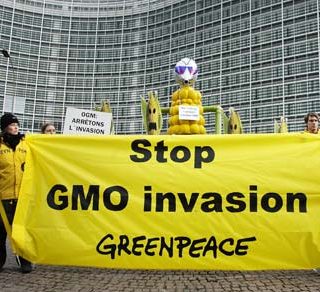
Activist organisations like Greenpeace and Vandana Shiva’s Navdanya have successfully blocked the introduction of genetically modified crops around the world. Bt Brinjal was banned in India, and activists are working to stop the introduction of genetically modified mustard.
Anti-GMO activists claim this process is unnatural and could produce unanticipated mutations that could be devastating for the planet.
…
But that’s not the case, said Sir Richard Roberts, Nobel Laureate. And banning GMOs means farmers can’t get access to the tools they need to cope with changing climate conditions, like hotter temperatures and droughts.
[India needs] better crops, you know? The monsoons are changing, you’re not getting the same rains you used to have, you’re going to need drought resistant crops, you’re going to need a lot of changes being made. You can’t do that through traditional breeding.
We now have 30 years of experience, we now know that it’s perfectly safe. There has not been one documented case of any problem, and there have been thousands upon thousands upon thousands of hectares of these crops. Not one incident.
…
These activists should admit that the science overwhelmingly indicates that GMOs are necessary to address the world’s agricultural and nutritional challenges, said Roberts.
The liberal obsession with things that are “natural” or “organic” often also clashes with science…just because a product is processed, packaged, genetically modified, and full of preservatives does not mean it is unhealthy. In some cases these products can be healthier than their natural counterparts, and, in the case of genetically modified organisms (GMOs), critically important to the future of our species … As population grows, so too does the demand for food. If we have the power to increase yields, improve quality, and bolster heartiness, all while maintaining the safety and integrity of the food we eat, then we have a moral obligation to do so. GMOs accomplish this, and have been doing so in increasingly sophisticated and promising ways for more than 30 years.
Based on reviews of more than 900 studies, every major health organization in the world, from The World Health Organization to the National Academy of Sciences, has confidently declared GMOs safe to eat.
…
Last March, Senate Democrats killed a bill that would have prevented the mandatory labeling of GM foods. On the surface, this sounds like a victory for consumers…But the problem is that since GMOs are completely safe, to slap what amounts to a warning label on them is unnecessary, and could unjustly damage a vital industry.
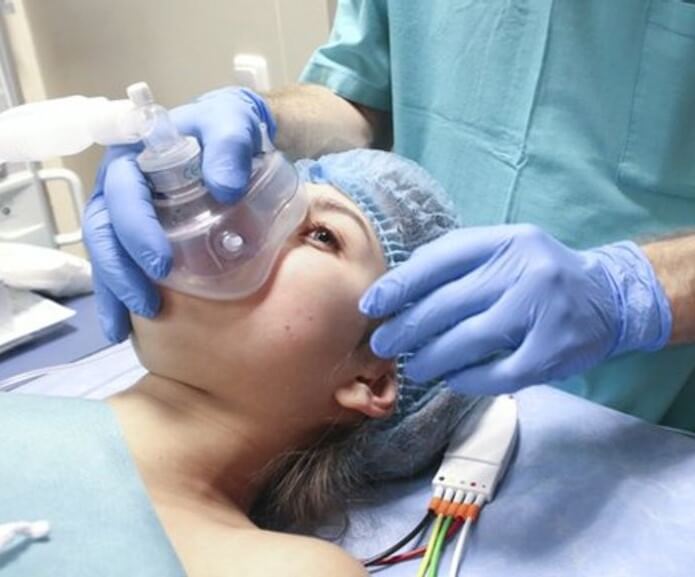
Local anesthetic resistance is a rare condition that’s so poorly researched that many medical professionals refuse to acknowledge that it’s even real. But for those individuals who experience it, there’s no doubt. Take Lori Lemon, for instance. She has had to endure excruciating dental procedures from a young age, often at the bewilderment of dentists.
…
But there are doctors who are taking this condition seriously, and a breakthrough may have finally been made, thanks in large part to Lemon and her family.
…
[A genetic analysis of the Lemon family] revealed a genetic defect…that relates to a specific sodium channel in the body, known as sodium 1.5…The reason that’s significant is because a leading theory for how local anesthetics work involves the fact that [the protein NaV1.5] disrupts sodium channels. These channels conduct positively charged sodium ions, and with them, the feeling of pain to nerve cells.
…
[I]t’s possible that the mutation could make the sodium channels more likely to remain open, which would allow pain signals to continue to flow to the brain even in the presence of local anesthetic.
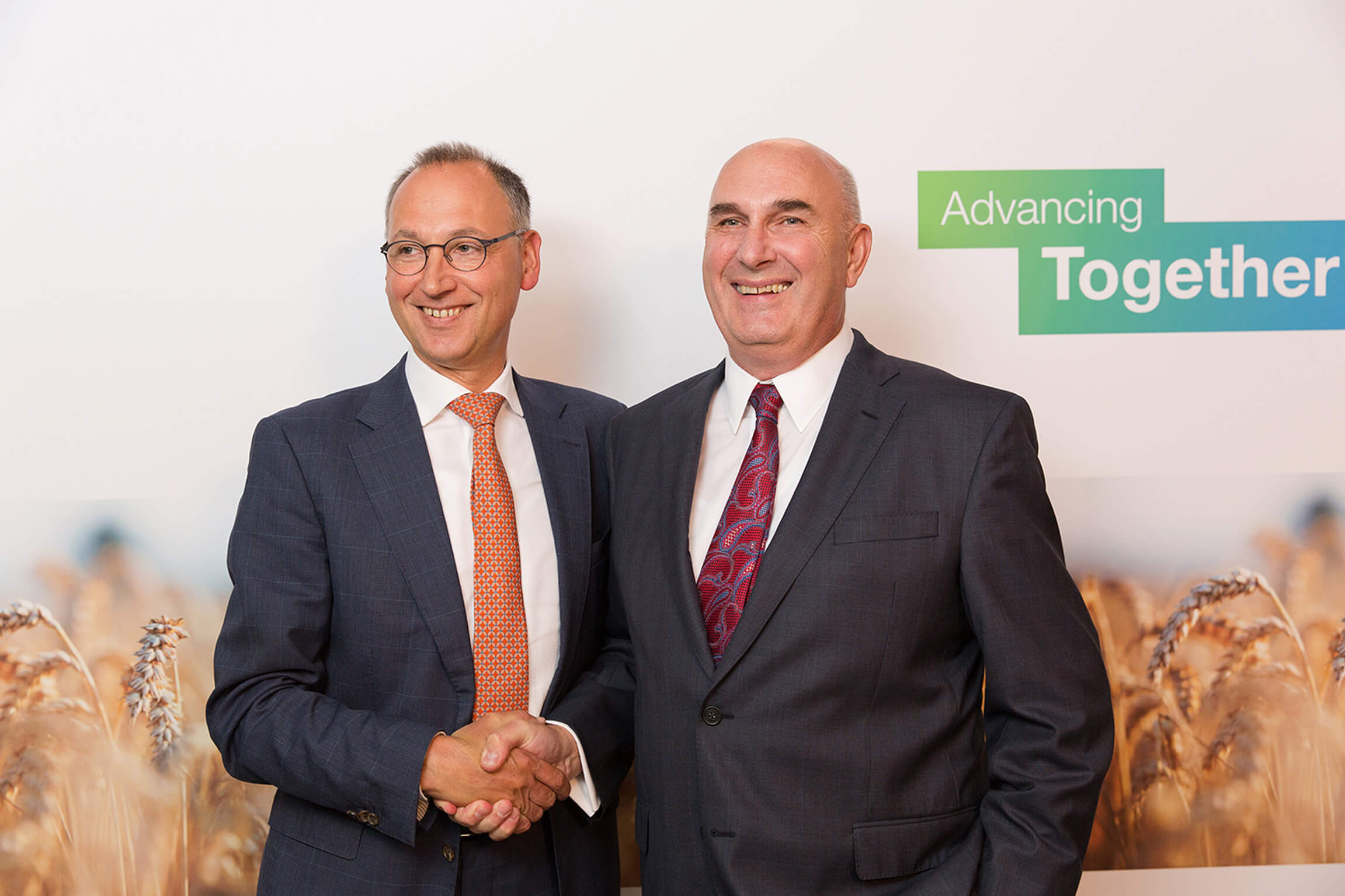
Top executives of Bayer AG and Monsanto Co. met with President-elect Donald Trump Wednesday in New York to pitch the benefits of their planned deal.
…
The German pharmaceutical giant’s planned purchase of Monsanto is one of three planned multibillion-dollar deals set to reshape the global seed and pesticide industry. While the companies have said that combining Bayer’s broad portfolio of pesticides with Monsanto’s sector-leading capabilities in seed engineering will accelerate breakthroughs in new crops and sprays, some farmers worry that the consolidation will boost the market power of the sector’s biggest players and leave farmers with fewer choices for critical supplies, and higher prices.
…
Mr. Trump has previously expressed skepticism about megamergers, including AT&T Inc.’s planned purchase of Time Warner Inc., but he hasn’t weighed in on the agricultural deals.
…
Beyond Bayer and Monsanto, China National Chemical Corp. is pursuing a $43 billion deal for Swiss pesticide maker Syngenta AG, while Dow Chemical Co. and DuPont Co. are pursuing their own merger that would unite those companies’ seed and crop chemical businesses.
The GLP aggregated and excerpted this blog/article to reflect the diversity of news, opinion, and analysis. Read full, original post: Bayer, Monsanto CEOs Pitch Deal to Trump
[Editor’s note: Stephanie Seneff, co-author of this paper, is a controversial MIT computer scientist and anti-GMO critic who has advanced several theories about the supposed detrimental health effects of glyphosate. You can read more about Seneff here and myths about the causes of autism in David Warmflash’s GLP article: Autism: No, it’s not caused by glyphosate or circumcision, but is likely in our genes.]
The prevalence of autism has been rising at an alarming rate in the United States over the past two decades… The pattern of this rise is extremely well matched temporally to the rising use of glyphosate on corn and soy crops….
. . . .
In this paper, we develop the hypothesis that glyphosate’s potential link to autism can be explained in part through an adverse effect on the thyroid gland of both the mother and the child during gestation.
. . . .
It was proposed that manganese chelation by glyphosate can explain a number of human pathologies that are currently on the rise, including autism. … Here, we focus on the effects of manganese deficiency on the disruption of phosphatase activity, and the ramifications leading to low thyroid activity.
We acknowledge that we have not yet proven that glyphosate/GFH [Glyphosate-formulated herbicide] exposure from common food and beverages causes human autism. On the other hand, we have perhaps highlighted glyphosate’s/GFH’s molecular potential, through a set of deduced mechanisms. This theory will have served its purpose if it spurs appropriate future research, including as outlined above. … Regardless, mothers are advised to consume and feed their family an organic diet as a precautionary measure.
Can tiny brains grown in a dish reveal the secrets of sociability? Balls of brain tissue generated from stem cells are enabling us to understand the underlying differences between people who struggle to be sociable and those who have difficulty reining themselves in.
Alysson Muotri at the University of California, San Diego, and his team created the mini-brains by exposing stem cells taken from the pulp of children’s milk teeth to cocktails of growth factors that help them mature. Eventually, they can develop as many as six layers of cerebral cortex.
…
The team found that mini-brains grown using stem cells from children with autism form fewer neural connections, while those from Williams syndrome children have an abnormally high number. When cells from the teeth of children with none of these conditions were used, the resulting mini-brains were somewhere in between these two extremes.
“The differences are striking, and go in opposite directions,” says Muotri. “In Williams syndrome, one of the cortical layers makes large projections linking into many other layers, and these are important for sociality,” he says. “By comparison, autism-linked brains are more immature, with fewer synapses,” he says.
The U.S. Department of Agriculture on [Jan. 11] took a step toward increasing the production of organic foods — which has not kept pace with demand — by launching a program to certify farmland that growers are in the process of switching to organic.
Obtaining certification under the program will allow farmers to sell products raised in accordance with organic guidelines for higher prices than conventionally-grown goods, according to the Organic Trade Association, an industry group. That should help growers cover the extra costs associated with transitioning to organic farming, the group said.
. . . .
Farmers must grow crops for three years without using prohibited substances, such as genetically-modified seeds and synthetic pesticides, in order to be certified as fully organic.
Those who are switching farmland to organic production must follow the same regulations as those who have already been fully certified, the trade group said. So far, however, farmers have not been able to designate their crops as being in transition in an attempt to sell the products for higher prices.
. . . .
Farmers will need to prove they have been following the guidelines for organic production for at least a year to be certified as transitioning their land, according to the trade group.
The GLP aggregated and excerpted this blog/article to reflect the diversity of news, opinion and analysis. Read full, original post: U.S. takes step to boost organic food production
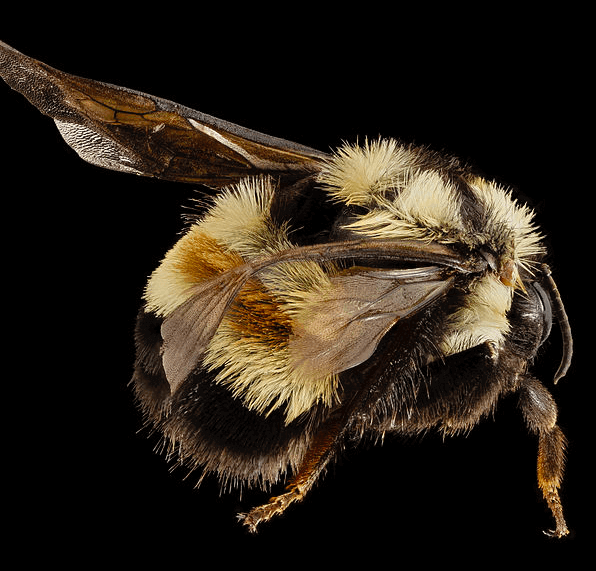
The rusty patched bumble bee … was listed on [Jan. 10] as an endangered species, becoming the first wild bee in the continental United States to gain such federal protection.
One of several species facing sharp declines, the bumble bee known to scientists as Bombus affinis has plunged nearly 90 percent in abundance and distribution since the late 1990s, according to the US Fish and Wildlife Service.
The agency listed the insect after determining it to be in danger of extinction across all or portions of its range, attributing its decline to a mix of factors, including disease, pesticides, climate change and habitat loss.
. . . .
Government scientists point to a certain class of pesticides called neonicotinoids — widely used on crops, lawns, gardens and forests — as posing a particular threat to bees because they are absorbed into a plant’s entire system, including leaf tissue, nectar and pollen.
Bumble bee populations may be especially vulnerable to pesticides applied early in the year because for one month an entire colony depends on the success of a solitary queen that emerges from winter dormancy, the wildlife service said.
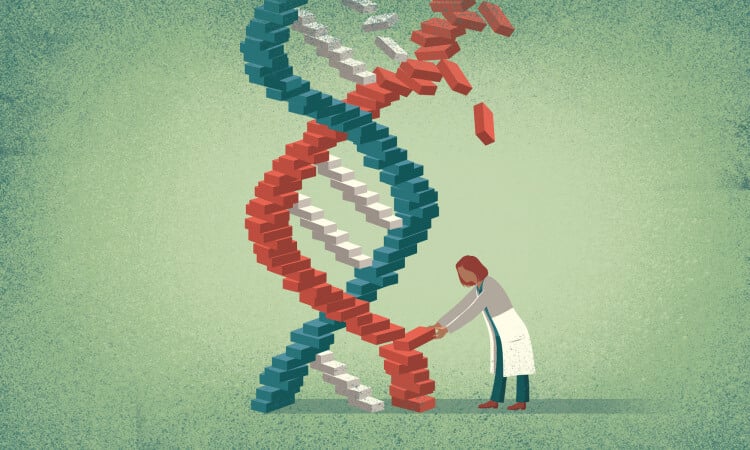
CRISPR-Cas9, the new gene modification tool, which has been heralded as a means for inserting ourselves into evolution, is itself evolving as a technology…On the immediate horizon, we are starting to see the silhouette of what Marcy Darnovsky, director of the Center for Genetics and Society, calls “market-based eugenics.”
…
Whether I agree with them should be separated from the ambition to “industrialize the human genome”—and why the alteration of our biology evokes hubris, and our applications and intents can go wrong.
[N]umerous studies of late have demonstrated that thousands of genetic variants straddled over the entire genome contribute to autism and psychiatric risk, as well as personality traits, and even intelligence.
…
[M]any of these genetic variants may be pleiotropic, meaning they have different, often unrelated effects in different cells or tissues. The severity of their enhancing or diminishing effects may also vary, depending on their genetic background, the other genetic variants they’re inherited with.
…
There are no superior genes. Genes have a long and layered history, and they often have three or four unrelated functions, which balance against each other under selection. Those risky variants that can, in the right scenario, say, make us better at numbers are actually helpful to remain in the population in low frequencies.
The GLP aggregated and excerpted this blog/article to reflect the diversity of news, opinion, and analysis. Read full, original post:How Gene Editing Could Ruin Human Evolution
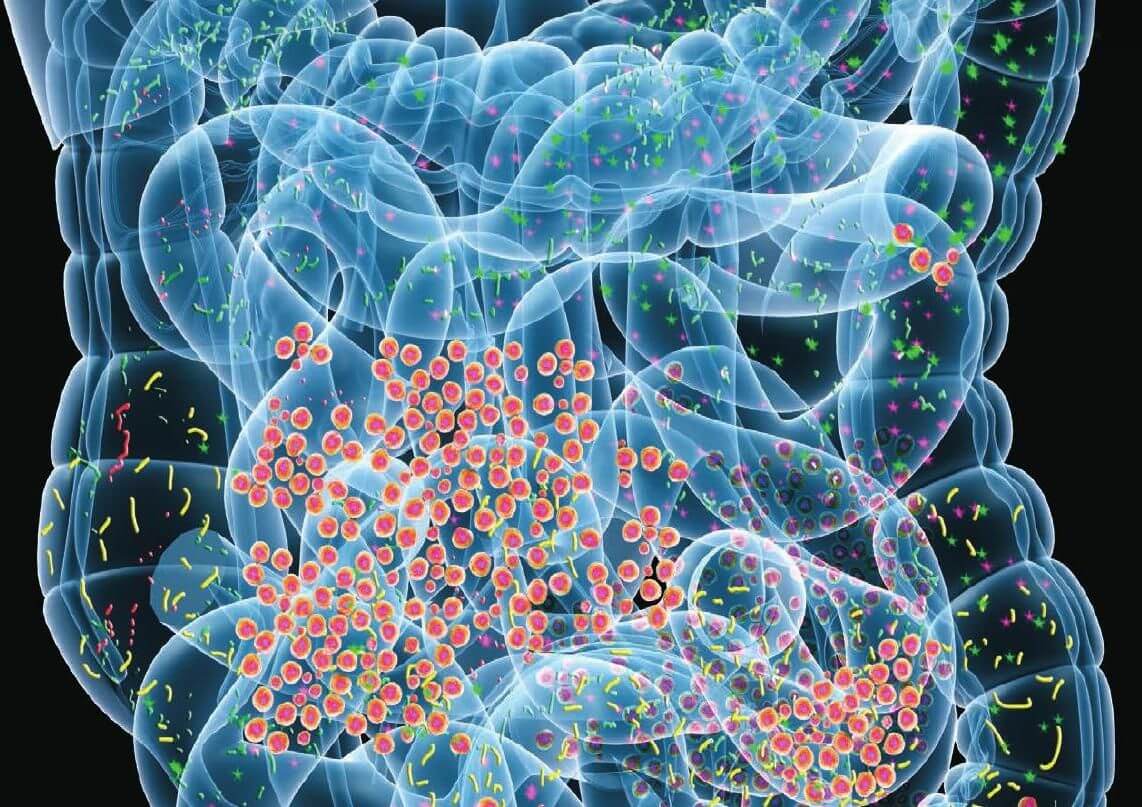
Many are now looking at a symbiotic relationship between the gut microbiome and the immune system, mediated by factors such as an increased use of antibiotics, as being responsible for [the significant increase in incidents of food allergies, asthma and obesity]. More importantly, this research is pointing towards new potential preventive therapies involving the gut to help not just digestive diseases, but everything from diabetes to asthma and even autism and mental health issues.
…
“Basically, the human is an incubator of bacteria,” says [Marc Ouellette, the scientific director of the Institute of Infection and Immunity at CIHR]. The large number of bacteria – mainly in the gut, but found throughout the body – play positive roles in helping digest food and other functions related to the immune system.
…
Unpalatable though it may seem, the poster child for successful treatment approaches focusing on the gut microbiome has been fecal transplantation. According to Dr. Ouellette, using fecal transplants to treat Clostridium difficile infection has been the most dramatic example of the type of transitional medicine now being attempted as a result of gut microbiome research.