Okanagan Specialty Fruits (OSF) is gearing up for the first commercial crop of its non-browning apples this autumn.
Marketed under the Arctic Apples brand, the genetically modified fruit, which is engineered to resist browning when sliced, has already caused quite a stir in the US since being trialed through consumer research and taste tests earlier this year.
The apples have been engineered using a gene silencing technique to dramatically reduce the production of polyphenol oxidase (PPO), an enzyme that triggers the chemical reaction that causes browning when the fruit is sliced or bruised.
According to OSF, a small agricultural biotech company based in Summerland, British Columbia, this is a precise change that doesn’t alter the other characteristics of the fruit.
…
Three non-browning varieties have been approved for sale in the US: Golden, Granny and Fuji. Gala is next in line, with additional varieties being introduced further ahead.
This season the apples will be available in 10oz grab-n-go bags but other value-added formats are also under development.
…
The apples will be available in a few dozen stores from October to December, or until supplies run out.
The GLP aggregated and excerpted this article to reflect the diversity of news, opinion and analysis. Read full, original post: Non-browning apples land in US stores
Gary Ruskin, the chief junkyard dog of US Right To Know, an industry front group created by Organic Consumers Association to harass and intimidate scientists, has managed to pay-to-publish a Short Article which allows him to claim he has been in a peer-reviewed journal.
That has to be placed in context. In an open-access digital world, where thousands of predatory journals now exist which allow anyone to buy the right to claim they have been peer-reviewed, being peer-reviewed doesn’t mean what it used to mean.
…
How much did Ruskin pay to claim he was in a journal?
Here is the answer, from the journal itself (1):
The title he paid to publish is “How food companies influence evidence and opinion – straight from the horse’s mouth” and he is joined by three anti-science activists from the same department of the same school in New Zealand. They promise us “The results provide direct evidence” of their belief in vast right-wing pro-science corporate malfeasance but it turns out to be a conspiracy theory fabricated from just one email between two retired colleagues from Coca-Cola. (2) Instead of being an actual examination of industry influence of food science, it is what Katherine Rich in Food Navigator rightly dismissed as hyperbole spun “with all the fury and outrage of Watergate.”
Scientists are using stem cells to create clumps of cells that increasingly resemble bits of brain, lungs, or intestine. […] Now some like [mechanical engineer Yao] Shao are finding it’s possible to mimic the embryo itself.
…
[Human] embryoids represented only a part of the embryo. While they had the beginnings of an amniotic sac, they lacked an entire lineage of cells, called trophoblast, whose role is to make the placenta. And inside the clump of cells that constitutes an embryo proper, the researchers detected only one of three key types needed to make a complete body.
…
No human embryo is studied beyond two weeks, or past when the primitive streak forms, whichever comes first. […] But scientists are prepared to argue that their structures aren’t real embryos, and that they should be able to stretch the limit.
…
[S]ynthetic embryology might eventually help engineers grow complete human organs. “I am not talking about a human body without a brain. But what is a true possibility is you could develop a mini-gut or a mini-liver, since the embryo develops them, too. And if you have the primitive organs, they could grow into a functional one,” [professor Jianping] Fu predicts.
A dig through the literature has uncovered evidence of 27 distinct viruses from a wide variety of families capable of staying intact as they’re transmitted through semen to a new host. While not all of the microbes are confirmed sexually transmitted infections, the review does draw attention to the fact the testes seems to provide a potentially easy way for just about any kind of virus to migrate into a new home. This latest research was inspired by the recent discovery of Zika virus RNA in the semen of infected hosts.
…
To see what other nasties might be lurking alongside our sperm, the researchers ran a search through the PubMed catalogue for relevant terms, filtering out over 3,800 papers containing some mention of viruses and semen. All up they fished out evidence of 27 viruses – including Zika – that could remain intact enough to infect the blood of a new host.
…
Viruses responsible for diseases such as influenza, SARS, and dengue have been found in the testes, making it a fair question to ask if they’re one small step away from an easy passage. […] But with Zika taking a number of people by surprise, we should be thinking outside of the box when it comes to the spread of viruses.
It’s pretty common knowledge that obesity increases the chance that a woman will develop breast cancer, and how her excess adiposity is distributed on her body can be a clue to her risk.
…
[In a new study] investigators examined the association between body size-related characteristics such as body mass index (BMI) and waist-hip ratios (WHR) and breast cancer risk for women with different hormone receptor status. They found that both BMI (as an index of overall obesity) and WHR had a positive association with risk of breast cancer. However, depending on the hormone status, the relationship between size indicators and breast cancer risk varied.
There was a significant association between BMI and risk of breast cancer — but only for women whose tumors were ER+/PR+, and for premenopausal women.
…
Mechanisms responsible for the differences in the effects of overall and central obesity are not clear, the authors stated. They did note that the type of obesity a woman presents with may provide a clue to the type of treatment that would be appropriate — which could differ with respect to the receptor status and menopausal status of the woman.
Sen. John McCain has captured considerable attention in recent months while thwarting congressional efforts to repeal Obamacare. The high-profile conflict between the Arizona Republican and his own party — including President Trump — has been amplified by the fact that it followed on the heels of McCain’s revelation that he was diagnosed with glioblastoma, a particularly aggressive form of brain cancer.
It is the same type of cancer that took the life of Ted Kennedy, the “Lion of the Senate” who spent his last months working on health-care reform. The fearsome disease has a median two-year survival rate of 30 percent, with half of patients dying within 15 months.
Traditional cancer-fighting tools — surgery, radiation and chemotherapy — have proven largely ineffective at halting the tumors. So research is increasingly turning to new drug combinations and out-of-the box treatment ideas. Which brings us to Zika.
Could the infamous tropical fever offer new hope for glioblastoma patients? The Zika virus is a mosquito-borne pathogen that is closely related to yellow fever and dengue. It’s most well-known effect is causing microcephaly — a severely underdeveloped brain in the fetuses of pregnant women who become infected. It is extremely counterintuitive to consider that Zika could be welcomed back into society as medicine, much less as a treatment for brain disease.
Sen. John McCain.
Glioblastoma is a cancer of the glial family, the most abundant type of cell in the central nervous system, surrounding and insulating neurons. While other brain cancers, such as astrocytomas and oligodendrogliomas, afflict just one type of glial cells, glioblastomas are cancers of the precursor cells, known as glioblasts. They can turn into any type of neuroglia. This makes them, by far, the deadliest form of brain cancer, since they can adapt, blend in with their surroundings, and become extremely difficult to treat without damaging neighboring neurons. Furthermore, they grow remarkably quickly, doubling in size every 50 days without treatment.
Treating this cancer with Zika is exactly what American researchers posit in provocative new research published in Rockefeller University’s Journal of Experimental Medicine. The researchers tested the effects of Zika exposure to glioblastomas found in mice and samples of human brain tissue. Their experiments found that, in the brain, Zika is an “oncolytic virus” — one that prefers to infect and destroy cancer cells while leaving the vast majority of normal cells unscathed. The glioblastoma-riddled mice showed remarkably shrunken tumors and survived “substantially longer and at greater rates” when infected with the Zika virus than did the mice in the control group. The human brain tissue samples also noted dramatic reductions in tumor size. While this is assuredly encouraging, it is important to remember that cancer in a real living human brain will not necessarily respond in the same manner as do cancer cells treated in isolation.
The result is surprising, but the underlying mechanism is logical, even elegant. Zika is corrosive to the stem cells that differentiate to become neurons in fetuses. Adults have few stem cells in their brains, so Zika is not neurotoxic to adults. However, glioblastomas are rich in stem cells. It is this richness that allows them to adapt and disguise themselves so well in our brains. “We hypothesized that the preference of Zika virus for neural precursor cells could be leveraged against glioblastoma stem cells,” explained study co-director Michael Diamond of the Washington University School of Medicine in St. Louis. While most existing glioblastoma treatments risk either damaging healthy tissue or leaving some cancer, treatment via Zika offers the possibility of tumor degradation that spares the brain.
The team hopes to move their research to the human trial stage within 18 months. Of course, humans may be less willing to become infected with Zika virus than mice, even if it is for treatment. Before the human trials begin, the researchers are producing a modified version of the virus that will deactivate its pathology — except the oncolytic effects. Diamond noted that, “Once we add a few more changes, I think it’s going to be impossible for the virus to overcome them and cause disease.”
Using notorious human viruses to alleviate the most treatment-resistant cancers is not limited to Zika and glioblastoma. A recently-completed study at UCLA tested the efficacy of a modified version of the herpes virus on advanced melanoma in conjunction with chemotherapy. The objective-response rate of the herpes treatment was 61.9 percent, with a partial-response rate of 28.6 percent and a complete-response rate was 33.3 percent. This means that the tumors shrunk in almost two-thirds of the patients, and disappeared entirely in one-third of them. The herpes therapy thus represents a desperately needed addition to the toolbox for the treatment of stage IV melanoma, the five-year survival rate of which is only 15-20 percent.
Several other oncolytic viruses are either already offered as treatment or are in the process of being studied, including the common cold, polio, and measles. Viral therapy has become even more sought-after due to its coincidence with the advent of CRISPR/Cas9 gene editing, directed evolution of viruses and other synthetic biology paradigms. Obviously, most cancer patients, who may already be weakened by invasive surgery, radiation, and drug treatments, will not be keen on submitting themselves to terrible sicknesses. Synthetic biology offers the possibility of designing new viruses that can kill tumors without making their hosts sick.
Joe Biden, Beau’s bereaved father, helped shepherd the 21st Century Cures Act through Congress in December 2016 as one of his final actions as Vice President. The bill earmarks $1.5 billion for research on brain disease and $1.8 billion for cancer research over the course of seven-years in what has been deemed a “cancer moonshot.” In practice, its implementation has so far meant increased sequencing of tumor genomes and data sharing between hospitals, governments, and patients. Though this will surely improve our execution of currently existing treatments, it falls short of the government’s ambitious goal to fund innovative new treatments for cancer. For the moon to wax once more, policymakers should consider funding oncolytic viral therapies, such as human trials of the Zika virus against glioblastoma.
Sean Hall is a writer and engineering student at Santa Rosa Junior College exploring the overlap between politics and synthetic biology. Follow him on Twitter at @seantheserene.
Prime Minister Edouard Philippe reiterated Paris would vote against the European Commission’s proposal to extend for 10 years the license for glyphosate, which is used in Monsanto’s Roundup, citing uncertainty about its safety.
A vote is due to take place by the end of the year.
However, Philippe said the French government had asked the farm and environment ministries to propose by the end of the year “a plan to move away from glyphosate in light of the current research and available alternatives for farmers,” signaling a readiness to accept a gradual phasing out.
…
French farmers welcomed the prime minister’s statement.
“This means Matignon (the prime minister) is starting to understand that a full ban would be impossible to apply in France. This is already an easing in position,” Christiane Lambert, head of France’s largest farm union FNSEA, told reporters after meeting Environment Minister Nicolas Hulot.
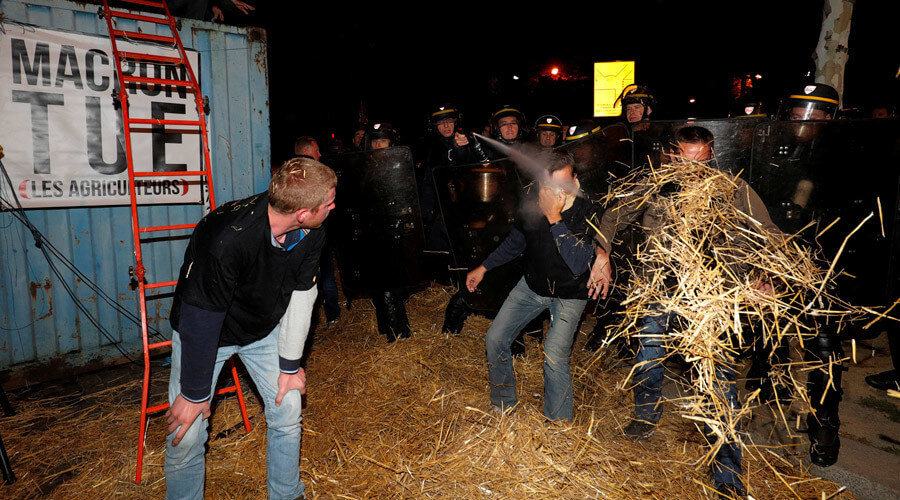
Three hundreds farmers protested on Paris’s landmark Champs-Elysee shopping street on Friday against Hulot’s position against the renewal of glyphosate’s license. Farmers say there is no alternative to the product.
A European Commission source said a vote due on Oct. 5-6 on the license had been postponed for at least a month.
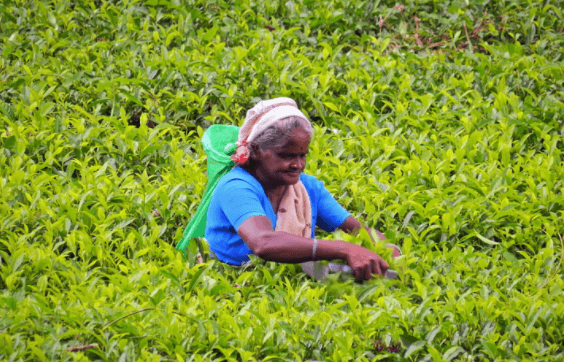
With the ban of the weed killer glyphosate without scientific evidence, some planters have started using alternative chemicals, running the risk of Ceylon Tea exports becoming banned in overseas markets, according to Ceylon Tea Board Chairman Rohan Pethiyagoda.
“Many plantation owners have started using alternatives which are not authorized. These are now coming up in various countries. Sooner or later, this is going to lead to importing countries putting restrictions on Sri Lankan tea exports,” he said.
…
Glyphosate was banned in 2015 through a Presidential Order, following the lobbying of Presidential Advisor, and MP Athuraliye Rathana Thero, who blamed the chemical for causing the chronic kidney disease of unknown etiology (CKDu) in the North Central and Uva Provinces.
“Who should have taken that decision? We have a Registrar of Pesticides; we have a Fertilizer Secretariat; we have a Medical Research Institute and we have a Tea Research Institute, (but) nobody was consulted…” Pethiyagoda said.
He noted how Plantation Industries Minister Navin Dissanayake has submitted three proposals to reverse the ban to no avail, and that no one is able to say exactly why the chemical was banned.
Numerous scientists, agriculturalists and agricultural economists have pointed out that there is no scientific reasoning behind the ban.
The idea behind gene therapy is that genetic material is used as a “living drug” to treat disease. Scientists have been trying to get gene therapies to work for decades, so Kymriah’s approval is historic. But the therapy’s $475,000 price tag was immediately met with alarm and criticism from patient advocates. More gene therapies are in development, and those too could cost hundreds of thousands of dollars. And while some see sticker shock, others see a bargain.
That’s because many gene therapies promise to be outright cures with a one-time injection, a fundamentally different approach to medicine.
…
[T]he average annual cost of health care for sickle cell patients ranged from $10,704 for children up to nine years old to $34,266 for those aged 30 to 39 years. Lifetime health-care costs for a 45-year-old with sickle cell disease reached $953,640. Earlier this year, biotech company Bluebird Bio reported that its experimental gene therapy cured a teenage boy in France.
…
One question that will remain even after some of these therapies get approved is how long their effects last. “The minute we launch a drug, we usually don’t have a full picture of what the long-term effect of the drug is,” [Ed Schoonveld, a drug pricing and market access expert] says.
Film and entertainment news site Deadline Hollywood announced last week that Hulu has acquired rights to the Food Evolution documentary, directed by Oscar-nominated filmmaker Scott Hamilton Kennedy and narrated by celebrity astrophysicist Neil deGrasse Tyson.
…
Like clockwork, the controversy quickly reared its head in the comments section of the Deadline story. “This is disgusting. If HULU believes that it’s okay to push this propaganda – well, I’ll be stopping my monthly subscription to HULU,” wrote one critic. “I wonder how much they were paid to air this trash Monsanto science.”
…
In response, another commenter offered a correction: “Monsanto didn’t fund this. The Institute of Crop Technologists did. It’s the trade association for crop scientists. This is quite literally a documentary funded by crop scientists frustrated at the disinformation about GMOs.” In fact, the film was sponsored by the Institute of Food Technologists (IFT), a non-profit society of over 17,000 professionals involved in food science and technology.
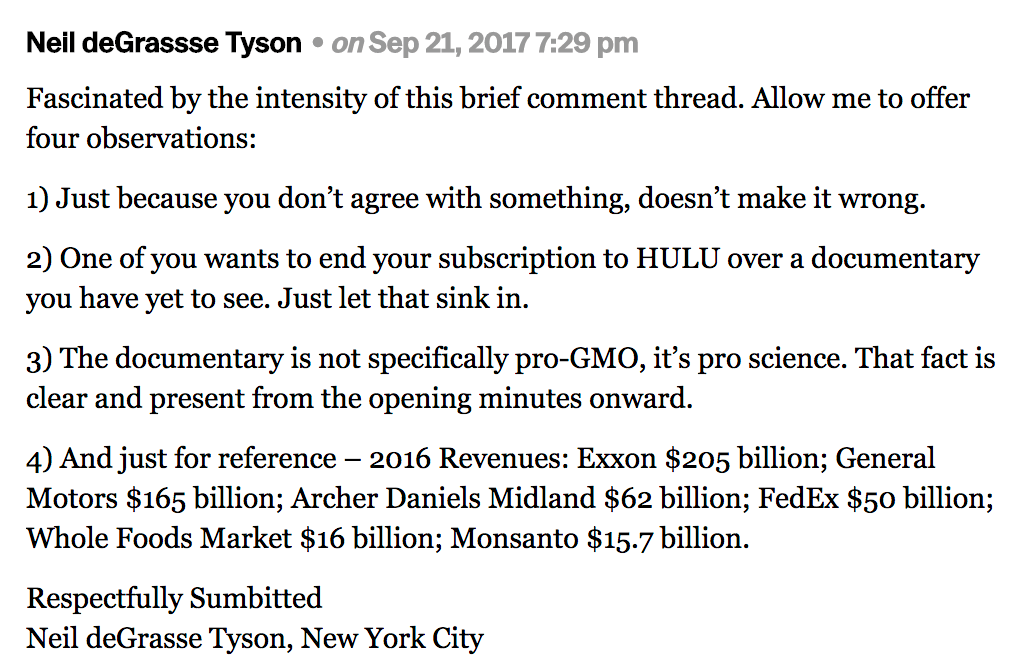
In his trademark measured fashion, the film’s narrator Neil deGrasse Tyson, who is known for his science “mic drops,” showed up to intervene.
The Oregon Court of Appeals has decided to keep blocking a voter-approved initiative that bans genetically engineered crops in Josephine County.
The appeals court last week affirmed a lower-court decision that said a 2013 state law forbidding local action against genetically modified organisms, or GMOs, took precedence over the county’s 2014 ban.
That ruling by Circuit Court Judge Pat Wolke came in a lawsuit from Oregon farmers Robert and Shelley White, who once grew GMO sugar beets for the Swiss corporation Syngenta.
Portland attorney John DiLorenzo Jr., who represented the Whites, said the appeals court decision made the county ordinance unenforceable. In fact, the county never tried to enforce it and did not defend it in court, the Grants Pass Daily Courier reported.
…
Mary Middleton, leader of the group Oregonians for Safe Farms and Families that defended the ban in court, conceded defeat.
“I don’t believe there’s another next step in Oregon,” she said. “There’s not another court to go higher with this. We’ve come to the end of the road, in terms of litigation.”
Middleton vowed to keep seeking change at the legislative level, saying lawmakers are ignoring the will of the people.
The GLP aggregated and excerpted this article to reflect the diversity of news, opinion and analysis. Read full, original post: Oregon appeals court keeps blocking county’s GMO ban
Syngenta AG reached an in-trial settlement with a group of about 22,000 Minnesota farmers who claimed the company carelessly marketed its genetically modified corn seed, causing contamination of U.S. crops and a rejection of imports by Chinese officials.
The farmers were seeking more than $400 million in damages. The settlement was announced in state court in Minneapolis Tuesday. The amount wasn’t disclosed.
The settlement comes three months after Syngenta lost a $218 million jury verdict to a class of Kansas farmers, in the first trial over the corn contamination claims. Several other trials are pending as lawyers pursue suits on behalf of some 350,000 corn growers claiming as much as $13 billion in losses. The farmers allege Syngenta caused five years of depressed corn prices.
…
The Minnesota farmers claimed Syngenta, the Swiss agrochemical giant, rushed its GMO seed to market before getting import approval from China. In 2013, China stopped taking shipments from the U.S., calling the corn contaminated. The farmers also claimed Syngenta misled them on when the Chinese would approve the seed.
Even as machines known as “deep neural networks” have learned to converse, drive cars, beat video games and Go champions, dream, paint pictures and help make scientific discoveries, they have also confounded their human creators, who never expected so-called “deep-learning” algorithms to work so well. No underlying principle has guided the design of these learning systems, other than vague inspiration drawn from the architecture of the brain.
…
Naftali Tishby, a computer scientist and neuroscientist from the Hebrew University of Jerusalem, presented evidence in support of a new theory explaining how deep learning works. Tishby argues that deep neural networks learn according to a procedure called the “information bottleneck,” which he and two collaborators first described in purely theoretical terms in 1999. The idea is that a network rids noisy input data of extraneous details as if by squeezing the information through a bottleneck, retaining only the features most relevant to general concepts. Striking new computer experiments by Tishby and his student Ravid Shwartz-Ziv reveal how this squeezing procedure happens during deep learning, at least in the cases they studied.
…
One immediate insight that can be gleaned from the theory is a better understanding of which kinds of problems can be solved by real and artificial neural networks.
[Editor’s note: Nicole Rodriguez is a Registered Dietitian Nutritionist.]
Every day is Election Day – at the grocery store. Here’s how to cut through the nonsense and vote with your food dollar. By avoiding one easy-to-spot label [the Non-GMO Project butterfly], you’ll save money, enhance your diet, and take a stand for science.
This post has been a long time coming, and it’s personal as much as it’s professional. Here’s what: I’m tired. Exasperated. Frustrated. And simply can’t sit quietly while a sham of a non-profit contributes to food-shaming at its finest. By finest, I mean absolute worst.
Genetically modified wheat isn’t available in the United States. All pasta is Non-GMO. Same for anything else not mentioned on the list above. So, when I see the butterfly on pasta, coffee, kiwi, or any of the other thousands of foods that DO NOT HAVE A GMO COUNTERPART, it resonates in a very particular way. That way is a slap in the face.
Foods verified by this now seemingly Godly seal are not any more nutritious or wholesome than their non-labeled counterparts. And companies that choose to become verified by the Non-GMO project and label foods containing ingredients aside from potato, corn, canola, soy, papaya, sugar, or summer squash are preying on consumers’ misplaced fear. I CRINGE at the thought of someone, especially another mother like myself trying to feed her young family, feeling shamed into making food purchases based on pure nonsense.
The GLP aggregated and excerpted this article to reflect the diversity of news, opinion and analysis. Read full, original post: The One Food Label I Avoid
To define human consciousness at the neuronal level is among the most difficult of tasks for neuroscience. Still, researchers have made inroads, most recently by sinking electrodes deep with the brains of epilepsy patients and recording the activity of single neurons as the awake patients described whether they observed an image flashed before them.
Previous work had found that the stronger the individual neuron activity, the more likely it is to be associated with conscious perception. In this latest study, published…in Current Biology, researchers from the University of Bonn Medical Center in Germany find a second factor—timing—that appears important to the brain’s conscious awareness.
…
Cumulatively, the team recorded from 2,735 neurons and directly compared the neuronal activity between times when the subjects reported seeing the image and when they didn’t. The researchers were able to differentiate the cellular activity representing conscious and unconscious perception of the visual stimuli.
…
Although single-neuron activity is important to understand, [neurobiologist Rafael] Malach also emphasizes the importance of the network of neurons acting as a single unit. Mormann and his team are now probing what exactly determines whether something is consciously perceived and how interfering with the neuronal networks could change conscious perception.
The GLP aggregated and excerpted this blog/article to reflect the diversity of news, opinion, and analysis. Read full, original post: The Cellular Hallmarks of Consciousness
Farmers planted a new kind of seed on 25 million acres of soybean and cotton fields this year. Developed by Monsanto, the seeds, genetically modified to be resistant to a weed killer called dicamba, are one of the biggest product releases in the company’s history.
But the seeds and the weed killer have turned some farmers — often customers of Monsanto, which sells both — against the company and alarmed regulators.
…
[Some] farmers say they face a difficult choice — either buy the new genetically modified seeds or run the risk that their soybeans would be damaged more by a neighbor’s spraying of weed killers than by the weeds themselves.
…
Monsanto has put the onus on farmers. In a letter to Arkansas’ governor … a top company executive said problems were “all readily correctable through additional training, education and enforcement.” The company has already trained about 50,000 people to apply the weed killer properly.
The instructions are quite complex, discouraging spraying both when it is too windy or when it is not windy enough. Some farmers are chafing at the company’s approach.
[Buying food from small, local, organic farms] cannot fix that chemical-intensive system that crowds out biodiversity, depletes the soil, pollutes the water, etc. And that’s not a lack of confidence in, or enthusiasm for, that kind of small farm. It’s simply a recognition that there are economic, logistic, topographical and even arithmetic reasons that those farms can only be a small slice of a reimagined, responsible, food system.
…
The crops that carpet the vast swaths of the Midwest cannot be successfully grown small and local, because you need economies of scale to make those crops profitable. What’s great about staple crops such as oats, lentils, barley and, yes, corn and soy is that they produce huge amounts of nutritious, affordable food per acre.
…
In some ways, organic agriculture has an environmental edge over conventional, but the standard was developed to conform to an idea of “naturalness,” not to minimize environmental impact. And so, while organic farms tend to have healthier soil and to lock away more carbon in that soil, conventional systems have higher yields and can more easily reduce the need to disturb the soil by tilling, which can help soil retain water and reduce runoff.
Hulu has acquired the exclusive US [Video-on-Demand] rights to Food Evolution from Academy Award-nominated director Scott Hamilton Kennedy. The highly polarizing film is narrated by science communicator Neil deGrasse Tyson. The film [premiered] on Hulu on Sept. 21.
The doc is significant for a couple of reasons. First, it is one of the most controversial and contentious docs on the food industry because it delves into the positive side of GMOs on sustaining the human food supply, and second, it received a rare 100% Rotten Tomatoes rating.
The film tells the story of GMOs, from Hawaiian papaya groves — where experimentation with GMOs and the pesticides they involve has been deemed a disaster to school children in the area by other documentaries like Island Earth — to the cornfields of Iowa and banana farms in Uganda.
The doc has been condemned by organic growers and called “a corporate propaganda film” as it was funded by Institute of Food Technologists….The filmmakers have defended their funding while critics say they are propagating “Monsanto science.”
Two studies on the health of bumblebees and links to neonicotinoid health were published simultaneously last month in sister publications of the prestigious science journal empire Nature.
Both examined closely similar scientific questions, with somewhat different experimental methodologies. But the study that found that neonics caused no serious issues was ignored by the media while the one suggesting a bee-apocalypse was widely played up as “definitive.’
Let’s unpack what these studies actually showed, and reflect on why the studies have been reported on so differently.
The studies were not identical in focus, although they had one author in common—entomologist Nigel Raine of the University of Guelph in Ontario. They looked at different stages in the life cycle of bumblebees and their queens. So, on that basis alone, the findings about the differences in bee health could have been different. But the issue here is not only the conclusions, but the reporting on the studies.
One study—the one that suggested bumble queens might face mortal danger—was widely circulated. It reported, according to a press release by Guelph, that ‘neonics placed bumbles at the risk of extinction.
“This study shows that neonicotinoids could be having a devastating effect on wild bumblebee populations,” Raine said. “We urgently need to know more about how pesticides could be affecting other species to make informed decisions about the risks associated with using these chemicals.”
It’s not hard to see why this study got intense media attention. Apocalyptic predictions grab headlines. Understandably, it generated a tremendous amount of scary news coverage. The media was all over it with literally dozens of stories in prestigious publications and it swamped social media.
Bee-apocalypse that never happened
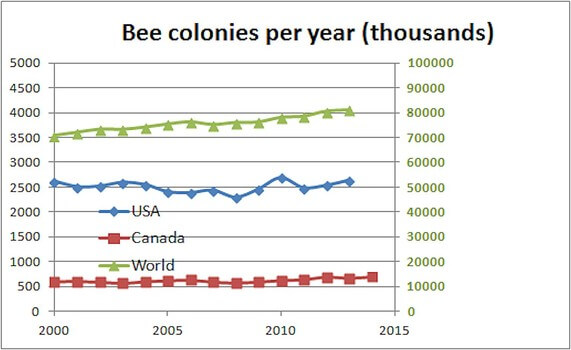
The title of the press release was apocalyptic. It also contradicts what we know about honeybees and neonics, a subject of intense scrutiny. For years, a minority of scientists and an overwhelming majority of reporters with little clue about the science, predicted the demise of honey bees—remember the now infamous 2013 Time cover story, A World Without Bees. Since then the opposite has happened. Honeybee colonies around the world are at all-time highs.
Environmental advocates, joined by some beekeepers and scientists, had already fingered a culprit for the presumed mass honeybee die-off. They blamed neonic pesticides for everything from Colony Collapse Disorder—a still-unexplained condition in which bees suddenly abandon their colonies that has come and gone over the last decade, just as it has many times in history—to recent years’ elevated over-winter honey bee colony losses.
Now we know that was a false, largely ideologically driven, alarm. It’s now widely understood that bee populations are at generational highs, rising in Europe and North America. With some setbacks, linked largely to cold winters and the lingering effects of CCD, they have been rising ever since neonics came on the market in the mid 1990s. There is no honeybee apocalypse on the horizon.
That’s not to say that all is rosy with the world bee population. There have been some spikes in the overwinter death rate beyond the 20% or so that is considered acceptable by beekeepers. And bees, which are treated like agricultural livestock by commercial beekeepers, do face unusual stressors.
But It’s become clear to most entomologists that the health problems afflicting honeybees are attributable to a complex set of factors, at the center of which is the ubiquitous and hard-to-combat Varroa destructor mite. The pest transmits and makes virulent up to a dozen viruses and diseases in honey bee colonies—and has been around in growing numbers since the 1980s.
Bumblebees near extinction study
But what about bumblebees? The focus of anti-pesticide campaigners shifted to bumblebees once it was clear that honeybees were not endangered. There is a huge volume of data, including many field studies, on honeybees, which show in real world conditions that honeybees are not endangered because of neonics. There is not so much research on bumblebees, however. These two recent studies were designed to begin to address that research gap.
Both studies addressed the effects of one neonicotinoid pesticide—thiamethoxam—on bumblebee colonies. Neither could be called ‘field realistic’. One focused on queens before they started laying eggs. The other targeted established colonies. Both exposed their target subjects to jugs of neonic laced syrup over many days—nothing like they would have experienced in real world conditions. And they came up with radically different conclusions as to the effect of the chemical, as interpreted by the researchers. Let’s dig deeper.
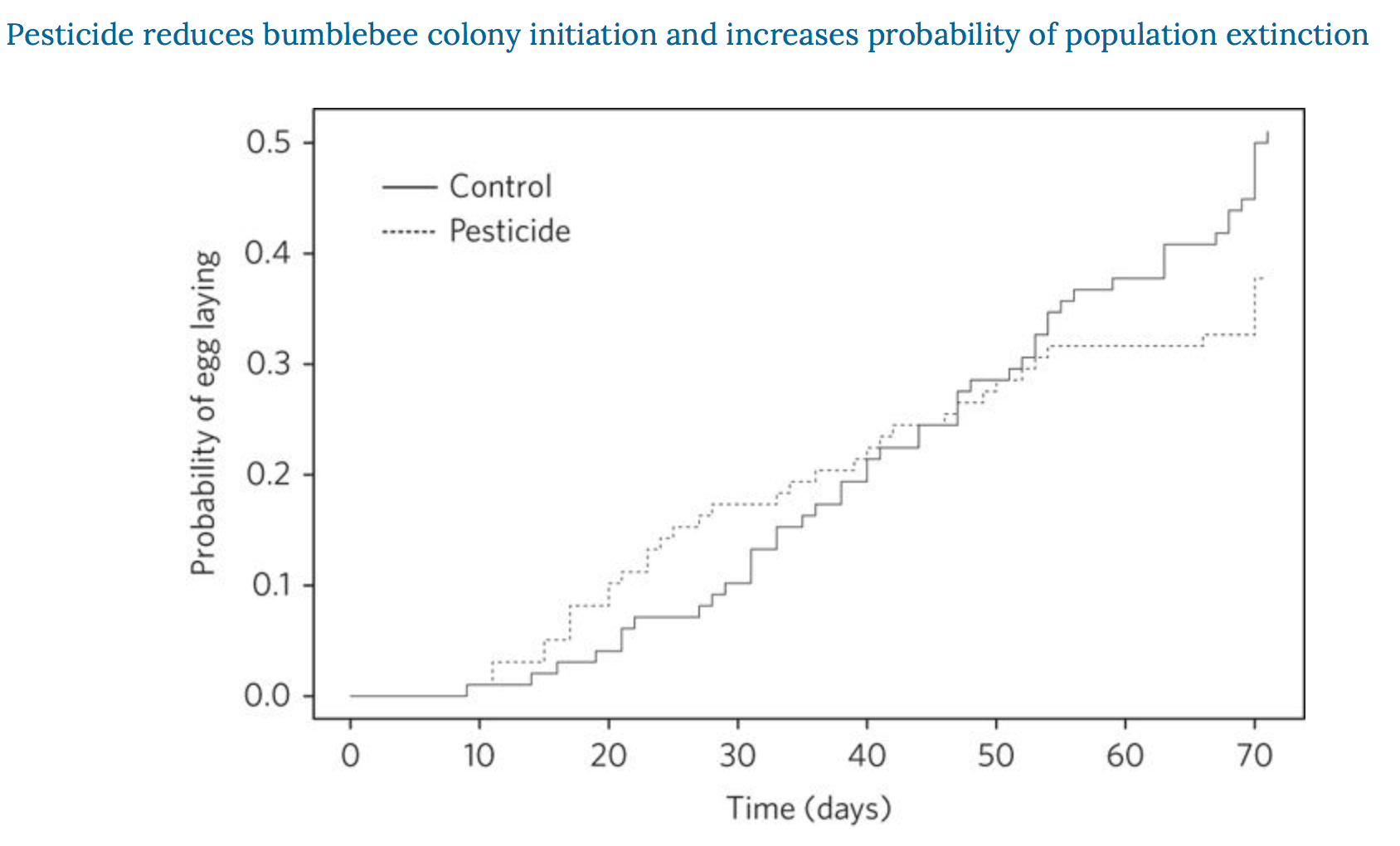
The queen study, led by Gemma Baron of the UK’s Royal Holloway University, exposed mated (fertilized) queen bees of Bombs terrestris—one of the most ubiquitous of the more than 250 known bumblebee species—to two weeks of laboratory feedings of sugar syrup spiked with what was claimed to be ‘field realistic’ concentrations of the neonic thiamethoxam (2.4 parts per billion). The result, they said, was a 26% reduction in the frequency of treated queens initiating a new colony by post-hibernation egg-laying. The reduction was said to be more pronounced after a long hibernation (12 weeks) rather than a short one (6 weeks)—even though a realistic hibernation would be more like 6-9 months! The study’s key finding was summarized in this graphic.
Effect of pesticide exposure on egg laying
This event history curve shows the cumulative probability of egg laying (from the end of hibernation (zero days) until the first egg was laid) by queens exposed to either the pesticide thiamethoxam or a control.
But look at the graph carefully, and notice the crossed lines near 50 days. The graph shows that queens exposed to thiamethoxam out-layed the un-treated (control) bumblebee queens from around day 12. Only after day 50 did the treated queens’ egg-laying plateau and the untreated (control) queens’ egg-laying decidedly surpass it.
That slender basis drove the radical conclusions of the piece, which—recklessly say some scientists—projected the possible extinction of one of the world’s most prolific and ubiquitous wild bee species.
“That’s just not enough information to make such a sweeping conclusion,” I was told by Angela Gradish, a postdoctoral fellow, who also happens to research and teach at Guelph. Gradish does not currently do research on neonics, but is a pesticide eco-toxicologist who studies the impact of pesticides on pollinators. She questions many aspects of the study, and its central conclusion.
“By characterizing this study as ‘realistic’, the authors imply that the results they’ve obtained are likely to happen. But what they’ve actually replicated is a type of ‘worst case scenario’.” It’s a form of catastrophe speculation that’s just not supported by the data, she told me.
“We have other studies that have shown no effects, so giving studies like this exclusive coverage, gives the false impression all the research points in the same direction, to health threats.”
Other research tells a different story—notably the UK’s Center for Ecology and Hydrology August 2016 study modeling neonic impacts on wild bee populations in England and David Kleijn’s team’s June 2015 study of crop pollination services by wild pollinators) showing that Bombus terrestris, among other bee species that forage on neonic-treated oilseed rape crops, hadn’t even declined, much less started toward extinction.
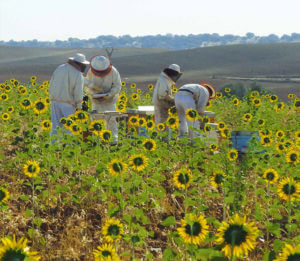
Bayer scientists in field during neonics study.
But this study’s results have been exaggerated in other ways. First, no real explanation is offered for why bumblebee queens exposed to the thiamethoxam consistently outperformed unexposed queens in egg-laying during the first two-thirds to three-fourths of the study period. The most logical explanation is heresies—a well-known phenomenon in which low doses of certain pesticides have a simulative effect on some insect activities and functions. I’ve noted this phenomenon previously (here) in other studies of neonics’ effects on bees, but it’s not even mentioned or explored in this Gemma Baron-led bumblebee study.
Second, as Gradish points out, what’s claimed to be a ‘field-realistic’ dose of 2.4 ppb of neonic-spiked sugar syrup fed to the bumblebee queens for 14 days is almost certainly unrealistic. There is no single concentration that is universally agreed upon as realistic, Gradish says. Researchers are free to use what they want and everyone seems to cherry-pick a value from the literature.
This figure was taken from a 2013 field study by the UK’s Food and Environment Research Agency of neonic effects on bumblebees. But, of the three experimental sites in that study; 2.4 ppb was the highest neonic concentration detected, not the average or the median. The other two sites’ detected concentrations of 0.885 ppb and 0 ppb.
In other words, this study’s authors chose a worst-case scenario dose from one bumble bee study—not even an average .986 ppb—of the concentrations found at its three sites—and represented it as ‘field-realistic—with no justification. By this logic, a field-realistic Thiamethoxam dose for Bombus terrestris queens for this study could just as easily have been less than 1 ppb (0.885)—or even zero ppb!
Even if the dosage might be the correct one, it still does not make the study any more convincing. “Force feeding bees even a realistic concentration continuously for 14-27 days, as they did in these two studies, is not realistic or representative of what they would be exposed to in real life.”
In other words, weeks of exclusively feeding neonic-spiked syrup to bumblebee queens is itself field-unrealistic. In field settings, even amid large acreage of neonic-treated crops, Bombus terrestris queens would have access to wild flowers and other natural forage plants surrounding the planted croplands. These would dilute their neonic-treated diet in ways not reflected in this lab study.
“This was what I would call a ‘worst case’ exposure scenario,” Gradish said. In the real world, bees don’t forage on only one type of plant continuously for weeks on end, and they are not exposed to residues in every plant at the highest values ever recorded, like this type of exposure scenario assumes. Some studies indicate that as much as 95% of seed-treated crop plants show no traces of neonics at flowering. So, it’s important to interpret the results from such studies in a worst-case scenario context.””
These research design choices are a familiar recipe—one I’ve written about repeatedly (e.g., here and here): overdose bees with neonics in a field test or laboratory (without being clear that this is what’s been done); discover (no surprise) some negative effect; then extrapolate the result to a scary conclusion. Add press promotion (e.g., an embargoed university press release) and, voilà: instant publicity for a new ‘scientific’ discovery’.
The ‘other’ study
Only this time, on the very same day that Nature published Gemma Baron’s team’s study, it also published a study by Dara Stanley, also teamed with Nigel Raine. More prosaically titled, ‘Bumblebee colony development following chronic exposure to field-realistic levels of the neonicotinoid pesticide thiamethoxam under laboratory conditions,’ this study subjected different groups of mature Bombus terrestris colonies to two different neonic exposure levels—2.4 ppb and 10 ppb—or up to 27 days. The study didn’t benefit from advance press advisories—and predictably, unlike its sister study, it was not heavily promoted by Guelph and received no press attention.
Could it be because its conclusion was remarkable, but in a different way—the study identified no negative effects. “We found no impact of insecticide exposure on colony weight gain or the number and mass of sexual produced, although colonies exposed to 2.4 ppb produced larger males.”
Tellingly, neither Nature nor any of the media coverage devoted to the alarming-sounding Gemma Baron study even bothered to mention this parallel study, which found no adverse neonic effects on mature Bombus terrestris colonies. Maybe that’s why the German Plant Protection Industry Group, and some independent scientists familiar with the nuts and bolts of toxicological bee research dismissed the first study as typical of ‘campaign-style’ advocacy” research” with ‘the sole aim of discrediting plant protection products.”
And what about the University of Guelph? On what basis do they promote the apocalyptic findings of one study while ignoring the contradictory findings of another study—co-authored by the same well known researcher, Nigel Raine, who has been associated with a number of controversial studies critical of neonics—that was published on the same day in a Nature-owened journal.
“The bottom line,” says Gradish, is what happens in the real world. As far as I’m aware, there isn’t any evidence that this species of bumble bee is at risk for extinction or even localized extinction in the wild. This study doesn’t make its case.”
Jon Entine is executive director of the Genetic Literacy Project.