Video: Josiah Zayner’s deep dive into DIY biohacking

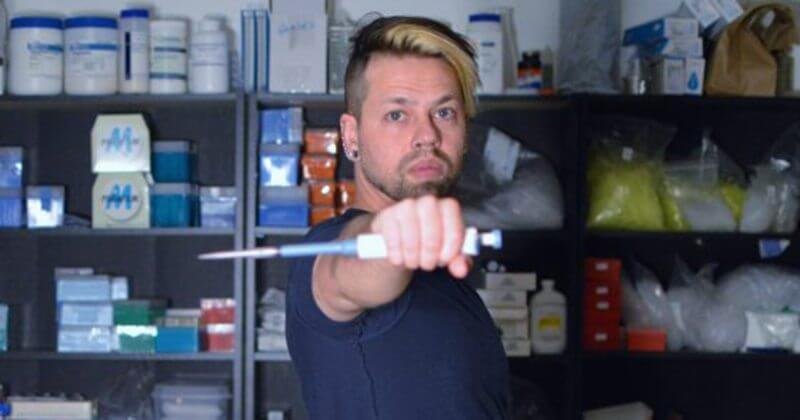
In 2016, Josiah Zayner, a former synthetic biology research scientist at NASA, checked himself into a hotel room. Over the course of four days, he performed an extremely risky experiment on himself. The goal: “To completely replace all of the bacteria that are contained within my body.”

Gut Hack, a short documentary by Kate McLean and Mario Furloni, chronicles Zayner’s attempt to transplant his microbiome in order to relieve himself of a lifetime of debilitating gastrointestinal problems. “All of the medical doctors [I’ve seen] haven’t helped,” Zayner says in the film. “You just expect me to deal with my symptoms for the rest of my life? Why are people so afraid of something different—some change, some experiment?” Using bacterial samples from a donor, Zayner takes matters into his own hands to recolonize his body with a new ecosystem of microorganisms.

“This movie is our attempt to share Josiah’s grueling and grotesque ordeal,” McLean told The Atlantic, “and communicate how it felt to behold this weird period of his life: alternately full of wonder, disgust, anxiety, excitement, exhaustion, and awe.”

Zayner expressed concerns about the way in which the public has interpreted his biohacking experiments. “I see myself as a scientist but also a social activist,” he said. “How can I do experiments in a scientific way but also make people think?”

Read full, original post: A ‘Grueling and Grotesque’ Biohacking Experiment

{{ reviewsTotal }}{{ options.labels.singularReviewCountLabel }}
{{ reviewsTotal }}{{ options.labels.pluralReviewCountLabel }}
{{ options.labels.newReviewButton }}
{{ userData.canReview.message }}

Related Articles

Infographic: Global regulatory and health research agencies on whether glyphosate causes cancer

Infographic: Global regulatory and health research agencies on whether glyphosate causes cancer

Does glyphosate—the world's most heavily-used herbicide—pose serious harm to humans? Is it carcinogenic? Those issues are of both legal and ...

Most Popular

Screenshot 2026-05-06 at 2.56
Singularity crisis ahead? Can super babies save us from rogue AI geniuses?
Screenshot-2026-03-13-at-12.14.04-PM
The FDA wants to make many popular prescription drugs OTC—a great idea. Here’s why it’s unlikely to happen
Screenshot-2026-04-20-at-2.26.27-PM
Viewpoint — Food-fear world: The latest activist scientists campaign: Cancer-causing additives
Screenshot-2026-05-01-at-11.56.24-AM
‘Science moves forward when people are willing to think differently’: Memories of DNA maverick Craig Venter
images
The never-ending GMO debate: Pros and cons
Screenshot-2026-05-01-at-1.29.41-PM
Viewpoint: What happens when whole grains meet modern food manufacturing? Labels don’t tell the whole story.
Screenshot-PM-24
Viewpoint: The herbicide glyphosate isn’t perfect. Banning it would be far worse.
Screenshot-2026-04-03-at-11.15.51-AM
Paraben panic: How a flawed study, media hype, and chemophobia convinced the public of the danger of one of the safest classes of preservatives
Screenshot-2026-04-30-at-2.19.37-PM
5 myths about summer dehydration that could damage your health — or even kill you
Screenshot-2026-05-06-at-2.07.43-PM
Manufacturing a conspiracy: The timeline of how  the White House embraced the fringe claim that scientists are being mysteriously murdered
Screenshot-2026-04-12-135256
Bixonimania: The fake disease scam that AI swallowed whole
glp menu logo outlined

Get news on human & agricultural genetics and biotechnology delivered to your inbox.