Hatchery-raised vs wild-born coho salmon: Containment sites may alter epigenome, hurting survival in the wild

FISH Friends of the Issaquah Salmon Hatchery
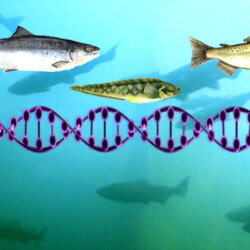
[Biologist Louis Bernatchez of Quebec’s Laval University] and his colleagues set out to search for evidence of a different kind of hatchery adaptation, detectable in the epigenome rather than the genome. They trapped juvenile coho salmon (Oncorhynchus kisutch) just before, or a few weeks after, release from hatcheries on two rivers in British Columbia, and wild juveniles from the same area. Then, they collected and sequenced samples of the fish’s muscle tissue. When they compared the two populations’ genomes, the researchers found no significant genetic differences. But compared to the genomes of their wild counterparts, 100 regions on the genomes of hatchery-reared salmon were differentially methylated, and of those, 89 were hypermethylated.

“That’s a pretty clear-cut and striking result,” Bernatchez says, adding that the results imply “that those genes are downregulated, or less expressed, most likely, in the hatchery fish relative to wild fish.” Some of the hypermethylated regions contain genes for immunity, the transmission of neural signals to muscles for locomotion, and appetite and feeding behaviors. “Quite a few important biological functions were affected,” he adds, indicating that the methylation patterns may play into the fitness differences between wild and hatchery-reared fish.

Editor’s note: Read the full study (behind paywall)
Read full, original post: Study Finds Epigenetic Differences Between Hatchery-Raised and Wild-Born Salmon

Related Articles

Infographic: Global regulatory and health research agencies on whether glyphosate causes cancer

Infographic: Global regulatory and health research agencies on whether glyphosate causes cancer

Does glyphosate—the world's most heavily-used herbicide—pose serious harm to humans? Is it carcinogenic? Those issues are of both legal and ...

Most Popular

ChatGPT-Image-Sep-17-2026-12_28_43-PM
Vitamin D, omega-3 fish oil and glucosamine supplements could cause brain damage 
ChatGPT-Image-Mar-10-2026-01_39_01-PM
Viewpoint—“Miracle molecule” debunked: Why acemannan supplements don’t work
ChatGPT-Image-Sep-17-2026-10_17_15-AM
Viewpoint: Why are the less intelligent more likely to be conservative—and smarter people more socially liberal?
Screenshot-2026-08-12-at-11.31.46-AM
AI is helping develop new vaccines
Screenshot-2026-09-10-at-12.20.19-PM
'Jet fuel didn't melt the steel': 9/11 conspiracy theories debunked
Screenshot-2026-09-17-at-10.24.54-AM
Viewpoint: Dubious environmental fears: Why the AI buildout is critical to America’s ecological future
Screenshot 2026-09-11 at 12.39
Child-monitoring apps: When the cure is worse than the harm—and how the technology could be tweaked
Screenshot-2026-09-16-at-12.07.47-PM
The heated debate over trans athletes in the WNBA
ChatGPT-Image-Sep-9-2026-02_48_24-PM
Viewpoint: Trump-RFK Jr. report on “Gender Ideology & Left-wing Ideology’ targets LGBTQ community—and science
ChatGPT-Image-Sep-15-2026-12_15_00-PM
Viewpoint: Women, depression and empathy: Explaining the gender gap in views about child-murderer Lindsay Clancy
glp menu logo outlined

Get news on human & agricultural genetics and biotechnology delivered to your inbox.