Is this ancient hashtag just a decoration or the first human symbol?

hastag x
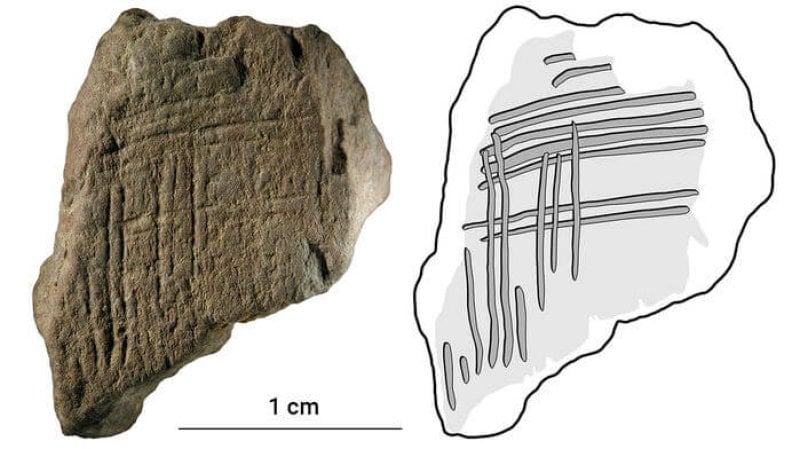
An early human scratched this hashtag pattern into a red ochre stone at Blombos Cave in South Africa. Image credit: CHRISTOPHER HENSHILWOOD AND FRANCESCO D’ERRICO

About 100,000 years ago, ancient humans started etching lines and hashtag patterns onto red rocks in a South African cave. Such handiwork has been cited as the first sign our species could make symbols—distinct marks that stand for some meaning—and thus evidence of a sophisticated mind.

[Researcher Kristian] Tylén figured that if the marks were chiefly decorative, created because someone enjoyed looking at the pattern, the eyes of living humans would be able to see the patterns easily. If the markings were cultural traditions, they would need to be memorable, because the cave dwellers may have had to make them multiple times. And in that case, people today also ought to able to remember and copy them.

Tylén asked 65 Danish university students to examine 24 cleaned-up images of the original stone or shell markings, and then perform tasks such as sorting or copying the lines. The researchers wanted to know whether people could tell the marks from one site from those from the other, and whether they could copy them after looking at them briefly.

[P]eople weren’t able to sort the markings into the correct groupings by place, and weren’t able to distinguish signs from each other. That’s a minimal test of being a symbol—being distinct from another marking—and the engravings failed.

Read full, original post: Is this 100,000-year-old hashtag the first humanmade symbol—or just a pretty decoration?

{{ reviewsTotal }}{{ options.labels.singularReviewCountLabel }}
{{ reviewsTotal }}{{ options.labels.pluralReviewCountLabel }}
{{ options.labels.newReviewButton }}
{{ userData.canReview.message }}

Related Articles

Infographic: Global regulatory and health research agencies on whether glyphosate causes cancer

Infographic: Global regulatory and health research agencies on whether glyphosate causes cancer

Does glyphosate—the world's most heavily-used herbicide—pose serious harm to humans? Is it carcinogenic? Those issues are of both legal and ...

Most Popular

Screenshot-PM-24
Viewpoint: The herbicide glyphosate isn’t perfect. Banning it would be far worse.
79d03212-2508-45d0-b427-8e9743ff6432
Viewpoint: The Casey Means hustle—Wellness woo opportunism dressed up as medical wisdom
d-b
Blocked arteries, kidney stones, nausea, constipation, fatigue: Long list of health problems caused by too much vitamin D 
ChatGPT-Image-Mar-27-2026-11_27_05-AM
The myths of “process”: What science says about the “dangers’ of synthetic products and ultra-processed foods
ChatGPT-Image-Apr-30-2026-05_00_48-PM
Wellness grifter physician turned wellness influencer out as surgeon general nominee
Screenshot-2026-04-30-at-11.33.46-AM
Anti-seed-oil to anti-vax pipeline: MAHA movement spreads to teen influencers
ChatGPT-Image-Mar-10-2026-01_39_01-PM
Viewpoint—“Miracle molecule” debunked: Why acemannan supplements don’t work
ChatGPT-Image-Mar-3-2026-01_17_14-PM
MAHA wellness influencers deride proven anxiety medications, tout lifestyle fixes
ChatGPT-Image-Feb-16-2026-01_04_32-PM
Raw milk myth wake-up call
Screenshot-2026-04-29-at-11.31.42-AM
Dad brains: Only women undergo bodily changes during and after childbirth? Think again.
glp menu logo outlined

Get news on human & agricultural genetics and biotechnology delivered to your inbox.