CRISPR legal battle front: UC Berkeley wins pair of patents

doudna
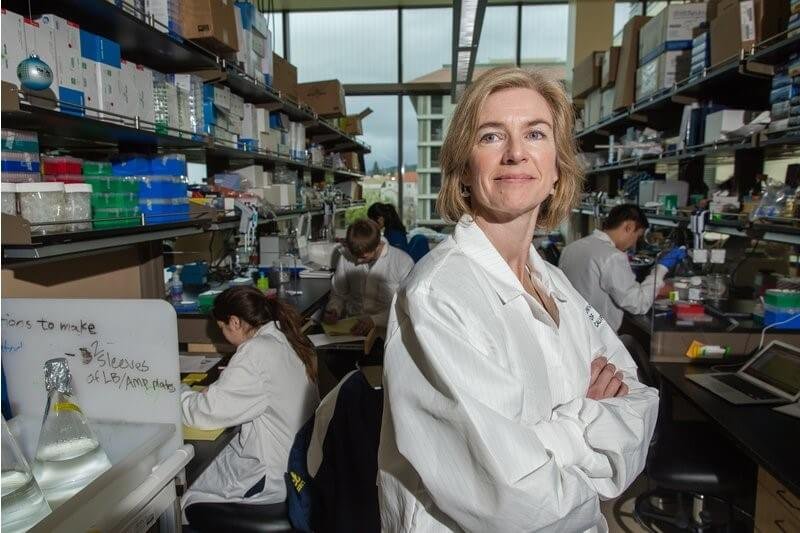
Jennifer Doudna, an inventor of the revolutionary gene-editing tool CRISPR. Image credit: The Washington Post

There’s been a legal battle going on to determine which of the scientists whose research led to CRISPR’s discovery gets to own it (and collect money from licensing it).

The U.S. Patent and Trademark Office (USPTO) just decided to grant not one, but two new CRISPR patents to UC Berkeley, home of biochemist Jennifer Doudna.

On [June 12], the office granted UC Berkeley its first CRISPR-related patent, which the university applied for in 2014. This one focuses on using CRISPR-Cas9 to edit single-stranded RNA (and not DNA).

The USPTO will reportedly grant UC Berkeley the other patent, which the university applied for in 2015, next week, according to a STAT News report. That patent centers on using the standard CRISPR-Cas9 system to edit regions specifically 10 to 15 base pairs long. UC Berkley sees a number of potential applications in research, diagnostics, and industry for their new CRISPR patent.

But the rest of the scientific community sees it differently. A spokesman for the Broad told STAT the issued patent’s claims “are extremely narrow and would have little or no effect on the CRISPR field.”

No matter how important these specific patents are, the sheer number of granted patents is a testament to the amount of research dedicated to CRISPR. With each new discovery, we get one step closer to that imagined future free of disease.

Read full, original post: UC Berkeley Finally Scores a Win With Two CRISPR Patents

{{ reviewsTotal }}{{ options.labels.singularReviewCountLabel }}
{{ reviewsTotal }}{{ options.labels.pluralReviewCountLabel }}
{{ options.labels.newReviewButton }}
{{ userData.canReview.message }}

Related Articles

Infographic: Global regulatory and health research agencies on whether glyphosate causes cancer

Infographic: Global regulatory and health research agencies on whether glyphosate causes cancer

Does glyphosate—the world's most heavily-used herbicide—pose serious harm to humans? Is it carcinogenic? Those issues are of both legal and ...

Most Popular

ChatGPT-Image-May-7-2026-12_16_37-PM-2
Viewpoint: Are cancer rates ‘skyrocketing’ as RFK, Jr. and MAHA claims? The evidence says mostly the opposite
Screenshot-2026-04-13-at-1.39.26-PM
Viewpoint: ‘Safer for children?’ Stonyfield yogurt under fire for deceptive organic marketing
Screenshot-2026-04-22-at-10.46.29-AM
Viewpoint: How to counter science disinformation? Science journalist offers 12 practical tips
png-pill-omega-Supp-fish-oil
Millions take omega-3 fish oil for brain health. New research suggests it may do the opposite.
Screenshot-2026-04-23-at-11.00.36-AM
Regulators' dilemma: Thalidomide, Metformin, and the cost of getting drug approvals wrong

Sorry. No data so far.

glp menu logo outlined

Get news on human & agricultural genetics and biotechnology delivered to your inbox.