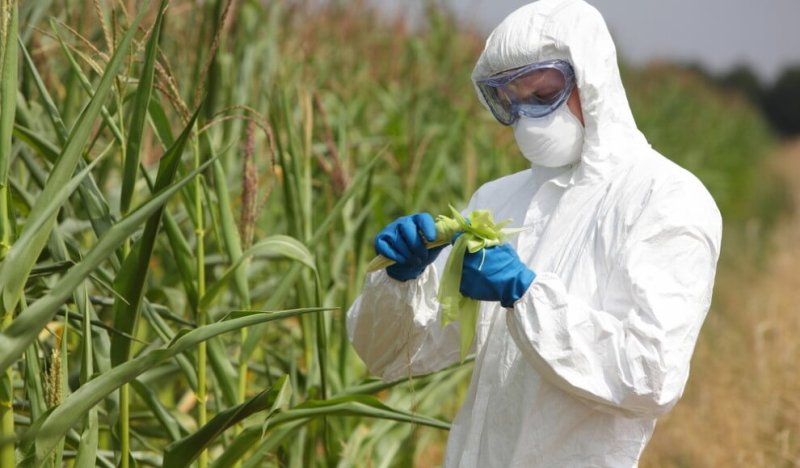
GMO crops so efficient at killing pests, adjacent non-GMO crops are also protected

Feed the World sans GMOs x
Image Credit: Shutterstock

One of the great purported boons of GMOs is that they allow farmers to use fewer pesticides, some of which are known to be harmful to humans or other species. Bt corn, cotton, and soybeans have been engineered to express insect-killing proteins from the bacterium Bacillus thuringiensis, and they have indeed been successful at controlling the crops’ respective pests. They even protect the non-Bt versions of the same crop that must be planted in adjacent fields to help limit the evolution of Bt resistance.

But new work shows that Bt corn also controls pests in other types of crops planted nearby, specifically vegetables. In doing so, it cuts down on the use of pesticides on these crops, as well.

Entomologists and ecologists compared crop damage and insecticide use in four agricultural mid-Atlantic states: New Jersey, Delaware, Maryland, and Virginia. Their data came from the years before Bt corn was widespread (1976-1996) and continued after it was adopted (1996-2016). They also looked at the levels of the pests themselves: two different species of moths, commonly known as the European corn borer and corn earworm. They were named as scourges of corn, but their larvae eat a number of different crops, including peppers and green beans.

After Bt corn was planted in 1996, the number of moths captured for analysis every night in vegetable fields dropped by 75 percent. The drop was a function of the percentage of Bt corn planted in the area and occurred even though moth populations usually go up with temperature. So the Bt corn more than counteracted the effect of the rising temperatures we’ve experienced over the quarter century covered by the study.

Read full, original article: Planting GMOs kills so many bugs that it helps non-GMO crops

Related Articles

Infographic: Global regulatory and health research agencies on whether glyphosate causes cancer

Infographic: Global regulatory and health research agencies on whether glyphosate causes cancer

Does glyphosate—the world's most heavily-used herbicide—pose serious harm to humans? Is it carcinogenic? Those issues are of both legal and ...

Most Popular

ChatGPT-Image-Mar-10-2026-01_39_01-PM
Viewpoint—“Miracle molecule” debunked: Why acemannan supplements don’t work
Screenshot-2026-10-02-at-9.11.36-AM
The genetics of personality
Radioactive-Americana-Collage-2
The kooky logic behind the raft of spurious cancer claims from Harvard’s T.H. Chan School of Public Health
Supreme-Court-Amid-Climate-Crisis
Should fossil fuel companies be shielded from lawsuits over climate change damage? The Supreme Court takes up the question
Screenshot 2025-09-17 at 12.41
Jump-starting global warming: Rising temperatures are driving up emissions from wildfires, fermenting wetlands, and melting permafrost
Screenshot-2026-10-06-at-2.36.47-PM
Is organic farming really more sustainable? 100 recent studies say ‘no’
Screenshot-2026-09-28-at-11.26.17-AM
Viewpoint: Wellness movement activists reposition nicotine from a killer addictive drug into a cure-all for brain ills
strand of dna genetics
No, GMO foods do not “damage genes, natural disposition and hormones, or decrease physical health and intelligence”
Screenshot-2026-10-02-at-8.56.38-AM
Trump finalizes Medicare drug price cuts, drawing Big Pharma’s fury and a legal challenge
Kind-People-Kind-Futures-Hands
Patches for sleep, weight, NAD+, energy, focus, periods. No evidence to support the latest social media wellness scams
Screenshot-2026-10-02-at-11.12.24-AM
‘Why do we keep falling for this stuff?’ America’s love affair with snake oil salesmen and scams
Childrens-Health-Defense-Press-Briefing
Court links patient’s death to anti-vaccine doctor promoted by Kennedy’s Children’s Health Defense
glp menu logo outlined

Get news on human & agricultural genetics and biotechnology delivered to your inbox.