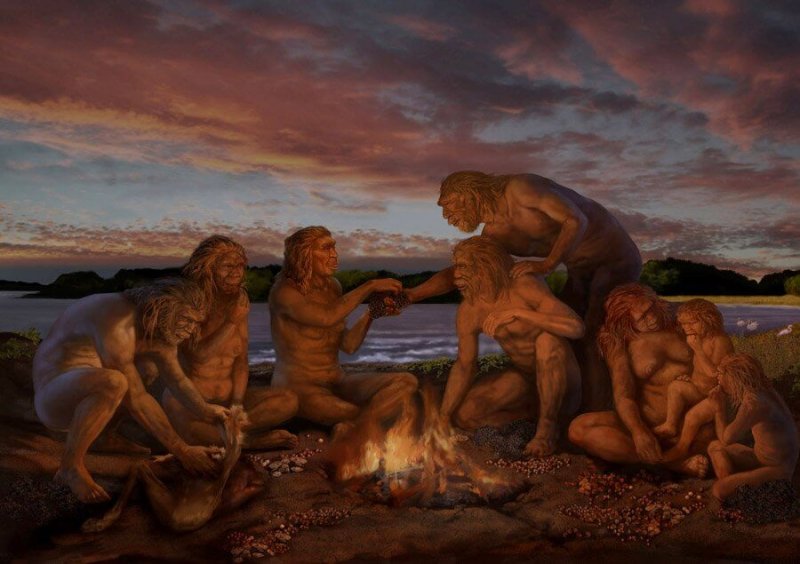
Challenging the story of our origin: Human traits had ‘patchwork emergence’ across Africa

Dev UKVAAAxiKB
Image credit: Smithsonian

The origins of our species have long been traced to east Africa, where the world’s oldest undisputed Homo sapiens fossils were discovered.

However, a team of prominent scientists is now calling for a rewriting of this traditional narrative, based on a comprehensive survey of fossil, archaeological and genetic evidence. Instead, the international team argue, the distinctive features that make us human emerged mosaic-like across different populations spanning the entire African continent.

Dr Eleanor Scerri, an archaeologist at Oxford University, who led the international research, said: “This single origin, single population view has stuck in people’s mind … but the way we’ve been thinking about it is too simplistic.”

The telltale characteristics of a modern human – globular brain case, a chin, a more delicate brow and a small face – seem to first appear in different places at different times. Previously, this has either been explained as evidence of a single, large population trekking around the continent en masse.

The latest analysis suggests that this patchwork emergence of human traits can be explained by the existence of multiple populations that were periodically separated for millennia by rivers, deserts, forests and mountains before coming into contact again”

“Someone finds a skull somewhere and that’s the source of humanity. Someone finds some tools somewhere, that’s the source of humanity,” [Scerri] said.

Read full, original post: No single birthplace of mankind, say scientists

{{ reviewsTotal }}{{ options.labels.singularReviewCountLabel }}
{{ reviewsTotal }}{{ options.labels.pluralReviewCountLabel }}
{{ options.labels.newReviewButton }}
{{ userData.canReview.message }}

Related Articles

Infographic: Global regulatory and health research agencies on whether glyphosate causes cancer

Infographic: Global regulatory and health research agencies on whether glyphosate causes cancer

Does glyphosate—the world's most heavily-used herbicide—pose serious harm to humans? Is it carcinogenic? Those issues are of both legal and ...

Most Popular

ChatGPT-Image-Jun-17-2026-10_52_43-AM
Anguished parents, doctors in tears: Utah’s long measles outbreak takes a toll
Screenshot-2026-06-15-at-1.55.27-PM
America's trust in Trump-Kennedy's CDC health recommendations is plunging
ChatGPT-Image-Jun-23-2026-03_12_23-PM
Is cellular reprogramming junk science? Nearly 20 patients are getting eye injections in the first FDA-cleared cellular trial
ChatGPT-Image-Jun-24-2026-11_36_47-AM
Why the human genome is less a script than a puzzle
Screenshot 2026-06-25 at 10.55
Leading OB-GYN group challenges RFK, Jr. gutting of maternal vaccine schedule
ChatGPT-Image-Mar-10-2026-01_39_01-PM
Viewpoint—“Miracle molecule” debunked: Why acemannan supplements don’t work
Screenshot-2026-06-22-at-9.04.46-PM
Kennedy's nutrition prescription for medical schools: Real problem, bad cure
ChatGPT-Image-Jun-25-2026-12_23_17-PM
No, Bill Gates did not secretly engineer ticks to promote veganism
Screenshot-2026-06-25-at-1.48.40-PM
Glyphosate affirmed as safe: Supreme Court rejects lawsuit claiming Roundup herbicide causes cancer, upholding EPA determination
Screenshot-2026-06-24-at-2.57.41-PM
Viewpoint: Trump’s Reflecting Pool algae fiasco points to a bigger culprit: Climate change
Screenshot-2026-06-24-at-2.40.46-PM
Hegseth reversal: As Air Force flu outbreak continues to surge, military reinstitutes mandatory vaccines for recruits
ChatGPT-Image-Jun-22-2026-01_30_11-PM
Facts & Fallacies podcast: Psychedelics for PTSD? Examining RFK, Jr's claims about ibogaine
glp menu logo outlined

Get news on human & agricultural genetics and biotechnology delivered to your inbox.