
Americans think they know about GMOs, but poll shows consumers still badly confused

confused
Image: Shutterstock

As a non-expert consumer, it’s hard to know what to think about GMOs. Of course, we’re already consuming them, with 10 crops in the U.S. having so far received the go-ahead for commercial production: alfalfa, apples, canola, corn, cotton, papaya, potatoes, soybeans, squash and sugar beets. Insurers netQuote recently surveyed 1,021 Americans to find out how we’re feeling about GMOs these days and the degree to which we even understand what they are.
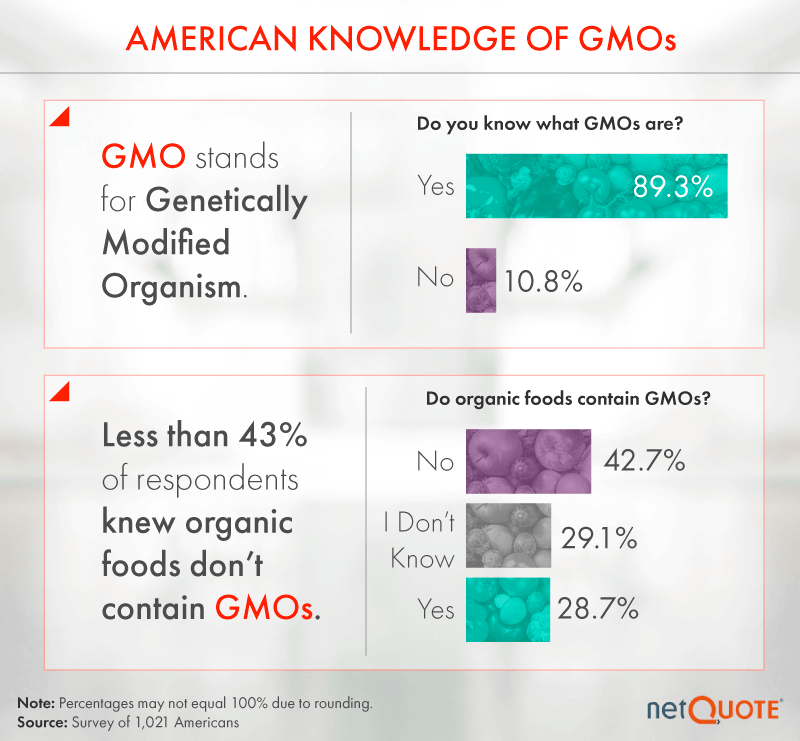
American Knowledge of GMOs

While 89.3% of respondents claimed to know that “GMO” stands for “Genetically Modified Organism,” it’s not at all clear they’ve given much thought to what that phrase actually means.

[W]hen we think genetic mishaps, we tend to think of cancer. netQuote asked people if they believe GMOs cause cancer …. While nearly two-thirds of respondents felt GMOs could cause cancer, basically no one believed it could help prevent it.

We’re confused about GMOs. Or not. 60 other countries currently insist on rigorous labeling of GMO foods, so the U.S. is an outlier. 300 regions have banned GMOs altogether.

We — baffled as we may be — nonetheless have daily choices to make regarding what we put into our own bodies. The best we can do is keep reading up on GMOs and try and sort out the science from the fiction.

Read full, original article: Is the American public finally okay with GMOs? Um…

{{ reviewsTotal }}{{ options.labels.singularReviewCountLabel }}
{{ reviewsTotal }}{{ options.labels.pluralReviewCountLabel }}
{{ options.labels.newReviewButton }}
{{ userData.canReview.message }}

Related Articles

Infographic: Global regulatory and health research agencies on whether glyphosate causes cancer

Infographic: Global regulatory and health research agencies on whether glyphosate causes cancer

Does glyphosate—the world's most heavily-used herbicide—pose serious harm to humans? Is it carcinogenic? Those issues are of both legal and ...

Most Popular

ChatGPT-Image-Jul-8-2026-12_32_48-PM
Viewpoint: SCOTUS strikes a blow against junk science in Bayer glyphosate case. Will it deter mass tort litigators?
ChatGPT-Image-Mar-10-2026-01_39_01-PM
Viewpoint—“Miracle molecule” debunked: Why acemannan supplements don’t work
Screenshot-2026-07-08-at-9.36.03-AM
Viewpoint: Long-contained diseases are on the rise in the U.S. Are Trump cuts to blame?
afb-a-b
As the EU loosens restrictions on agricultural gene editing, it remains years behind the rest of the world on equally-safe GMO foods
Viewpoint: Consensus as truth? How ‘misinformation police’ control policy narratives
Which among war, weather and cyber attacks is the biggest world threat? None of the above. It’s misinformation, and here’s why.
c9f0a584-46e9-4dd8-9a77-f5f5a7a51a84
Across Eastern Europe, science disinformation has spread far beyond COVID and vaccine denialism. Here’s the grim list.
Screenshot 2026-07-11 100209
Viewpoint: Supplements to clean your liver? Not a good idea.
ChatGPT-Image-Jul-7-2026-01_57_55-PM
Viewpoint: Europe’s rejection of air conditioning is the poster child for misunderstanding how to mitigate the impact of climate change
Gemini_Generated_Image_gabo48gabo48gabo
Viewpoint: A plastic surgeon on why banning gender-transition surgery without further research is wrong and harmful
ChatGPT-Image-Jun-25-2026-12_23_17-PM
No, Bill Gates did not secretly engineer ticks to promote veganism
ChatGPT-Image-Jul-1-2026-03_33_49-PM
‘Alternative’ cancer treatments that could kill you
Screenshot-2026-07-10-at-3.10.50-PM
Snake-oil cures throughout history
ChatGPT-Image-Jul-1-2026-12_37_08-PM
Viewpoint: Trump poised to politicize all U.S.-supported science research
glp menu logo outlined

Get news on human & agricultural genetics and biotechnology delivered to your inbox.